
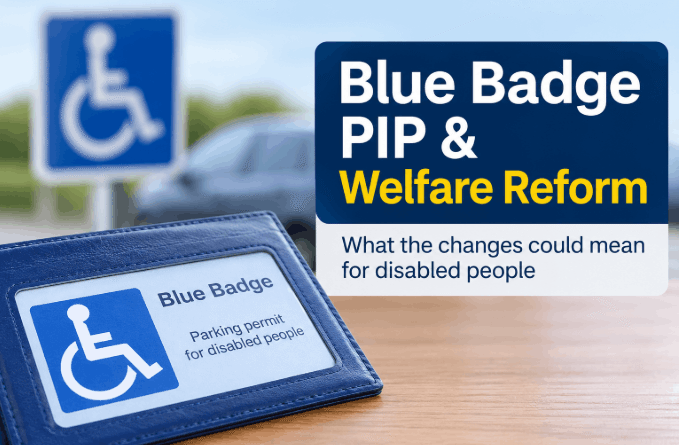
Blue Badge PIP Welfare Reform Explained: Rules, Point Scores, and What Changes in 2026
The blue badge PIP welfare reform refers to the Department for Work and Pensions review of Personal Independence Payment mobility assessments, expected to conclude in autumn 2026, which could change how new applicants qualify for a Blue Badge while leaving current claimants unaffected under rules confirmed as of July 2026.
Key Takeaways
- Existing PIP claimants keep their Blue Badge under current rules, with no change confirmed for anyone already receiving the benefit.
- Automatic Blue Badge eligibility currently rests on two separate PIP mobility scores: 8 points for moving around, or 10 points for planning and following a journey.
- Direct PIP eligibility changes were removed from the Universal Credit and Personal Independence Payment Bill, with further proposals now sitting inside the Timms Review, due to report in autumn 2026.
Does PIP Entitle You to a Blue Badge?
PIP does not automatically entitle every claimant to a Blue Badge, but two specific PIP mobility scores trigger automatic qualification in England.
A person who scores highly enough on either activity within the mobility component skips the local council assessment entirely. Anyone scoring below both thresholds can still apply, but the application moves to a manual review.
| Qualifying route | PIP requirement | Automatic Blue Badge |
|---|---|---|
| Moving around activity | 8 points or more | Yes |
| Planning and following a journey | 10 points for descriptor E, overwhelming psychological distress | Yes |
| Any other PIP mobility score | Below both thresholds | No, council assessment required |
| No PIP award | Not applicable | Possible through local authority discretionary assessment |
This table reflects the rules currently in force. Automatic qualification has not changed under any confirmed reform to date.
Eligibility for Blue Badge PIP Welfare Reform
You may qualify for a Blue Badge in several ways beyond PIP alone, and knowing every route before applying can save weeks of unnecessary waiting. Some routes grant a badge automatically with no further assessment, while others still lead to a badge but only after your council reviews medical evidence.
- You get 8 points or more for the moving around activity of PIP. In plain terms, this means walking any real distance safely, whether at all or without severe difficulty, is genuinely hard for you, even with an aid such as a stick or a frame.
- You score 10 points for descriptor E under planning and following a journey. This route is about mental health rather than physical mobility. It applies where travelling anywhere, even somewhere familiar, would cause overwhelming psychological distress, such as severe anxiety, autism, or a related condition.
- You receive the higher rate mobility component of Disability Living Allowance. This applies to people who have not yet been moved onto PIP, including many long term claimants whose DLA award has not expired.
- You are registered blind or severely sight impaired with your local authority. Councils use their own visual impairment register, so this is confirmed through that register rather than through a benefit award.
- You receive the War Pensioners Mobility Supplement. This is a separate payment for armed forces personnel with a service related disability and sits entirely outside the PIP and DLA system.
- You do not meet any of the routes above but still find walking difficult. In this case, your local council carries out its own assessment, using medical evidence, GP letters, or a face to face appointment, to decide whether you qualify.
Meeting any single one of the first five points guarantees a Blue Badge without further assessment, since the qualifying benefit or register entry is treated as sufficient proof on its own.
Point six covers everyone else, including many people with hidden disabilities that councils have only formally recognised as valid grounds since 2019, so it is always worth applying even without one of the automatic qualifications above.
Is the Blue Badge PIP Welfare Reform Already in Force?
No part of the Blue Badge PIP welfare reform has taken legal effect yet. The only confirmed development so far is a procedural one, not a change to who qualifies.
Direct PIP eligibility changes were removed from the Universal Credit and Personal Independence Payment Bill after MPs voted on amendments in July 2025.
Any future changes to how PIP mobility points are scored now depend on the Timms Review, led by Minister for Social Security and Disability Sir Stephen Timms, which the DWP has said will conclude in autumn 2026.
Recent DWP legacy benefits changes followed a familiar pattern, with early proposals softened by parliamentary scrutiny long before reaching claimants.
Widely circulated claim: A stricter points test, sometimes described as a four point rule, is already being applied to new PIP claims.
Correct position: That specific proposal was removed from the Bill before it passed. No four point threshold currently applies to any PIP claim, new or existing.
Source: Hansard record of the Universal Credit and Personal Independence Payment Bill debate, and DWP statements confirming the amendment.
Claimants should wait for an official DWP letter before treating any change as confirmed, rather than relying on headlines about a review still in progress.
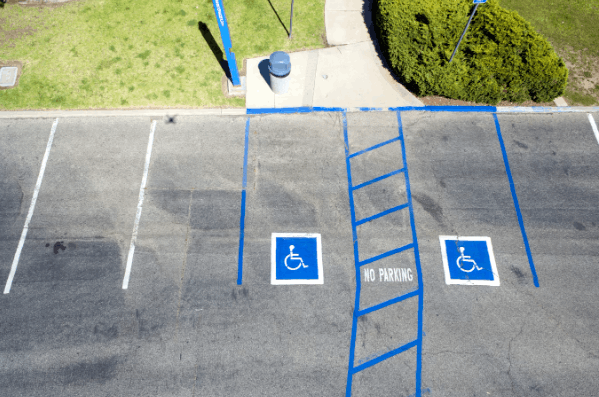
How Many PIP Points Do You Need for a Blue Badge?
Two separate PIP mobility descriptors can each independently unlock automatic Blue Badge eligibility, and mixing them up is the most common mistake claimants make.
- Score 8 points or more under the moving around activity. This covers people who cannot walk more than a short distance, or who need physical support to walk safely.
- Score 10 points for descriptor E under planning and following a journey. This route applies where travelling anywhere, even a familiar route, would cause overwhelming psychological distress.
- If neither threshold is met, the local council may still request medical evidence and assess mobility separately from the PIP award.
A Blue Badge issued through either automatic route is typically valid for up to three years, matching the standard PIP award review cycle in most cases. According to GOV.UK, applicants should keep their PIP award letter to hand, since it shows exactly which descriptor and score were awarded.
What Happens to Existing Blue Badge Holders?
Existing Blue Badge holders retain their badge and their PIP award under the rules confirmed today. Nothing in the current review takes away support that has already been granted.
- Current recipients continue receiving PIP passported benefits, including Blue Badge access, without reassessment triggered by the reform itself.
- Renewal applications still follow the existing point thresholds, not any proposed future test.
- Related support, including PIP DLA and Motability payments, remains unaffected by the ongoing Timms Review.
Councils can still review a badge at renewal if personal circumstances have changed. This is standard practice, unrelated to the welfare reform process.
Who Else Is Affected by the Reform?
New applicants face the most uncertainty, since any changes to come out of the Timms Review are expected to apply to fresh claims rather than existing awards. Around 3.7 million people currently receive PIP in England and Wales, and the review’s outcome will shape how future claimants are assessed.
People near either mobility threshold have the most to watch from the blue badge PIP welfare reform, particularly those with fluctuating conditions whose scores can shift between assessments.
Families managing a disabled child’s broader entitlements will find the disabled child element of Universal Credit runs alongside, rather than inside, the PIP mobility test.
Borderline cases, including people with non visible disabilities such as cognitive or neurological conditions, often need additional medical evidence regardless of any reform outcome.

Can You Get a Blue Badge Without PIP?
Yes, a Blue Badge does not require a PIP award at all. Local councils can approve applications based on medical evidence alone, particularly for conditions that cause serious difficulty, danger, or psychological distress when travelling.
- Children under three with specific medical equipment needs qualify under separate criteria, and parents should see what else children on DLA are entitled to for the wider benefits picture.
- Adults receiving the higher rate mobility component of Disability Living Allowance retain automatic eligibility where DLA still applies.
- People with dementia, severe anxiety, or autism can qualify through council discretion even without a qualifying PIP score.
More than 815,000 people currently use the related Motability scheme, a reminder that PIP mobility support stretches well beyond the Blue Badge itself.
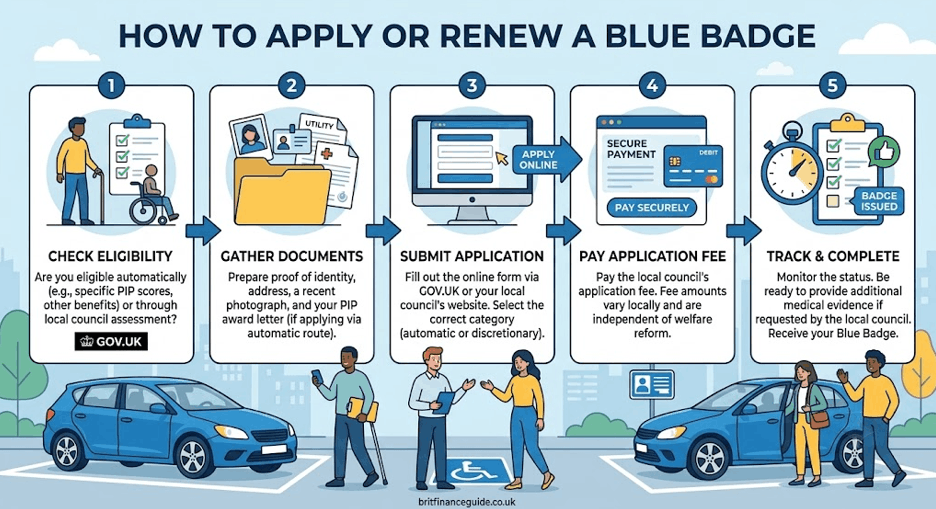
How to Apply or Renew a Blue Badge?
Applying correctly the first time avoids the delays that manual assessments can bring.
- Gather proof of identity, proof of address, a recent photograph, and a PIP award letter if applying through the automatic route.
- Submit the application through the local council or GOV.UK, selecting the correct automatic or discretionary category.
- Pay any applicable fee, which councils set locally and which is not linked to the welfare reform process.
- Track the application and respond promptly if the council requests further medical evidence.
Anyone unsure which route applies, or waiting on a decision, should remember that councils and the DWP handle separate parts of the process. Guidance on how to contact DWP by phone covers questions about the PIP award itself, rather than the Blue Badge application.
Common Blue Badge and PIP Myths
Several persistent misunderstandings shape how people approach their applications, and correcting them saves unnecessary delay.
| Myth | Reality |
|---|---|
| Any PIP award guarantees a Blue Badge | Only specific mobility scores trigger automatic qualification |
| The badge belongs to a specific vehicle | The badge belongs to the individual and can be used in any car they travel in |
| A family member can use the badge to run errands alone | The badge holder must be present in the vehicle for it to be valid |
| A refused application cannot be challenged | Applicants can request a council review and submit further medical evidence |
| Hidden disabilities never qualify | Cognitive, neurological, and mental health conditions can qualify under current rules |
Figures confirmed as of July 2026 via GOV.UK and DWP published guidance.
Conclusion
The blue badge PIP welfare reform has not changed who qualifies, despite what recent headlines imply. Existing claimants hold onto their Blue Badge, and automatic qualification still rests on the same PIP mobility scores as before.
Anyone applying now should rely on current GOV.UK guidance rather than proposals still under review. Blue Badge PIP welfare reform means continuity today, and possible change for new applicants from autumn 2026.
FAQ
Are you entitled to a Blue Badge if you get PIP?
Not automatically in every case. A PIP award only guarantees a Blue Badge if the claimant scores 8 points or more for moving around, or 10 points for descriptor E under planning and following a journey.
Will PIP changes affect my Blue Badge?
No confirmed change currently affects Blue Badge eligibility. Direct PIP eligibility changes were removed from the Universal Credit and Personal Independence Payment Bill, and any future proposals depend on the Timms Review reporting in autumn 2026.
What is the maximum walking distance for a Blue Badge?
There is no single fixed distance written into the rules. Assessors instead consider whether a person can walk safely, repeatedly, and to an acceptable standard, which is why PIP mobility scoring focuses on difficulty rather than distance alone.
What benefits am I entitled to with a Blue Badge?
A Blue Badge itself provides free or reduced cost parking in designated bays and some pay and display areas. It does not include financial payments, which come separately through PIP, Motability, or related council travel schemes.
How many PIP points do you need for a Blue Badge?
Eight points or more for moving around, or ten points for descriptor E under planning and following a journey, each independently unlock automatic Blue Badge eligibility under current rules.
Disclaimer: This article is for informational purposes only and does not constitute official legal or benefits advice; check GOV.UK or contact the DWP for individual guidance.



Pingback: Full List Of DWP 177 Health Conditions For PIP Approval