Disabled Child Element Universal Credit: 2026/27 Rates, Eligibility, Claiming, Backdating
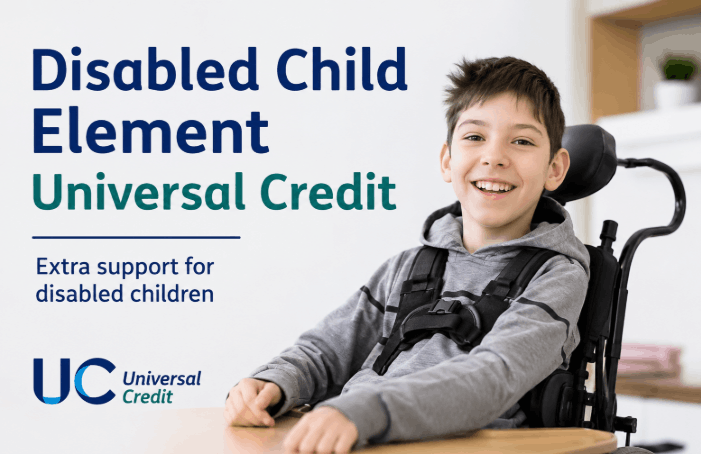
The disabled child element of Universal Credit is a monthly payment of £164.79 or £514.71, added on top of the standard child element, for a child receiving Disability Living Allowance, Personal Independence Payment, or their Scottish equivalent.
Rates apply from April 2026 to April 2027 under the current Universal Credit Regulations 2013.
Key takeaways
- The lower rate disabled child element is £164.79 a month, and the higher rate is £514.71 a month, both effective from April 2026.
- The addition is unaffected by the two-child limit, which was abolished from 6 April 2026 under the Universal Credit Act 2025.
- Backdating follows the date a child’s DLA or PIP award began, not the date it was reported to the DWP.
What Is the Disabled Child Element of Universal Credit?
The disabled child element sits inside a Universal Credit award as a separate monthly addition, on top of the standard child element. It reflects the extra costs disabled children can bring, from specialist equipment to additional care, on top of everyday family spending.
The Department for Work and Pensions adds this element once it has evidence of a qualifying disability benefit, under rules set out in the Universal Credit Regulations 2013.
Parents sometimes confuse the disabled child element with Disability Living Allowance itself. They are not the same payment. DLA or PIP is what unlocks the addition, but the money comes through the Universal Credit award, calculated separately.

Lower Rate or Higher Rate: What’s the Difference?
Universal Credit uses two tiers for the disabled child element, called the lower rate and the higher rate. Terms like “middle rate” or “high rate” are often used in place of the correct names, usually because Disability Living Allowance has several components of its own.
Universal Credit itself only ever pays one of two amounts.
| Rate | Monthly amount | Qualifying criteria |
|---|---|---|
| Lower rate | £164.79 | Child receives any rate of DLA care or mobility component, or standard rate PIP |
| Higher rate | £514.71 | Child receives DLA highest rate care component, enhanced rate PIP daily living, or is registered blind |
Both rates are paid in addition to the Universal Credit child element, which covers every child in the household regardless of disability, so a family with a disabled child typically sees both amounts listed separately on their statement.
How Much Is the Disabled Child Element in 2026/27?
These April 2026 figures, £164.79 a month at the lower rate and £514.71 a month at the higher rate, are set out in GOV.UK’s benefit and pension rates publication for the 2026 to 2027 financial year.
- £164.79 a month if a child receives any rate of DLA, standard rate PIP daily living, or the mobility component.
- £514.71 a month if a child receives DLA highest rate care, enhanced rate PIP daily living, or is registered blind or severely sight impaired. This higher amount is sometimes referred to as the severely disabled child addition.
- Only one disabled child element rate is paid per child, never both together.
- Rates rose by 3.8 per cent in April 2026, following the wider uprating introduced under the Universal Credit Act 2025.
Over a full year, the higher rate adds close to £6,200 to a household’s income, compared with roughly £1,980 from the lower rate.
A parent providing at least 35 hours of care a week for their child may also qualify for the separate carer element, assessed on its own terms rather than as part of the disabled child addition.

Does DLA or PIP Reduce Your Universal Credit?
No, DLA and PIP do not reduce Universal Credit. Both are non means tested, so they are paid regardless of income or savings and are never counted as earnings when the DWP works out a Universal Credit award.
A qualifying DLA or PIP award has the opposite effect: it adds the disabled child element on top
How to Add the Disabled Child Element to an Existing Claim?
Adding the disabled child element to an existing claim starts with reporting the qualifying disability benefit through the online journal. The DWP does not add it automatically just because a child receives DLA or PIP; the claimant must report the award before it is included.
- Sign in to your Universal Credit account and select report a change of circumstances.
- Choose the option for children and other people who live with you.
- Enter the details of the DLA or PIP award, including the rate and start date.
- Provide the DLA or PIP decision letter reference if asked for it.
- Check your next Universal Credit statement to confirm the disabled child element has been added.
In most cases, the new element appears on a statement within one or two assessment periods of the change being reported.
Backdating the Disabled Child Element: What You’re Entitled To?
What matters for backdating is the start date of the disability benefit itself, not the date it happened to be reported to Universal Credit. This is set out clearly in the Universal Credit Regulations 2013, though claimants often need to push for it.
If your child’s DLA started before you claimed Universal Credit
If a child was already receiving DLA or PIP before the Universal Credit claim began, and the disabled child element was missing from the very start, backdating becomes more complicated and usually needs individual advice from Citizens Advice or a local welfare rights service.
If DLA is awarded after your claim starts
Where DLA or PIP is awarded, or increased, after Universal Credit has started, the addition should be backdated to the start of the assessment period in which the disability benefit began.
This applies however late the DWP was told, provided the household was on Universal Credit throughout.
- Confirm the start date shown on the DLA or PIP award letter.
- Report the change through the online journal as soon as possible.
- Ask specifically for the disabled child element to be backdated to the award start date.
- If refused, request a mandatory reconsideration rather than accepting a one month limit.
Widely circulated claim: Universal Credit cannot backdate the disabled child element more than one month unless special circumstances apply.
Correct position: The Universal Credit Regulations 2013 require backdating to the date the qualifying disability benefit began, regardless of how late it was reported, as long as the household remained on Universal Credit throughout that period.
Source: Contact, the charity for families with disabled children, sets this out in its backdating guidance, and the Child Poverty Action Group has documented cases where this rule was wrongly applied.
If a request stalls in the journal for weeks, calling the DWP contact number can often move a stuck backdating decision forward faster than a written message alone.
Does the Two Child Limit Affect the Disabled Child Element?
The disabled child element was never limited to two children, even while the wider two child limit was in force. That older restriction only affected the standard child element, not the disability addition.
From 6 April 2026, the two child limit was abolished entirely under the Universal Credit Act 2025, so every child in a household now attracts the standard child element as well as any disabled child addition they qualify for.
Guidance published before April 2026 may still describe the two child limit as current policy; this position has since been superseded.
Universal Credit and Regional Variations: Scotland and Northern Ireland
The disabled child element applies across the whole of the United Kingdom, though the qualifying disability benefit changes by nation. A family’s Universal Credit payment works the same way regardless of where in the UK they live.
- England and Wales: the qualifying benefit is Disability Living Allowance or Personal Independence Payment
- Scotland: the qualifying benefit is Child Disability Payment, administered by Social Security Scotland rather than the DWP.
- Northern Ireland: Universal Credit operates under separate but broadly equivalent regulations, alongside Disability Living Allowance
A family who moves between nations keeps the same disabled child element rate, provided the new qualifying benefit sits at an equivalent level.
Checking Your Statement for the Disabled Child Element
A quick check of a Universal Credit statement, especially after any change to a child’s DLA or PIP award, is the easiest way to catch a missing disabled child element.
A Universal Credit statement lists every element separately, including the disabled child addition, above the total payment figure.
If the statement shows only a standard child element with no separate disabled child line, despite a current DLA or PIP award, the addition is likely missing and should be reported through the online journal.
- The statement lists a child element but no separate disabled child addition line.
- A recent DLA or PIP decision letter has not yet been reported to Universal Credit.
- The payment amount has not changed since a child’s DLA rate increased.
- A previous disabled child addition disappeared without explanation on the statement.
Running the figures through a benefits calculator, such as the one hosted by Turn2us, is a straightforward way to confirm the amount on a statement is correct.
Conclusion
The disabled child element of Universal Credit adds £164.79 or £514.71 a month once a child qualifies through DLA, PIP, or Child Disability Payment. Getting the right amount depends on reporting the award promptly and challenging any refusal to backdate correctly.
The disabled child element of Universal Credit means real extra income for families raising a disabled child in 2026.
FAQ
How much is a disabled child element on Universal Credit?
The disabled child element is worth £164.79 a month at the lower rate or £514.71 a month at the higher rate, from April 2026. Only one rate applies per child, based on the DLA or PIP component they receive.
How long does UC take to add disabled child element?
Most claims show the disabled child element within one or two assessment periods after the change is reported. Backdated payments can take longer, sometimes several weeks, once a decision maker has confirmed the correct start date.
Will claiming DLA or PIP for a child change the Universal Credit payment?
Yes, upward. Qualifying through DLA, PIP, or Child Disability Payment adds the disabled child element on top of the standard child element rather than affecting it in any other way.
Is the disabled child element the same as PIP or DLA?
No, they are separate payments. DLA or PIP is paid directly to the family for the child’s needs, while the disabled child element is an addition inside the Universal Credit award itself.
Do I need to claim DLA before Universal Credit will add the element?
Yes, the disabled child element only starts once a qualifying DLA, PIP, or Child Disability Payment award exists and has been reported. Without an award in place, Universal Credit has no basis to add the payment.
Disclaimer: This article is for general information only and does not constitute financial or legal advice; always confirm current rates and eligibility directly with GOV.UK or the DWP.