
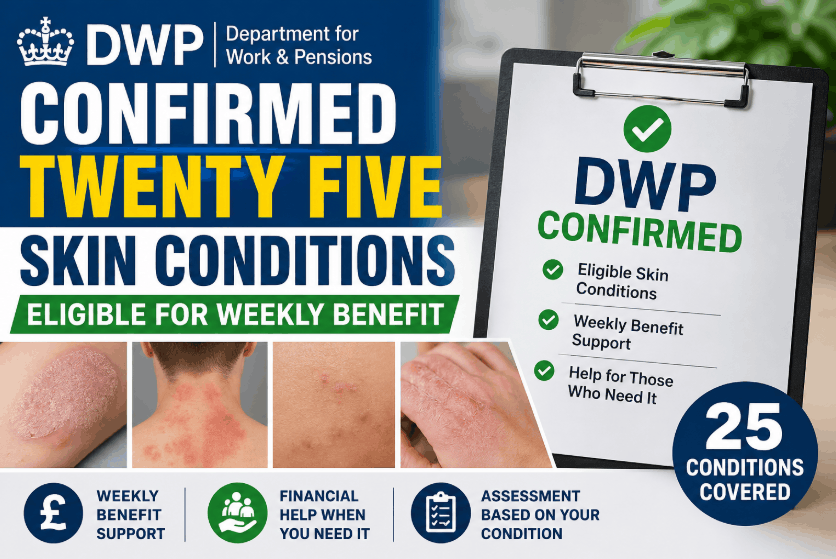
DWP Confirmed Twenty Five Skin Conditions Eligible for Weekly Benefit? Full List and PIP Rates
Headlines claiming that the Department for Work and Pensions (DWP) has confirmed 25 skin conditions eligible for a weekly benefit overstate the data. DWP published PIP claim statistics, not an eligibility ruling.
Personal Independence Payment (PIP) is a DWP benefit for eligible people in England and Wales whose long-term health condition or disability affects everyday living or getting around. As of the DWP statistics to April 2026, its data record 25 skin-disease sub-groups, but a diagnosis alone does not decide an award.
The DWP list of 25 skin conditions is a set of diagnosis categories in Personal Independence Payment (PIP) statistics that records the main condition behind each claim. It counts claims by main condition; it does not guarantee an award. PIP depends on how a condition affects daily living and mobility.
Key takeaways
- DWP’s list of 25 skin conditions counts Personal Independence Payment (PIP) claims by main condition and does not decide eligibility.
- PIP awards depend on how a condition affects 12 daily living and mobility activities, not on the diagnosis alone.
- PIP is paid every four weeks, and the maximum combines the enhanced daily living and enhanced mobility rates.
Twenty Five Skin Conditions Eligible for Weekly Benefit: Full DWP List
DWP’s PIP statistics list 25 skin conditions, and the table names every one with a plain-English description. PIP is the benefit that helps with the extra costs of a long-term health condition.
| Condition (DWP Stat-Xplore label) | Condition explained |
|---|---|
| Acne vulgaris | Common acne with spots and inflamed pimples |
| Blood vessels and lymphatics: other diseases or type not known | Blood or lymph vessel conditions not listed separately |
| Bullous disease: other or type not known | Blistering skin conditions not listed separately |
| Burns | Skin damage from heat, chemicals or electricity |
| Cellulitis | Bacterial infection of the skin and tissue beneath it |
| Collagen and elastic tissue: other diseases or type not known | Connective tissue disorders not listed separately |
| Dermatitis herpetiformis | Intensely itchy, blistering rash linked to coeliac disease |
| Eczema (dermatitis) | Itchy, dry, inflamed skin |
| Eczema (varicose) | Eczema on the lower legs linked to poor vein circulation |
| Ehlers Danlos syndrome | Inherited condition affecting connective tissue in skin and joints |
| Epidermolysis bullosa | Inherited condition causing fragile, blistering skin |
| Impetigo | Contagious bacterial skin infection with crusted sores |
| Infections: other or type not known | Skin infections not listed separately |
| Leg ulcers (arterial) | Open leg sores caused by a poor arterial blood supply |
| Leg ulcers (venous) | Open leg sores caused by poor vein circulation |
| Lymphoedema | Long-term swelling caused by a build-up of lymph fluid |
| Papulosquamous and inflammatory rashes: other or type not known | Raised, scaly or inflamed rashes not listed separately |
| Pemphigoid | Autoimmune condition causing skin blisters |
| Pemphigus vulgaris | Autoimmune condition causing blisters on the skin and mouth lining |
| Pressure sores | Skin and tissue damage caused by prolonged pressure |
| Psoriasis | Long-term condition causing raised, scaly patches |
| Rosacea | Long-term facial redness, flushing and visible blood vessels |
| Skin disease: other or type not known | Skin conditions not listed separately |
| Urticaria | Hives: itchy, raised weals on the skin |
| Venous insufficiency (chronic) | Weak leg veins that struggle to return blood to the heart |
Current figures (DWP data to April 2026): DWP’s official disability metadata records 25 skin-disease sub-groups. These DWP statistics cover England and Wales. Scotland administers Adult Disability Payment instead, while Northern Ireland operates its own PIP service.
The claim totals for each sub-group should be checked directly in DWP Stat-Xplore before publication. DWP’s next release after this April 2026 dataset was published on 15 September 2026; the following release is due on 15 December 2026.
The rows can be grouped broadly for readability, although DWP does not use these groupings in its statistics.
Inflammatory conditions include psoriasis, both eczema rows, urticaria, rosacea, acne vulgaris and the papulosquamous rashes.
Blistering conditions include epidermolysis bullosa, pemphigus vulgaris, pemphigoid, dermatitis herpetiformis and bullous disease.
Leg and circulation conditions cover leg ulcers, chronic venous insufficiency, lymphoedema and the blood vessel row.
Infections and injuries cover cellulitis, impetigo, burns and pressure sores. Ehlers Danlos syndrome and the collagen row are connective tissue disorders.
Several rows are labelled “other” or “type not known”. These are catch-all categories, so the named rows are not a complete map of every diagnosis involved.
Psoriasis and eczema both appear on the list, which answers a common question: they do reach PIP, but the list shows that claims exist, not that any single claim succeeds.
DWP statistics show that psychiatric, musculoskeletal and neurological conditions account for most PIP claims; skin conditions are a small share.
What the 25 conditions actually count
DWP’s PIP statistics count each claim under the claimant’s primary disabling condition only, the one judged to have the most significant effect on daily function. A claimant’s secondary conditions are not counted in these rows.
The list therefore understates how many PIP claimants live with a skin condition, and it is not a list of skin conditions that qualify for PIP automatically.
The assessment itself looks at the effect of all a claimant’s health conditions on the activities, not at the primary label alone, so every symptom belongs on the claim form.
Three points are often misunderstood. A listed condition does not guarantee an award, because the assessment looks at how the condition affects activities, not the diagnosis alone.
An unlisted condition is not excluded, because GOV.UK sets the test as difficulty with everyday tasks or getting around. Our wider guide to DWP health conditions and PIP covers other condition groups in more detail.
And the list is not a success record, because it does not show how many claims were refused.
Why some reports say 24 conditions and others 25
Some reports have described 24 skin conditions, but DWP’s official disability metadata currently lists 25 skin-disease sub-groups. Check the latest Stat-Xplore metadata before quoting a count. Whether any listed condition leads to an award depends on the eligibility test below.
Which Skin Conditions Qualify for PIP? How the Eligibility Test Works
A skin condition qualifies for PIP when it causes enough difficulty with daily tasks or getting around; the diagnosis alone decides nothing. GOV.UK sets out four conditions that must all apply:
- You are 16 or over, and usually under State Pension age to make a new claim.
- You have a long-term physical or mental health condition or disability.
- You have difficulty doing certain everyday tasks or getting around.
- You expect the difficulties to last at least 12 months from when they started.
DWP assesses 12 activities: 10 on daily living and 2 on mobility. For each activity, the assessor chooses the highest-scoring descriptor that applies on more than 50% of days in the 12-month period.
The assessor also tests whether the activity can be done safely, to an acceptable standard, repeatedly and within a reasonable time. For a condition that flares and settles, the number of difficult days across a year therefore carries real weight.
Skin symptoms that may be relevant to the PIP assessment include:
- Managing therapy or monitoring a health condition: Descriptors are scored by weekly therapy time, from up to 3.5 hours to more than 14 hours, so time spent on treatments and dressings is worth recording.
- Washing and bathing: Where skin damage, pain or dressings limit washing.
- Dressing and undressing: Where symptoms affect putting on clothes or footwear.
- Preparing food: Where hand or skin symptoms limit handling food.
- Moving around: Where leg or foot symptoms, such as ulcers or swelling, limit walking.
Where a claimant lives, and their age change the route. Scotland uses Adult Disability Payment instead of PIP, and Northern Ireland runs a separate PIP service. New claims after State Pension age usually go to Attendance Allowance, a similar benefit for older people.
PIP is not means-tested, so working or having savings does not stop a claim. Government reviews can change the PIP assessment, so GOV.UK is the place to confirm the criteria before claiming. For how award reviews and extensions fit alongside wider benefit changes, see our guide to DWP PIP legacy benefits changes.
Maximum PIP Payment Per Week
Current rates (from April 2026): The maximum PIP payment is £194.60 a week, made up of the enhanced daily living component (£114.60) plus the enhanced mobility component (£80.00). Over a four-week payment period, that is £778.40.
| Rate | Weekly amount (from April 2026) |
|---|---|
| Daily living, standard rate | £76.70 |
| Daily living, enhanced rate | £114.60 |
| Mobility, standard rate | £30.30 |
| Mobility, enhanced rate | £80.00 |
| Maximum combined | £194.60 |
PIP has two parts, daily living and mobility, and each is paid at a standard or enhanced rate. A claimant may receive one component, both components, or neither. Each component is assessed separately.
Scores of 8 to 11 points in an assessment lead to the standard rate for a component, and 12 or more to the enhanced rate.
The maximum is both enhanced rates together. Rates are normally uprated each April, so the table above is the part to recheck each year.
Previous year and stale figures: the 2025/26 maximum was £187.45, so the 2026/27 maximum is £7.15 a week (about 3.8%) higher. Older figures, such as a maximum of around £187 or an enhanced daily living rate of £114.80, no longer apply; GOV.UK lists £114.60 for 2026/27.
PIP is tax free and unaffected by income or savings. The mobility part can open access to a Blue Badge, and the higher mobility rate to a Motability Scheme vehicle. Blue Badge eligibility depends on specific PIP mobility scores, which our Blue Badge and PIP welfare reform guide explains.

How to Claim PIP for a Skin Condition, Step by Step
Claiming PIP for a skin condition follows the same route as any other claim. The date of first contact matters, because entitlement can run from the date of claim.
Once the eligibility test above looks achievable, follow these steps:
- Call the PIP new claims line on 0800 917 2222 (Monday to Friday, 8 AM to 5 PM), or post a letter to Freepost DWP PIP 1 saying you want to claim. Relay UK users dial 18001, then 0800 917 2222.
- Answer the basic questions about you and your condition.
- Complete the “How your disability affects you” form online or by post, and return it within 1 month. Describe how often symptoms occur and what help you need, not only the diagnosis.
- Attend an assessment if DWP needs more information. It can be paper-based, by phone, by video or face to face.
- Read the decision letter, which gives the first payment date and how long the award lasts.
Some areas of England allow a full online application.
What you need before you call
- Your contact details and date of birth
- Your National Insurance number, if you have one
- Your bank or building society account number and sort code
- Your doctor’s or health worker’s name, address and telephone number
- Dates and addresses of any care home or hospital stays
- Dates and countries of any time abroad of more than 4 weeks at a time
Supporting documents are optional, but prescription lists, care plans and information from a doctor or others involved in care can be attached to the form.
After You Claim: Waiting Times, Award Length, Contacts and Disputes
How long a PIP claim takes
A PIP claim is decided by DWP, and the decision letter states the first payment date, how long the award runs and when it will be reviewed. Payments are usually made every four weeks. Entitlement can run from the date of the first claim, so the date of the first call fixes where any back payment begins.
If DWP later awards PIP from an earlier date, a PIP back pay calculator can give an estimate of the arrears.
DWP gives no guaranteed decision date, and GOV.UK states no processing time. Waiting times change over time and DWP publishes them as medians (middle values). An assessment provider is the company DWP uses to carry out assessments.
DWP does not publish the time between a decision and the money reaching a bank account. The first payment date in the decision letter is the firmest guide. Awards are time-limited and reviewed, and changes in needs should be reported to DWP straight away.
Current figures (DWP data to July 2026): a new claim took a median of 18 weeks from registration to decision. The median from assessment-provider referral to decision was 12 weeks.
A year earlier, the figures were 15 and 10 weeks. 34% of cleared new claims received an award in the quarter to July 2026, against 41% a year earlier. Since April 2026, most new awards for people aged 25 or over run for 4 years, with a review after 3.
Who to contact and what to do if the decision is wrong
DWP decides and pays PIP claims in England and Wales. The PIP enquiry line is 0800 121 4433 (Monday to Friday, 9 AM to 5 PM). For the separate new-claims line, Relay UK details and other DWP helplines, see our guide to DWP contact numbers.
If you disagree with a decision, follow this route:
- Ask DWP for a mandatory reconsideration, a second look at the decision, which must be completed before an appeal.
- If the decision stands, appeal to the tribunal run by His Majesty’s Courts and Tribunals Service.
Current figures (DWP data to July 2026): the median mandatory reconsideration for new claims took 45 days. Over the previous five years, 27% of those cleared led to a change in award.
Conclusion
DWP confirmed twenty five skin conditions eligible for weekly benefit only in the loose sense used by headlines. The list counts claims by main condition, and an assessment decides every award.
Anyone working out how to claim PIP for a skin condition needs the 12-activity test, the date of first contact and the current figures on GOV.UK.
FAQs
Did DWP confirm twenty five skin conditions eligible for weekly benefit?
No. DWP’s PIP statistics list 25 skin conditions by each claimant’s main condition, but they do not rule on eligibility. An assessment of daily living and mobility decides each award, and PIP is paid every four weeks, not weekly.
Can you get PIP for psoriasis or eczema?
Yes, if the condition causes enough difficulty with daily living or mobility. Psoriasis and eczema both appear in DWP’s PIP statistics, but entitlement depends on the 12-activity assessment, not the diagnosis.
Which department handles PIP claims?
DWP handles PIP claims in England and Wales. Scotland uses Adult Disability Payment from Social Security Scotland, and Northern Ireland runs its own PIP service.
Can you claim PIP while working?
Yes. PIP is not means-tested, so working or having savings does not stop a claim. GOV.UK says PIP can be claimed by people who are working, have savings or are getting most other benefits. Some payments can affect PIP: Constant Attendance Allowance reduces the daily living component, while War Pensioners’ Mobility Supplement means the mobility component is not paid.
PIP entitlement depends on individual circumstances and DWP’s assessment. Check GOV.UK for the latest rates, rules and statistics before claiming.