What Is a Fixed Rate Bond? How Fixed Rate Savings Work, FSCS Protection, Tax Rules, Early Access and Current UK Rates
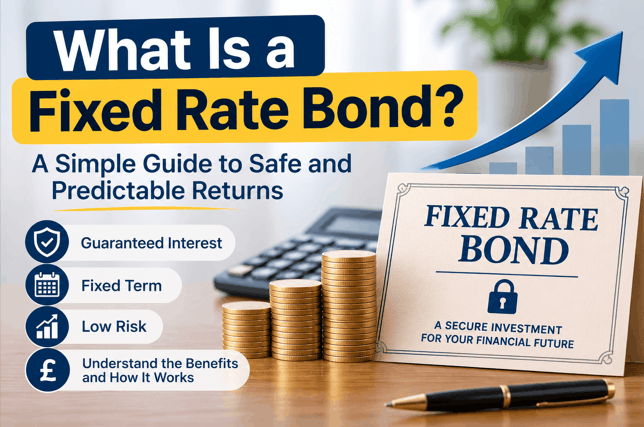
What is a fixed rate bond? A fixed rate bond is a UK cash savings account that holds a lump sum for a fixed term, often between one and five years. The interest rate is guaranteed for the term, but access is usually restricted until maturity.
FSCS protection can apply where the provider is UK-authorised, subject to the £120,000 limit from 1 December 2025.
Key takeaways
- A fixed rate bond locks a lump sum away at a rate that cannot change, so interest is known in advance.
- Fixed rate bonds are safe up to the FSCS limit: £120,000 per person, per authorised firm, since 1 December 2025.
- Tax on fixed rate bond interest applies above the Personal Savings Allowance: £1,000 basic rate, £500 higher rate, £0 additional.
- On 6 November 2026, the top Moneyfacts rate was 5.40% AER (annual equivalent rate).
Rates, tax thresholds and FSCS figures below reflect information available on 6 and 7 November 2026. Savings rates and product availability can change at any time.
What is a fixed rate bond and how does it work?
A fixed rate bond works in four stages: a lump sum goes in, the term runs, interest builds at the agreed rate, and the money comes back at maturity. Providers also call it a fixed term deposit or a fixed rate savings account.
- Choose a term and rate. Terms can run from as little as one month to seven years, although the longest term many providers offer is five years.
- Pay in a lump sum. Most bonds accept one deposit only, so the full amount has to be ready when the account opens.
- Earn interest. Interest is paid monthly, annually or at maturity, depending on the product.
- Reach maturity. The term ends, and the deposit plus interest can be withdrawn, reinvested or moved to another provider.
Fixed rate bond or investment bond?
A fixed rate bond is a cash savings account, so the deposit is not exposed to market swings. Government bonds (gilts) and corporate bonds share the word “bond” but are investments that pay coupons, meaning regular interest payments, and can lose value.
Premium Bonds, run by National Savings and Investments (NS&I), pay prizes instead of interest.
How long can you fix for, and how much can you deposit?
Most fixed rate bonds run for one to five years, but terms range from as little as one month to seven years, although the longest term many providers offer is five years. Deposit limits vary by provider.
| Feature | What providers offer | Source |
|---|---|---|
| Shortest term | From one month | Moneyfacts |
| Longest term | Seven years, from a handful of providers | Moneyfacts |
| Common terms | One to five years | Moneyfacts |
| Minimum deposit | From £1 to £10,000 | Moneyfacts |
| Maximum deposit | £250,000 | Leek Building Society |
| Maximum deposit | £2 million | YBS |
| Top-ups after opening | Usually none | Moneyfacts |
Some providers allow a short funding window after opening. Leek Building Society allows 14 days, and YBS accepts top-ups until a week after a bond is withdrawn from sale. Outside such windows, a bond is funded by one deposit only.

Fixed rate bond pros and cons
A fixed rate bond suits savers with spare cash and a known time horizon, but it penalises anyone who needs the money early.
Pros
- Rate certainty. A rise or cut in the Bank of England’s base rate does not change a bond already opened.
- Predictable return. The interest due at maturity is known from the start.
- Higher rates. Bonds usually pay more than easy access accounts, because the money is locked in.
- Built-in discipline. Locked money cannot be spent on impulse.
Cons
- No easy access. Early withdrawal is usually barred or penalised.
- No regular saving. Most bonds accept a single deposit.
- Missed upside. A bond keeps its rate even when market rates rise.
- Inflation risk. If prices rise faster than the fixed rate, buying power falls.
Money that may be needed within the term usually belongs in an easy access account instead.
Are fixed rate bonds safe? The FSCS limit explained
Yes: fixed rate bonds held with a UK-authorised bank or building society are protected by the FSCS up to £120,000 per person, per authorised firm. Protection applies if the provider fails and cannot repay eligible deposits.
It is not a guarantee of interest, a substitute for checking the provider, or protection against a fall in the value of an investment product.
The limit rose from £85,000, in place since January 2017, on 1 December 2025. The Prudential Regulation Authority (PRA), part of the Bank of England, consulted in March 2025 and confirmed the rise in November 2025.
FSCS protection applies per person, so joint accounts are covered up to £240,000. The limit counts total deposits with one firm, not each account.
Brands that share a banking licence count as one firm: the £120,000 limit applies across YBS, Chelsea Building Society and Norwich & Peterborough Building Society.
Several widely read guides still quote £85,000, and some quote both figures on one page, so the date of a figure matters. Common mistakes are treating £85,000 as current, assuming each account has its own limit and treating two brands as separate firms.
UK banks and building societies are prudentially regulated by the PRA and regulated for conduct by the FCA, and the Financial Services Register lists their status.
Check the provider on the Financial Services Register, then use the FSCS bank and savings checker to see whether brands share a licence. If you hold more than £120,000, spread it across firms with separate licences.
Do you pay tax on fixed rate bonds?
Yes, interest is taxable, but many savers owe nothing because allowances shelter some interest. UK banks and building societies generally pay interest gross, so no tax is deducted at source.
Tax may still be due through HMRC if your interest exceeds your available allowances.
| Allowance | Who gets it | Tax-free interest |
|---|---|---|
| Personal Savings Allowance | Basic-rate taxpayers | £1,000 |
| Personal Savings Allowance | Higher-rate taxpayers | £500 |
| Personal Savings Allowance | Additional-rate taxpayers | £0 |
| Starting rate for savings | Other taxable income below £17,570 | Up to £5,000 |
The starting rate for savings falls by £1 for every £1 of other income above the £12,570 Personal Allowance, the tax-free income threshold.
GOV.UK gives an example: a basic-rate taxpayer with £1,300 of savings interest pays 20% tax on the £300 above the £1,000 Personal Savings Allowance, which is £60.
Figures reflect GOV.UK guidance last updated on 30 September 2026, for the 2026/27 tax year (6 April 2026 to 5 April 2027). Moneyfacts notes that HM Revenue and Customs (HMRC) treats interest on a joint account as split equally between the holders.
After the tax year ends, banks and building societies tell HMRC how much interest they paid you. If you have tax to pay, HMRC will usually collect it through a change to your tax code or send you a tax calculation.
HMRC may send a Simple Assessment notice where it cannot collect the tax through PAYE or the tax owed is more than £3,000. If you need to query a calculation, you can contact HMRC.
Savers who already file Self Assessment should report the interest there. If your savings interest is more than £10,000, you must tell HMRC through a Self Assessment tax return; HMRC will send a notice to file if it is told you have more than £10,000 in savings interest.

Fixed rate bond vs fixed rate ISA vs easy access account
A fixed rate ISA pays tax-free interest at a rate that tends to be lower than a bond, while an easy access account allows withdrawals at a variable rate.
| Feature | Fixed rate bond | Fixed rate ISA | Easy access account |
|---|---|---|---|
| Interest rate | Fixed for the term | Fixed for the term | Variable |
| Access to money | Locked until maturity | Locked until maturity | Withdraw at any time |
| Tax on interest | Taxable above allowances | Tax-free | Taxable above allowances |
| Typical rate level | Usually above easy access | Tends to be below a standard bond | Generally below a fixed bond |
| Paying in | Usually one deposit | Limited by the annual ISA allowance | Deposits at any time |
A flexible cash ISA suits savers likely to exceed the Personal Savings Allowance, because ISA interest does not count towards it. A bond suits savers who are inside their allowance and want the higher rate.
Monthly, annual or at maturity: which interest payout is best?
How fixed rate bonds pay out is a choice, and no option is best for every saver. Monthly or annual payments provide income, while interest left in the account usually earns more in total.
AER, the annual equivalent rate, shows what a savings rate earns over a year once compounding is counted, so it allows like-for-like comparison. When interest is paid annually, the gross rate and AER match.
When it is paid monthly, the gross rate is lower than the AER, as in a bond showing 4.55% gross and 4.65% AER.
- Monthly: Regular income, with a lower gross rate than the AER.
- Annually: One payment a year, with the gross rate equal to the AER.
- At maturity: All interest arrives in one payment, built up by compounding.
The allowances in the tax table explain why timing matters. Moneyfacts illustrates it with £5,000 in a five-year bond at 4.00% AER: about £200 a year if paid out annually, but about £1,083 in one payment at maturity, which exceeds the £1,000 Personal Savings Allowance for that tax year.
Interest paid out also cannot compound, so total interest ends lower. Choose monthly or annual payment for income. Choose payment at maturity for growth, provided the single payment stays within your allowance.
Current fixed rate bond rates and how they have changed
On 6 November 2026, the highest rate on the Moneyfacts live table was 5.40% AER, for a five-year bond. Five of the six named products are five-year bonds.
| Provider | Product | AER |
|---|---|---|
| Afin Bank | 5-Year Fixed Term Account (Issue 15) | 5.40% |
| Chetwood Bank | 5 Year Fixed Rate Savings Account | 5.36% |
| Close Brothers Savings | Fixed Rate Bond | 5.35% |
| DF Capital | 5 Year Fixed Deposit, Annual Interest (Issue 9) | 5.35% |
| GB Bank | 5 Year Fixed Rate Bond | 5.35% |
| Vanquis Bank | 5 Year Fixed Rate Bond | 5.35% |
Source: Moneyfactscompare, 6 November 2026. Rates and product availability can change at any time; check the provider’s terms before applying.
Moneyfacts’ average one-year fixed bond rate was 1.80% in July 2022, 3.56% in January 2023, 4.80% in July 2023, 4.87% in January 2024 and 4.19% in January 2025.
A separate Moneyfacts measure, based on a £10,000 deposit, put the average one-year rate at 3.90% in April 2026 and 4.44% in October 2026. The five-year average rose from 4.02% to 4.58% over the same period.
Moneyfacts links the 2026 rise to higher inflation and expectations of a base-rate increase following the conflict in the Middle East, which led many providers to raise fixed rates. Providers can change rates at short notice.
Check a live comparison table before applying.
How to choose a fixed rate bond
Choose the term first: match it to the date the money will be needed, then compare rates like for like.
- Pick a term that ends before the cash is needed, and keep three to six months’ expenses in an easy-access account, as Moneyfacts suggests.
- Compare AER with AER, never a gross rate with an AER.
- Check the minimum and maximum deposit against the amount available.
- Choose a payout that matches the aim: income or growth.
- Weigh the pros and cons of early access, including any penalty.
- Confirm the provider is UK-authorised and check licence sharing, as the safety section explains.
MoneyHelper, the Money and Pensions Service’s guidance site, advises using more than one comparison site, because results differ.
Check eligibility and paperwork in the next section before applying.
Can laddering help?
Laddering splits money across bonds that mature in different years. In a generic illustration, a saver with £15,000 opens three £5,000 bonds of one, two and three years, then reinvests each in a new three-year bond as it matures. From year four, one bond matures every year.

Who can open a fixed rate bond, and what do you need?
Most bonds are open to UK residents aged 16 or 18 and over who hold a lump sum, with each provider setting its own minimum age.
Who is not eligible?
Applicants under the provider’s minimum age and non-UK residents are normally excluded. Businesses and charities use separate business bonds. Some bonds are open only to existing customers, and a few providers offer children’s bonds.
What you need to open one
Have these ready:
- Your name, address, date of birth and contact details
- Photo ID, such as a passport or UK driving licence
- Your National Insurance number, if the provider asks for it
- Details of a UK bank account for payments in and out
- The full lump sum, including the minimum deposit
Opening methods vary: online, app, branch, post or phone, and some products accept one channel only. Not every provider allows joint bonds.
Can you get money out of a fixed rate bond early?
Usually not: most fixed rate bonds bar early withdrawals, and those that allow them charge a penalty. Penalties take the form of lost interest or a charge, and a heavy penalty can eat into the original deposit.
Moneyfacts cites serious illness or bankruptcy as examples of exceptional circumstances. YBS says it may allow early closure in the following circumstances:
- Critical illness
- Terminal illness
- Death of an account holder
- Redundancy
- Nursing-home or elderly-care costs
- Divorce
- A court order
If an account holder dies, the next of kin or executor contacts the provider. Read the early access clause before depositing. If a bond might need to be broken, ask the provider for the exact charge.
What happens when a fixed rate bond matures?
At maturity, the provider returns the deposit plus interest, and the saver then chooses to withdraw, reinvest or move the money.
If no instruction is given at maturity, the provider normally moves the money to a default account. The replacement account may pay a lower rate than the maturing bond, so check the provider’s maturity options before the term ends.
Examples include an easy access account at Leek Building Society and a matured funds account at Shawbrook. Providers usually write before maturity: Leek Building Society at least 14 days ahead and Shawbrook a few weeks ahead.
Post Office warns that, if you do not take action at maturity, your money may be placed in a lower-interest holding account. A bond cannot normally move to another provider during the term, but the money moves freely once it matures.
Note the maturity date in a diary and compare rates a few weeks before it, so the default account never decides for you.
Conclusion
In practice, a fixed rate bond is a lump-sum savings account that trades access for certainty. FSCS protection can apply up to £120,000 per person, per authorised firm, where the provider is UK-authorised and fails, while tax may apply above the available allowances.
The right bond matches its term to the date the money is needed, compares AER with AER and stays within one firm’s FSCS limit.
FAQs
What is a fixed rate bond, and is it the same as an ISA?
No. A fixed rate bond is a savings account with a fixed rate for a set term. A fixed rate ISA also fixes the rate for a set term, but its interest is tax-free, and deposits count towards the annual ISA allowance.
Are fixed rate bonds a good idea?
They are a good fit when the money will not be needed during the term, and the rate beats easy access alternatives. They are a poor fit for emergency savings, because early access is usually barred or penalised.
Which bond is paying 7.5% interest?
None appeared among the top rates on Moneyfacts at 09:50 on 6 November 2026, when the highest was 5.40% AER. A rate far above the live table warrants checking whether it is gross or AER, applies to the full term and comes from a UK-authorised provider.
Can you open a fixed rate bond online?
Yes. Many providers accept online or app applications, though some products are branch-only or limited to one channel.
Can you hold more than one fixed rate bond?
Yes. There is no general limit, although each provider sets its own rules and the FSCS limit still applies per authorised firm.
Do older or disabled savers get special fixed bond rates?
Generally not: Moneyfacts says there are not typically fixed bonds designed specifically for older savers, so over-60s will usually need to choose from the standard range. Eligibility and product availability depend on the provider.
This article is general information, not financial advice. Savings rates, product terms, tax treatment and FSCS protection can change; check the provider’s terms and seek regulated advice if your circumstances are complex.