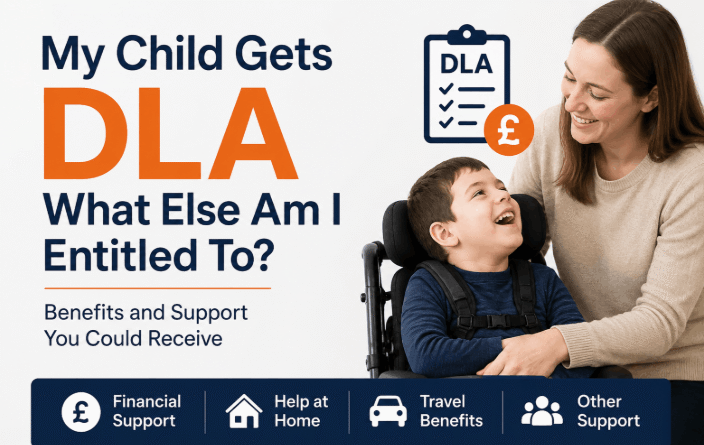
My Child Gets DLA What Else Am I Entitled To: Complete 2026 Guide to Extra Cash and Perks
When a child gets Disability Living Allowance, it can unlock a wider range of support beyond the benefit itself, including a disabled child element within Universal Credit, Carer’s Allowance for whoever provides the care, a Blue Badge, and grants from charities such as Family Fund.
These entitlements apply for the 2026 to 2027 benefit year.
Key takeaways
- Universal Credit adds a disabled child element worth £164.79 or £514.71 a month depending on the DLA rate awarded, current for 2026 to 2027.
- Carer’s Allowance pays £86.45 a week to someone providing at least 35 hours of care for a child on the middle or highest rate care component.
- A Blue Badge, Motability vehicle lease, Family Fund grants, and the Disability Access Fund for early years childcare are all available on top of DLA itself.
What Else Are You Entitled To When Your Child Gets DLA?
A DLA award for a child often qualifies the family for extra money and practical support well beyond the allowance itself. Getting DLA does not reduce any other benefit; it can only add to what a household already receives or open up entitlements that were not available before.
Several entitlements are worth checking straight away, each with its own current rate or rule:
- Universal Credit’s disabled child element, worth £164.79 or £514.71 a month, depending on the DLA rate awarded.
- Carer’s Allowance, worth £86.45 a week, or the Universal Credit carer element for the main carer.
- Full exemption from the benefit cap, plus a possible £84.46 a week disabled child premium within Housing Benefit.
- Automatic Blue Badge entitlement, for a badge fee of up to £10, and access to the Motability Scheme.
- The Disability Access Fund, worth £938 a year, toward a child’s free early years childcare place.
- One off grants from Family Fund and other charities supporting disabled children.
Tell every office that pays an existing benefit as soon as the DLA award letter arrives, since most of this extra support only starts once the Department for Work and Pensions and the local council know about it. A benefits calculator such as Turn2us can help identify which of these apply before contacting each office.

Universal Credit Disabled Child Element: How Much You Get?
The disabled child element of Universal Credit adds £164.79 a month for any rate of DLA, rising to £514.71 a month if the child gets the highest rate care component, current from April 2026 under the Department for Work and Pensions’ benefit and pension rates for 2026 to 2027.
How much extra a household gets on Universal Credit for a disabled child depends entirely on the DLA rate awarded, not on household income.
| DLA rate awarded | Universal Credit addition (2026 to 2027) |
|---|---|
| Any rate of care or mobility | £164.79 a month |
| Highest rate care component | £514.71 a month |
According to the Department for Work and Pensions, DLA itself is never counted as income when these additions are worked out. These figures apply to new and existing claims from April 2026, following the 3.8% uprating applied across DWP disability and carer benefits.
Widely circulated claim: Several finance and benefits sites still quote the disabled child element at £158.76 a month for any rate of DLA and £495.87 a month for the highest rate.
Correct position: The figures increased to £164.79 and £514.71 a month respectively from April 2026.
Source: Scope and Contact, the charity for families with disabled children, both confirmed as of April 2026.
Backdating rules, and how this addition sits alongside a Universal Credit transitional element, are explained fully in this guide to the disabled child element of Universal Credit.
Carer’s Allowance and the Universal Credit Carer Element
You may be able to claim Carer’s Allowance if you spend at least 35 hours a week caring for your child and the child receives the middle or highest rate care component of DLA. Carer’s Allowance pays £86.45 a week from April 2026.
- Confirm the child receives the middle or highest rate care component of DLA.
- Check that at least 35 hours of care are provided each week; this includes supervision and prompting, not only physical care.
- Check that earnings are £204 a week or less after tax, National Insurance, and expenses.
- Apply through GOV.UK or by phone, and ask about backdating to the DLA start date.
Carer’s Allowance itself counts as income and is deducted pound for pound from Universal Credit, but it still carries Class 1 National Insurance credits that protect the State Pension.
Anyone whose earnings are too high for Carer’s Allowance should ask about the Universal Credit carer element instead, since it has no equivalent earnings limit but still requires 35 hours of care a week.
Benefit Cap Exemption and Help With Council Tax
A child’s DLA award is one of several exemptions from the benefit cap and can increase the level of Council Tax Reduction available.
The benefit cap normally limits total benefit payments for out of work households, but any household with a child receiving DLA is fully exempt from this limit, regardless of how many other benefits are claimed. Council Tax Reduction schemes are set locally, so the exact discount for a disabled child varies by local authority.
Some councils also offer a disabled band reduction, which lowers a property’s Council Tax band by one level if a room or extra space is used to meet the child’s needs. Renting households can also qualify for a disabled child premium within Housing Benefit, worth an extra £84.46 a week.

Blue Badge and the Motability Scheme
Your child qualifies automatically for a Blue Badge if they get the higher rate mobility component of DLA, without any extra assessment.
Automatic Blue Badge Eligibility
- Higher rate mobility component of DLA gives automatic entitlement from age three
- Registered blind children also qualify automatically
- Children without automatic entitlement can still apply if mobility needs are severe
Applying for or renewing a Blue Badge costs up to £10 in England, though some councils issue them free of charge.
Leasing Through Motability
The Motability Scheme lets you lease a car, scooter, or powered wheelchair using the mobility component of DLA once your child turns three. The lease includes insurance, servicing, and breakdown cover, though fuel and electricity costs are not covered.
The Disability Access Fund Most Parents Never Hear About
This payment, detailed in the guidance on extra funding for early years providers, is paid directly to a nursery, childminder, or preschool rather than to the parent, for any child who receives DLA and takes up a funded early years place. It can only be claimed at one setting per child in any twelve month period.
Why the Payment Goes to the Nursery, Not You?
Many parents assume this money would come to them, so they never mention the DLA award to the setting once the free hours are already in place.
The fund exists to help the nursery make reasonable adjustments, from extra staff training to specialist equipment, so it only reaches a child if the provider knows about the DLA award and applies for it directly.
Family Fund Grants and Other Charity Support
Family Fund can provide a grant toward essential items if you are on a low income and care for a disabled or seriously ill child under eighteen.
- Check eligibility on the Family Fund website, which focuses on low income households with a disabled or seriously ill child.
- Apply online, describing the child’s condition and the items or support requested, such as sensory equipment or a washing machine.
- Contact Citizens Advice for guidance on which charity grants apply locally, since welfare schemes vary from one area to another.
Grants do not need to be repaid and will not reduce any means tested benefit already being received.
Turning Sixteen: What Happens To DLA And What Else Changes?
DLA for children ends at sixteen, when the young person is invited to apply for Personal Independence Payment instead.
- The Department for Work and Pensions writes to the family when the young person turns fifteen years and seven months old, inviting a PIP claim.
- DLA continues until the PIP decision is made, so payments should not stop suddenly
- A Mandatory Reconsideration, then an appeal to the Social Security and Child Support Tribunal, is available if PIP is refused
- Universal Credit additions and Carer’s Allowance eligibility are reassessed based on the new PIP award, not the old DLA rate
This is often the point families also review Child Benefit, particularly when a young person stays in full time education, so it is worth checking when does Child Benefit stop around the same time.
These figures were confirmed against Scope and Contact, the charity for families with disabled children, as of April 2026.

Conclusion
A DLA award for a child is usually just the starting point for further support. Reporting the award promptly to each office can add hundreds of pounds a month through Universal Credit, alongside Carer’s Allowance, a Blue Badge, Motability, the Disability Access Fund, and charity grants. DLA for a child means wider financial and practical support for the whole family in 2026 and beyond.
FAQ
What else is a family entitled to once a child gets DLA?
Extra Universal Credit, Carer’s Allowance for the main carer, a Blue Badge, and charity grants such as those from Family Fund can all follow a DLA award, without ever reducing the DLA payment itself.
Does a child’s DLA award reduce other benefits already being claimed?
No, receiving DLA for a child never reduces other benefit payments; it can only add to them or make new entitlements available once it is reported.
Can grandparents or foster carers claim these extra entitlements?
Yes, anyone acting as the main carer, including grandparents, foster carers, and guardians, can claim Carer’s Allowance and related entitlements if the care hours and DLA rate conditions are met.
Will these extra payments be backdated to when the DLA award started?
Usually yes, since Universal Credit additions are normally backdated in line with the DLA award, though Carer’s Allowance backdating is limited to three months from the decision date.
Is a new application needed every time a child’s DLA is reviewed?
Not automatically, but any change in the DLA rate should be reported straight away, since a higher or lower award can increase or reduce the linked entitlements.
Disclaimer: This information is for guidance only; check official DWP guidelines or consult a benefits advisor for personalized legal advice.