What Is the Triple Lock Pension? Rules Explained
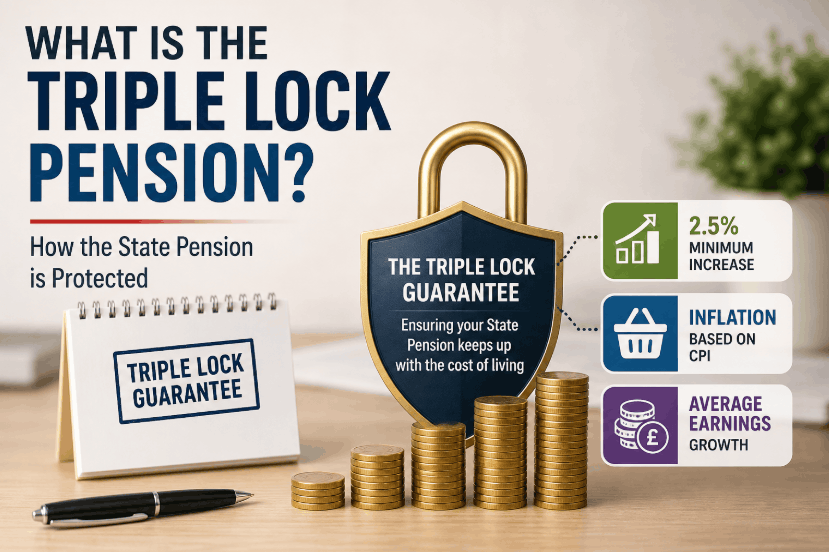
What is the triple lock pension? The triple lock is a UK government rule that raises the State Pension each April by the highest of three measures: earnings growth, Consumer Prices Index (CPI) inflation or 2.5%. It is not a separate payment, and the annual increase is applied automatically.
Key Takeaways
- The State Pension rises each April by the highest of average earnings growth, CPI inflation or 2.5%, and the increase is applied automatically.
- The full new State Pension is £241.30 a week from 6 April 2026, according to GOV.UK.
- The Department for Work and Pensions (DWP) says the triple lock will be adjusted from April 2030. People already receiving the State Pension will keep the existing triple lock until then.
How Does the Triple Lock Pension Work?
Every April, the basic State Pension and the full new State Pension rise by the highest of three figures. The basic State Pension covers people who reached State Pension age before 6 April 2016.
The new State Pension applies to people who reach State Pension age on or after that date, subject to transitional rules based on date of birth. The rule always applies the highest of these three figures:
- Prices: CPI inflation in the year to the previous September.
- Earnings: Average total pay growth in Great Britain from May to July of the previous year, including bonuses.
- Floor: A flat 2.5% minimum increase, which applies when prices and wages both rise by less.
The Office for National Statistics (ONS) publishes both the CPI and the earnings figures. April 2026 shows the rule at work. Average earnings growth of 4.8% was the highest of the three measures, so the State Pension rose by 4.8% on 6 April 2026.
That lifted the full new State Pension from £230.25 to £241.30 a week, an extra £11.05 a week, or about £575 over a year. Each rise becomes the base for the next, so the pension keeps the gains from whichever measure wins in a given year.
How Much Is the State Pension With the Triple Lock?
If you are wondering exactly how much State Pension you will get at 66, the full new State Pension is £241.30 a week, or £12,547.60 over 52 weeks, from 6 April 2026, according to GOV.UK. The amount depends on National Insurance qualifying years, meaning years with recorded contributions or credits.
Ten years are the minimum for any new State Pension, and 35 give the full rate. GOV.UK adds that people who were contracted out before 2016 usually need more than 35 years.
Contracted out means paying less National Insurance into the State Pension while a workplace or private pension was funded instead. GOV.UK puts the older basic State Pension at £184.90 a week.
| Figure | Amount | Applies from |
|---|---|---|
| Full new State Pension | £241.30 a week | 6 April 2026 |
| Full basic State Pension | £184.90 a week | 6 April 2026 |
| April 2026 increase | 4.8% | 6 April 2026 |
| April 2027 increase (provisional) | 3.9% | 6 April 2027 |
| Full new State Pension (provisional) | About £250.70 a week | 6 April 2027 |
| Full basic State Pension (provisional) | About £192.10 a week | 6 April 2027 |
ONS figures put September 2026 CPI inflation at 3.5%, below total earnings growth of 3.9% for May to July 2026.
The earnings measure therefore decides the 2027 State Pension increase, which the Autumn Budget on 28 October 2026 is due to confirm. These figures are provisional until the uprating is confirmed. Earnings and inflation estimates can be revised, and the final increase depends on the figures used for the uprating decision.
A 3.9% rise would add about £9.41 a week to the full new rate, or about £489 over a year. To estimate any rise, multiply the weekly amount by 1 plus the percentage. A hypothetical £150 a week becomes £155.85 after a 3.9% increase.
For a personal figure, a State Pension check on the GOV.UK forecast tool shows an individual’s expected amount and National Insurance record. A full new State Pension of £12,547.60 a year sits £22.40 below the standard £12,570 Personal Allowance for 2026/27.
The provisional £13,036.40 from April 2027 would exceed it, and the allowance stays at £12,570 for 2027/28. Income Tax can therefore apply to a full State Pension, depending on other income.
Will the Triple Lock Pension Be Scrapped? What Changes From April 2030
The triple lock is not ending outright, but DWP has announced it will be adjusted from April 2030. People who already receive the State Pension keep the existing triple lock until April 2030.
DWP’s Triple Lock reform factsheet, published on 6 October 2026, says the State Pension will then rise by the higher of 2.5% or an earnings-linked amount, with inflation protection.
That amount replaces the earnings measure described above and is designed to restore or maintain the pension’s value relative to earnings. The stated aim is for the pension to follow average earnings over time instead of consistently outpacing wages.
| Point | Common description | DWP factsheet |
|---|---|---|
| Measures from April 2030 | Inflation or 2.5% | The higher of 2.5% or an earnings-linked amount, with inflation protection |
| Status of details | Still to be confirmed | Set out in the 6 October factsheet |
| Long-run aim | Not described | Pension rises in line with average earnings over time |
The factsheet publishes no formula for the earnings-linked amount, so future rises cannot yet be calculated.
The current rule governs every uprating (yearly increase) before April 2030, including April 2027. DWP says the existing Triple Lock will continue to apply until April 2030. From April 2030, today’s pensioners move to the adjusted rule as well.
Who Qualifies for the Triple Lock Pension?
You get the yearly increase under the pension triple lock if you receive the basic State Pension or the new State Pension. If you live abroad, whether you receive the annual increase depends on where you live.
You do not claim it separately, because the increase is calculated and applied automatically on or just after 6 April.
GOV.UK identifies three elements that follow a different uprating rule:
- Additional State Pension: the earnings-related top-up some people built up before 6 April 2016.
- Deferral extras: Any extra amount earned by deferring, meaning delaying a claim; these usually rise each year in line with inflation.
- Protected payment: a top-up for some people who would have received more under the old rules.
Do You Need to Apply, and When Is the State Pension Paid?
The yearly increase needs no separate application, but you must claim the State Pension itself. The new State Pension is not paid automatically and must be claimed, so claiming it is the essential first step.
- Check your State Pension age on GOV.UK.
- Wait for the invitation letter, which carries the code for an online claim. If no letter has arrived and State Pension age is within three months, request a code online.
- Gather the date of your latest marriage, civil partnership or divorce, any dates living or working abroad, your bank or building society details and any foreign social security numbers.
- Claim online, by phone if State Pension age falls within four months, or by post using a form from the Pension Service.
- Tell the Pension Service about later changes of address or bank details.
The increase takes effect on or just after 6 April. The new State Pension is usually paid every four weeks, and the first payment arrives no later than five weeks after the chosen start date. The weekday depends on the last two digits of the National Insurance number, and a bank holiday can bring payment forward.
| Last two digits of National Insurance number | Payment day |
|---|---|
| 00 to 19 | Monday |
| 20 to 39 | Tuesday |
| 40 to 59 | Wednesday |
| 60 to 79 | Thursday |
| 80 to 99 | Friday |
Why Is It Called the Triple Lock, and What Does It Cost?
The name reflects three annual guarantees: prices, earnings and a 2.5% floor. It is a government commitment. The House of Commons Library says there is also a statutory requirement to uprate the basic and new State Pension by at least earnings growth each year.
- 2011/12: The Coalition government’s triple lock is implemented, after pensions had been uprated at least in line with prices since 1980.
- 2022/23: The earnings element is temporarily suspended, and State Pensions rise by 3.1% in line with CPI.
- 2026: The April rise is 4.8%.
- 2030: The adjusted version starts.
The Institute for Fiscal Studies (IFS) puts State Pension spending at £154 billion in 2026/27. It says the triple lock adds about £16 billion a year compared with earnings-only uprating since 2010.
When inflation is the highest of the three measures, the triple lock helps protect the State Pension’s real value against rising prices. The IFS counts the long-term cost as highly uncertain: about £20 billion a year by 2050, within a range of £5 billion to £40 billion.
The IFS forecasts that the State Pension would rise by 2.5% in April 2028 and April 2029, above both projected earnings growth and inflation. Those forecasts pre-date the latest inflation figures, so they can change.

Conclusion
The triple lock is the annual rule that raises the State Pension by the highest of earnings growth, CPI inflation or 2.5%. The increase is applied automatically to people already receiving the State Pension.
Although the triple lock is often discussed as though it may be scrapped, DWP has confirmed an adjustment from April 2030. Until then, the existing formula governs annual increases.
FAQs
What is the triple lock pension, and is it a separate payment?
No, it is a rule, not a payment. The triple lock only sets how much the State Pension rises each April, so nothing extra is claimed or paid.
Do husband and wife both get the State Pension?
Yes, when each partner qualifies in their own right. The new State Pension is usually based on each person’s own National Insurance record, so each partner’s pension and yearly increase are separate. The Pension Service can help with questions about State Pension payments and eligibility.
What age do you get the State Pension?
State Pension age is rising from 66 to 67 between 6 April 2026 and 5 March 2028. The GOV.UK State Pension age checker gives your exact date. You can claim after reaching State Pension age, and deferring your claim increases the weekly amount.
Can you work and claim the State Pension?
Yes. You can claim your State Pension while still working. Deferring your claim increases the weekly amount, and Income Tax may apply depending on your total income.
Who do you contact about State Pension problems?
The Pension Service can help with State Pension and Pension Credit queries on 0800 731 0469, Monday to Friday, 8 AM to 6 PM, except public holidays.
Who gets the triple lock increase if they live abroad?
It depends on the country of residence. GOV.UK says UK State Pension recipients overseas usually receive the yearly increase if they live in the EEA, Switzerland or certain countries with a UK social security agreement. GOV.UK publishes the country list.
Disclaimer: This article is for informational purposes only and does not constitute financial advice; please verify current figures on GOV.UK or consult a qualified advisor for personal guidance.