DWP Benefit Warning Letters Explained: Types, Deadlines, Rights and What To Do Next
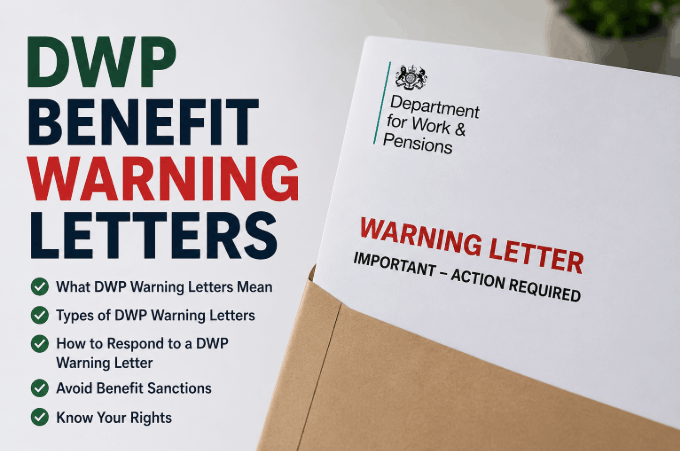
DWP benefit warning letters are official notices issued by the Department for Work and Pensions that require the recipient to take specific action or risk losing payments, facing debt recovery, or entering a formal investigation. In June 2026, the DWP is issuing five distinct types of warning letter, each with different legal consequences, deadlines, and required responses.
Key Takeaways
- A DWP migration notice gives recipients three months to claim Universal Credit before legacy benefit payments stop. Missing the deadline without requesting an extension means losing transitional protection permanently.
- An interview under caution is a formal criminal investigation interview conducted under the Police and Criminal Evidence Act. It is not a routine compliance check, and legal advice should be sought before attending.
- Under the Public Authorities (Fraud, Error and Recovery) Act 2025, the DWP began issuing debt recovery warning letters on 24 June 2026. Recipients have until October 2026 to repay or agree a plan before enforcement begins.
- Genuine DWP letters always arrive by post on DWP headed paper and never request bank details, card numbers, or upfront payments. Any communication making these requests is a scam.
What Does a DWP Benefit Warning Letter Actually Mean?
Not every DWP letter carries the same weight. The Department for Work and Pensions issues letters across five distinct categories in 2026, and what a DWP benefit warning letter means in practice depends entirely on which category has arrived.
The type of letter determines the urgency, the correct response, and the consequences of getting it wrong. Before doing anything else, two things need to happen:
- Identify which letter type it is. A migration notice and a debt enforcement warning letter can both arrive in identical brown envelopes but operate under entirely different legislation and require entirely different action.
- Verify that the letter is genuine. Jobcentre Plus correspondence is increasingly impersonated by fraudsters, particularly during periods of system change.
The DWP has substantially expanded its review and enforcement activity in 2026. A full breakdown of what that means for claimants across different benefit types is covered in the DWP benefit review 2026/27, which sets out which claims are being prioritised and on what timeline.

The Five Types of DWP Warning Letter in 2026
The DWP issues five primary letter types in 2026. Each requires a different response and carries different consequences for inaction.
| Letter Type | Why It Is Sent | Deadline | Key Consequence of Ignoring |
|---|---|---|---|
| Migration Notice | Legacy benefit ending; claim Universal Credit | 3 months from the issue date | Benefit stopped; transitional protection lost |
| Overpayment Recovery Notice | DWP has identified an excess payment | 28 days to challenge; deductions begin immediately | Ongoing deductions from benefit; possible debt referral |
| Compliance Review Letter | Discrepancy identified in claim data | Typically, 14 to 28 days to respond | Escalation to formal fraud investigation |
| Interview Under Caution Invitation | Formal fraud or error investigation underway | Date specified in the letter | Investigation continues without claimant input |
| Debt Enforcement Warning Letter | Outstanding debt from a former claimant | Until October 2026, enforcement begins | Direct bank recovery; possible driving ban |
Each letter has a named legal basis. Confusing one for another leads claimants to apply the wrong response to the wrong process, which in most cases makes the situation worse rather than better.
DWP Migration Notice: What It Means and How Long You Have?
A migration notice gives you three months from the date of issue to claim Universal Credit. Acting before that deadline is the only way to preserve transitional protection, and extensions must be requested before the deadline, not after it has passed.
The letter will be headed “Universal Credit Migration Notice” and will include your personal deadline date, the Migration Notice Helpline number (0800 169 0328), and a statutory reference to regulation 44 of the Universal Credit (Transitional Provisions) Regulations 2014, and that legislative citation is one of the clearest signs the letter is genuine.
If you would receive less under Universal Credit than your current benefits, transitional protection covers the difference, but only if you claim before the deadline. A 10-week reminder follows if no claim has been made.
Income Support and income-based Jobseeker’s Allowance closed on 31 March 2026, and for those still on Employment and Support Allowance or Housing Benefit, the extended deadline runs to the end of summer 2026.
When your migration notice arrives, check each of the following before taking any action:
- The personal deadline date printed on the letter. This is your specific cutoff, not a general programme date.
- Whether your benefit combination qualifies for transitional protection. Citizens Advice can confirm this if you are unsure.
- Whether your household savings exceed £16,000. This affects Universal Credit eligibility directly.
- Whether you need an extension. Contact the Migration Notice Helpline before the deadline, not after it passes.
How your Universal Credit amount is calculated after migration, including which elements carry over and which are reassessed in the new system, is explained in detail in this DWP Universal Credit payments review, which covers the assessment period rules that differ significantly from legacy benefit calculations.

DWP Overpayment Letter: Your Rights and the 28 Day Window
An overpayment letter means the DWP believes it has paid you more than you were entitled to receive. You have 28 days to challenge the decision if you believe it is wrong, and that window begins from the decision date on the letter, not from the date you opened it.
Not all overpayments result from deliberate wrongdoing. The DWP’s own figures, confirmed by the National Audit Office in October 2025, show that £540 million was overpaid in 2024 to 2025 due to errors made by the DWP itself, not by claimants.
The letter will state the overpayment amount, the period it covers, and the DWP’s proposed recovery method, most commonly deductions from ongoing benefit payments.
Reporting a change of circumstances promptly avoids overpayment in most cases, but once a decision has been recorded, the priority is to verify its accuracy before agreeing to any repayment arrangement.
When an overpayment letter arrives, work through the following steps in order:
- Check the decision date on the letter. Your 28-day mandatory reconsideration window begins from this date, not from the date you received it.
- Contact the DWP Debt Management contact centre if you cannot afford the proposed repayment rate. Deductions can be reduced or temporarily suspended based on your financial circumstances.
- Request a mandatory reconsideration in writing if you dispute the amount. State clearly that you are requesting a revision, include your National Insurance number, and set out the specific grounds for your challenge.
- If mandatory reconsideration fails, appeal to the HM Courts and Tribunals Service using form SSCS1 within one month of the Mandatory Reconsideration Notice date.
Overpayment debt transfers automatically to Universal Credit when a claimant migrates from a legacy benefit. It does not disappear on migration, and it does not reset the repayment terms.

DWP Compliance Letters and Interview Under Caution: What Is the Difference?
A compliance letter is an administrative review. An interview under caution is a formal criminal investigation conducted under the Police and Criminal Evidence Act. These two letter types require entirely different responses, and confusing them has serious consequences.
A compliance review letter from Jobcentre Plus asks you to confirm claim details or supply supporting documents, usually within 14 to 28 days, and responding accurately at this stage resolves most cases without further escalation. An interview under caution invitation is a different matter entirely.
The DWP’s Fraud and Error Service issues it only when a formal investigation is already underway, the interview is recorded under PACE caution, and outcomes range from no further action to an administrative penalty to criminal prosecution.
The DWP’s compliance activity is now data driven. The Eligibility Verification Measure cross references bank account data against declared circumstances. DWP Universal Credit bank account checks explains what claimants can expect if their account is flagged.
If you receive an interview under caution letter, the following rights apply:
- The right to seek legal advice before attending. Seeking advice is not an admission of guilt and will not be treated as such.
- The right to request that the interview be rescheduled if you need time to obtain proper representation.
- The right to silence during the interview, though exercising it without legal guidance can complicate your position if the case proceeds.
- The right to bring a legal representative, including a solicitor or welfare rights adviser, into the interview room itself.
If the letter invites you to a “compliance interview,” read it in full. It may contain caution language that changes its legal character entirely.
DWP Debt Enforcement Warning Letters: The New Powers in Force From June 2026
From 24 June 2026, the DWP began issuing debt enforcement warning letters under the Public Authorities (Fraud, Error and Recovery) Act 2025. Recipients have until October 2026 to engage with the DWP before formal enforcement begins.
These letters are sent to former claimants who owe the DWP at least £1,000, are no longer receiving benefits, and have repeatedly declined earlier repayment requests.
The PAFER Act grants the DWP two new enforcement tools: direct deduction from bank accounts without a court order, and an application to court for driving licence suspension.
Courts will only impose a driving ban where the debt exceeds £1,000 and will not do so where losing a licence would stop someone working or fulfilling caring responsibilities. The GOV.UK press release issued 24 June 2026 puts the estimated taxpayer saving from the wider fraud, error and debt recovery package at £14.6 billion over five years.
If you receive a debt enforcement warning letter, take these steps in order:
- Do not ignore it. The DWP has stated clearly that anyone who contacts them before October 2026 can still agree an affordable repayment plan and avoid enforcement entirely.
- Contact the DWP directly using the number on the letter to discuss repayment options. Free debt advice is also available through organisations the DWP can signpost.
- If you dispute the debt, seek independent advice from Citizens Advice before responding. Do not simply ignore the letter while waiting for an advice appointment.
- If enforcement action has already begun and you believe it has been wrongly applied, contact the Independent Case Examiner, whose details are available on GOV.UK.
The scope of the new driving licence powers, including exactly who they apply to, the court process involved, and the safeguards built into the legislation, is set out in DWP driving ban for unpaid benefit debt evaders, which also covers the threshold conditions and the process for challenging an enforcement decision.
The driving ban and direct bank deduction powers are tools of last resort. Engaging with the DWP before October 2026 is the most effective way to avoid either.

How to Tell Whether a DWP Letter Is Genuine or a Scam
Genuine DWP warning letters always arrive by post on headed paper and never ask for bank details, card numbers, or upfront payments. Any communication making these requests through text, email, or social media is a scam, regardless of how official it appears.
Scammers time fake DWP contact to coincide with system changes, including the managed migration programme and PAFER Act rollout, exploiting uncertainty about what the DWP is legitimately asking for. Action Fraud recorded a notable rise in DWP impersonation attempts throughout 2025.
Genuine DWP letters always include your full name, National Insurance number, a claim reference, and a citation of the specific regulation being applied.
A migration notice references regulation 44 of the Universal Credit (Transitional Provisions) Regulations 2014, and a debt enforcement letter cites the Public Authorities (Fraud, Error and Recovery) Act 2025 by name.
Any letter that does not reference the relevant legislation for the action it describes warrants caution. The DWP never requests bank details, passwords, or card information by text or email.
Forward suspicious messages to 7726 and report them to Action Fraud on 0300 123 2040. If a letter’s authenticity is in doubt, call the DWP using a number from GOV.UK directly.
Conclusion
DWP benefit warning letters are not all equal in urgency or consequence. The letter type determines the legal process, the applicable deadline, and the cost of inaction.
Identifying which letter has arrived and responding within the correct timeframe is the only reliable way to protect entitlements, avoid enforcement, and keep the right to challenge a decision open.
DWP benefit warning letters mean specific legal obligations and firm deadlines for UK benefit claimants in 2026, and the cost of misreading them is measured in lost payments, avoidable debt, and enforcement action that did not need to happen.
FAQ
What happens if you ignore a DWP warning letter?
Ignoring a DWP warning letter always makes the outcome worse. Missing a migration notice deadline costs transitional protection permanently. Ignoring a debt enforcement letter triggers bank deduction or driving ban enforcement from October 2026. Ignoring a compliance letter converts a routine check into a formal Fraud and Error Service investigation.
Can the DWP stop my benefits without warning?
Yes, but only during an active fraud investigation, where payments can be suspended without prior notice. For all other changes, including migration closures and overpayment deductions, the DWP must issue written notice with a deadline before reducing or stopping payments.
What happens after a DWP interview under caution?
The DWP’s Fraud and Error Service reaches one of four decisions: no further action, an overpayment recovery demand, an administrative penalty of the overpaid amount plus a 30% surcharge, or criminal prosecution referral. The process takes several weeks to several months depending on case complexity.
Can the DWP take money directly from my bank account?
Yes, from October 2026 under the Public Authorities (Fraud, Error and Recovery) Act 2025. This applies only to former claimants owing at least £1,000 who have repeatedly refused repayment. Current claimants are not affected. Deductions from active claims are handled separately through the DWP Debt Management contact centre.
Do I need a solicitor if I receive a DWP interview under caution letter?
Legally required, no. Strongly advisable, yes. You have the right to legal advice before any interview under caution. The process runs under the Police and Criminal Evidence Act and answers can be used as criminal evidence. Citizens Advice can help identify affordable representation.
Disclaimer: This article is for informational purposes only and does not constitute legal or financial advice. Always verify current DWP guidance at GOV.UK before taking action.