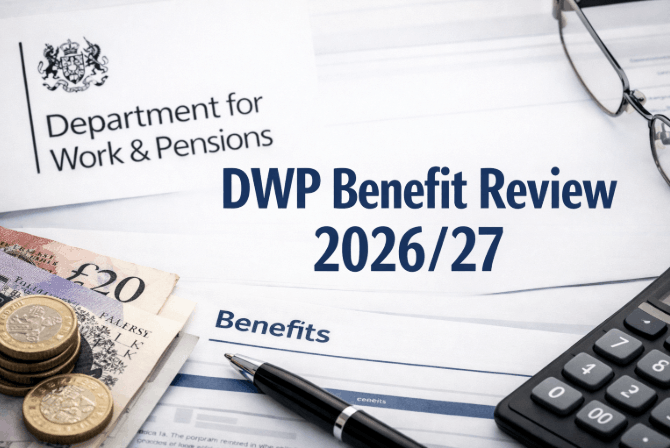
DWP Benefit Review 2026/27: Rates, Fraud Checks, PIP Changes and What To Do Next
The DWP benefit review covers three separate government processes: the annual statutory uprating of benefit rates, a targeted fraud and error review programme examining five major benefits, and structural changes to PIP award timelines.
It is crucial to note that final monetary rates and structural reforms are typically confirmed in the Autumn Statement. Figures discussed before official enactment are projections based on the Office for National Statistics’ September CPI data.
Key Takeaways
- Annual benefit uprating figures are traditionally tied to the September Consumer Prices Index (CPI) inflation figure.
- Universal Credit and PIP rules continue to operate under existing legislation, with any new powers or structural changes requiring formal parliamentary approval.
- Five benefits are under a DWP fraud and error review: Universal Credit, Housing Benefit (pension-age claimants), Pension Credit, the State Pension, and PIP. Results are evaluated annually.
- PIP award periods are subject to administrative adjustments to manage backlogs, meaning some existing fixed-term PIP awards may be extended.
DWP Benefit Review 2026/27: The annual Department for Work and Pensions evaluation encompassing statutory rate uprating, targeted fraud and error checks, and structural reviews of disability assessments. Rates for the upcoming tax year rely on September inflation data and are formally confirmed in the Autumn Statement.
Most claimants will see higher payments in line with inflation, not cuts, at the start of the new tax year. Three separate government processes share one search term, and the distinction between them matters.
What Does the DWP Benefit Review 2026/27 Actually Cover?
The phrase DWP benefit review 2026/27 describes three distinct government processes, and treating them as one is where most of the confusion around this topic starts.
The review encompasses the annual statutory uprating, the ongoing fraud and error measurement programme, and proposed structural reforms to PIP assessments. Administrative regulations allow the DWP to extend the length of existing fixed-term PIP awards to manage backlogs.
This sits alongside independent reviews examining how PIP assessments should work in the future. All three operate under different legal frameworks and carry different practical consequences for claimants.

What Are the New Benefit Rates for April 2026?
Benefit rates and statutory uprating figures for the upcoming tax year are traditionally tied to September inflation data and confirmed during the Autumn Statement.
Universal Credit and PIP rules continue to operate under existing legislation, with any new powers or structural changes requiring formal parliamentary approval.
From April of each new tax year, most DWP benefits increase in line with CPI inflation, provided the statutory uprating is approved by Parliament. These rates are not confirmed until officially published by the Government. Check gov.uk for full, current figures.
DWP Benefit and Pension Rates 2025/26 and 2026/27
| Benefit | 2025/26 Rate | 2026/27 Rate | Change |
|---|---|---|---|
| UC — Single, under 25 (monthly) | £316.98 | £338.58 | +£21.60 |
| UC — Single, 25 or over (monthly) | £400.14 | £424.90 | +£24.76 |
| UC — Joint claimants, both under 25 (monthly) | £497.55 | £528.34 | +£30.79 |
| UC — Joint claimants, 25 or over (monthly) | £628.10 | £666.97 | +£38.87 |
| New State Pension (weekly) | £230.25 | £241.30 | +£11.05 |
| Basic State Pension (weekly) | £176.45 | £184.90 | +£8.45 |
| Attendance Allowance — higher rate (weekly) | £110.40 | £114.60 | +£4.20 |
| Attendance Allowance — lower rate (weekly) | £73.90 | £76.70 | +£2.80 |
| Carer’s Allowance (weekly) | £83.30 | £86.45 | +£3.15 |
Source: DWP Benefit and Pension Rates 2026 to 2027, confirmed 16 February 2026.
Beyond the headline rate rise, two structural changes came into effect alongside the uprating. First, the LCWRA (Limited Capability for Work-Related Activity) element, now called the health element for new claims, splits into two tiers from April 2026.
Pre-2026 claimants and those meeting the severe conditions criteria receive £429.80 per month. New claimants who do not meet that threshold receive £217.26 per month, a reduction of approximately £47 per week from the previous rate.
Second, the two-child limit on the UC child element was removed on 6 April 2026, meaning families with three or more children can now claim a child element for each child.
Pensioners should also note that separate changes to the Winter Fuel payment clawback 2026 came into effect during the same financial year, affecting those who received payments they were no longer entitled to.
From April 2026, most DWP benefits increased by 3.8% in line with CPI inflation. Universal Credit standard allowances rose by a combined 6.1% due to an additional statutory uplift.
The new State Pension reached £241.30 per week. These are confirmed rates, not proposals. Check gov.uk for full figures.

What Disability Benefits Are Going to Be Cut?
No disability benefit has been cut outright in 2026/27, but the LCWRA health element has been restructured, and PIP faces longer-term reform that remains unresolved.
PIP itself has not been cut. Independent reviews examining PIP assessment criteria, descriptors, and processes are ongoing. Until official reports are published and legislation follows, no confirmed changes to PIP entitlement criteria exist.
Claimants should treat reports of confirmed PIP cuts with caution; no such changes have been legislated.
What has changed in recent years is the timeline between PIP reviews. To manage administrative burdens, the DWP frequently extends fixed-term PIP awards, meaning many claimants face longer gaps between reassessments.
DWP Benefit Review Myths vs Reality
| Myth | Reality |
|---|---|
| The DWP benefit review means all claimants will be reassessed. | The annual uprating review is a rate-setting exercise, not an individual reassessment. |
| PIP has been cut. | PIP payment rates generally rise with inflation. Policy reform reviews have not yet resulted in legislated cuts. |
| The fraud review means DWP will contact claimants. | The fraud review is largely a data and statistical exercise; most claimants will not be directly contacted unless an anomaly is found. |
| PIP reassessments are happening sooner. | The DWP has extended award periods for many claimants to help clear backlogs, meaning claimants often face longer gaps between reviews, not shorter ones. |
Which Benefits Are Under DWP Fraud Review in 2026/27?
The DWP has confirmed five benefits are subject to a formal fraud and error review during the 2026/27 financial year:
- Universal Credit
- Housing Benefit (pension-age claimants only)
- Pension Credit
- State Pension
- Personal Independence Payment (PIP)
The review is a statistical accuracy exercise, not a reassessment programme. The DWP analyses payment records and, where data-matching raises a concern, may initiate further checks.
The most relevant threshold for Universal Credit claimants is the £16,000 savings limit, accounts holding balances above this level may be flagged where eligibility concerns arise.

What Should Claimants Do in Response to the DWP Benefit Review?
What you need to do depends on which benefit you receive and which of the three review processes applies.
- Check your updated payment amount. Your UC, PIP, or pension payment should increase in April of the new tax year following the Autumn Statement confirmation. Log in to your online account or check your payment schedule.
- Confirm your savings are below the £16,000 UC threshold. If you receive Universal Credit, the savings limit remains £16,000. Savings above this level affect eligibility. If your financial situation has changed, report it to the DWP promptly.
- Check whether your PIP award has been extended. If your PIP award was due for review, it may have been extended automatically. Check your award letter or call the PIP enquiry line on 0800 121 4433 for confirmation.
- Verify your rates directly against gov.uk. The official confirmed rate tables are published annually at gov.uk. Check figures there rather than relying on third-party summaries.
- Do not ignore DWP correspondence. If contacted as part of the fraud and error review programme, or any other DWP process, respond promptly and honestly. Failure to respond can affect payments.
Conclusion
The DWP benefit review 2026/27 means higher payments for most claimants, a data-led fraud accuracy programme across five named benefits, and extended PIP award periods, not the sweeping cuts that confusion around this topic suggests. The uprating is confirmed.
The fraud review is statistical. PIP reform remains in progress, pending the Timms Review in Autumn 2026. One misconception requires correction: the fraud and error review does not trigger automatic reassessment or payment suspension. DWP’s own published guidance confirms it is a data exercise.
FAQ
Will the DWP benefit review affect my current payments?
Yes, for most claimants, the effect is an inflation-linked increase from April. The fraud and error review programme does not automatically alter individual payments. Only claimants found to have been incorrectly paid, following a formal review, face potential changes.
Can the DWP access my bank account as part of the review?
The DWP utilizes data-matching powers to identify fraud and error, particularly regarding undeclared capital. This is most relevant to Universal Credit claimants, given the £16,000 savings threshold.
How much can a pensioner have in savings before it affects Pension Credit?
Pension Credit does not carry a fixed upper savings limit. However, savings above £10,000 generate a tariff income deduction of £1 for every £500 held above that threshold, reducing the award. Contact the Pension Credit helpline on 0800 99 1234 for individual guidance.
Has PIP been cut?
No. PIP payment rates increase in line with CPI uprating. No confirmed cut to PIP entitlement criteria or rates has been legislated.
Does the 2-child limit still apply to Universal Credit?
Yes, the 2-child limit remains active legislation. Families are generally only entitled to the child element for their first two children, unless specific exceptions apply. Claimants should check GOV.UK for the exact exemptions.
Disclaimer: This article is for informational purposes only and does not constitute financial, legal, or benefits advice. Always check GOV.UK or speak to a qualified adviser for guidance specific to your circumstances.



Pingback: Beat the UK Cash ISA Allowance Reduction: Save Tax Now
Pingback: DWP Universal Credit Bank Account Checks: Know Your Rights