
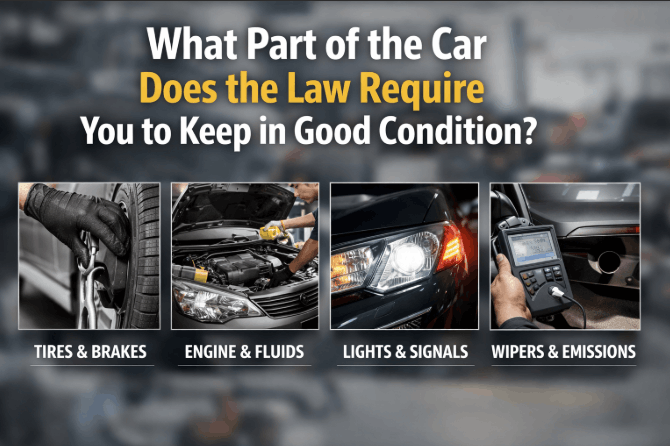
What Part of the Car Does the Law Require You to Keep in Good Condition: Tyres, Brakes, Lights and Your Full Legal Obligation in the UK
This guide draws on current DVSA guidance and the Road Vehicles (Construction and Use) Regulations 1986, reviewed May 2026.
UK law requires drivers to keep their tyres, brakes, and lights in good condition at all times, these are the three components most directly cited in the Highway Code and the UK driving theory test. Beyond those three, the Road Vehicles (Construction and Use) Regulations 1986 extend the legal obligation to windscreens, mirrors, seat belts, steering systems, and number plates.
Every driver is personally accountable for their vehicle’s roadworthiness each time it is used on a public road. Failing to meet these standards can result in fines, penalty points, prosecution, and an invalidated insurance policy.
Key Takeaways
- UK law requires tyres, brakes, and lights to be kept in good condition; these are the three parts most commonly cited in the driving theory test.
- The Road Vehicles (Construction and Use) Regulations 1986 extend legal obligations to windscreens, mirrors, seat belts, steering, and number plates.
- A valid MOT certificate does not guarantee that a vehicle is legally roadworthy throughout the year; defects can develop at any point.
- Driving an unroadworthy vehicle can invalidate motor insurance, result in a fine of up to £2,500 per defective tyre, and carry penalty points on a licence.
What Part of the Car Does the Law Require You to Keep in Good Condition?
UK law requires drivers to maintain multiple vehicle components in safe working order at all times. The primary legislative basis is the Road Vehicles (Construction and Use) Regulations 1986, which sets binding standards for every vehicle used on public roads in the United Kingdom.
The components legally required to be kept in good condition include:
- Tyres: correct tread depth, no cuts, bulges, or exposed cord
- Brakes: fully functional, including the handbrake
- Lights: all exterior lights operational, including headlights, brake lights, indicators, and fog lights
- Windscreen and wipers: free from obstructive damage; wipers must clear the screen effectively
- Mirrors: a minimum of two mirrors providing adequate rearward vision
- Seat belts: all belts fitted to the vehicle must be in good working order
- Steering: must be precise, responsive, and free from excessive play
- Number plates: clearly legible and properly illuminated at night
According to the Driver and Vehicle Standards Agency (DVSA), a vehicle that does not meet these standards is not considered roadworthy and must not be driven on a public road, regardless of whether it holds a current MOT certificate.
Which Three Parts Does the Law Require You to Keep in Good Condition?
The three parts of the car that the law most directly requires drivers to keep in good condition are tyres, brakes, and lights. This is the answer referenced in the UK driving theory test and reflected in the Highway Code.
These three components are prioritised because faults in any one of them directly and immediately compromise the safety of the driver, passengers, and other road users.
Tyres are the only point of contact between a vehicle and the road surface. Brakes are the primary mechanism for controlling speed and stopping in an emergency. Lights determine both a driver’s visibility and the vehicle’s visibility to others, particularly critical in low-light conditions, adverse weather, and on unlit roads.
The theory test question focuses on these three because they represent the components most frequently associated with road traffic accidents caused by vehicle defects. However, passing the theory test with this answer does not mean a driver’s legal obligations end there.
The broader statutory framework covers significantly more of the vehicle, a distinction covered in full in the section below.
Does Passing an MOT Mean Your Car Is Legally Roadworthy All Year?
No. A valid MOT certificate confirms only that a vehicle met the required safety and emissions standards on the specific date it was tested. It provides no guarantee of roadworthiness on any subsequent day.
The DVSA introduced a tiered defect classification system in May 2018. Every MOT outcome now categorises faults as one of the following:
- Dangerous: An immediate risk to road safety; the vehicle must not be driven
- Major: A significant defect that must be repaired before the vehicle is used on the road
- Minor: A defect that does not significantly affect safety but should be repaired
- Advisory: A condition to monitor that may develop into a more serious defect
A vehicle can pass its MOT with minor advisories noted. If those advisories deteriorate into dangerous or major defects in the weeks or months following the test, the vehicle becomes illegal to drive, despite holding a valid certificate. The driver bears full legal responsibility for identifying and addressing those faults.
Key Fact: A current MOT certificate is not a legal defence for driving a vehicle with a known defect. The Road Traffic Act 1988 places the duty of roadworthiness on the driver at all times.
Common Myths About Car Condition Laws
| Myth | Reality |
|---|---|
| A valid MOT means the car is legal to drive all year | An MOT confirms roadworthiness only on the test date. Defects developing afterwards make the vehicle illegal immediately. |
| Only tyres and brakes matter legally | UK law under the Construction and Use Regulations 1986 covers tyres, brakes, lights, mirrors, windscreen, seat belts, steering, and number plates. |
| A small crack in the windscreen is always legal | A crack in the driver’s line of vision, specifically in Zone A of the windscreen, is a Major MOT defect and makes the vehicle unroadworthy. |
| You only need to check tyre tread before an MOT | Tyres must meet the 1.6mm minimum tread depth standard every time the vehicle is driven. |
| Driving with one faulty indicator is a minor issue | A non-functioning indicator is a recordable defect and can result in a fixed penalty notice and three penalty points. |
| Seat belts only need to work for the driver | All seat belts fitted to the vehicle must be fully functional regardless of whether the seat is occupied. |
What Are the Legal Standards for Tyres, Brakes, and Lights in the UK?
Each of the three primary legally required components carries a specific enforceable standard under UK law. Each component carries a specific, enforceable standard, not a general expectation of upkeep.
Tyres
The minimum legal tread depth is 1.6mm across the central three-quarters of the tyre’s breadth and around the entire circumference. This requirement is set by Regulation 27 of the Road Vehicles (Construction and Use) Regulations 1986.
Tyres must also be free from cuts, lumps, bulges, or any exposure of the ply or cord structure. Each defective tyre carries a separate penalty, meaning four illegal tyres can result in four separate fines.
Brakes
The braking system must be maintained in good and efficient working order. The service brake and the secondary brake (handbrake) are both subject to legal standards.
The DVSA tests braking efficiency during MOT assessments using a brake performance measurement; the vehicle must meet minimum efficiency thresholds for both axles.
Lights
All obligatory lamps must be kept clean, correctly aligned, and fully operational. This includes headlights, rear lights, brake lights, front and rear indicators, hazard lights, reversing lights, number plate lights, and rear fog lights.
A single non-functioning brake light is sufficient to constitute a recordable defect under the Construction and Use Regulations.
Under the Road Vehicles (Construction and Use) Regulations 1986, the minimum legal tyre tread depth in the UK is 1.6mm across the central three-quarters of the tyre. Each tyre below this threshold is a separate offence.
Defective brakes and non-functioning lights are equally enforceable defects, each carrying fixed penalties, points, and potential prosecution.
What Happens If You Drive a Vehicle in Poor Condition in the UK?
UK Legal Requirements and Penalties by Vehicle Component
| Component | Legal Standard | Potential Penalty |
|---|---|---|
| Tyres | 1.6mm minimum tread depth; no structural damage | Up to £2,500 fine + 3 penalty points per tyre |
| Brakes | Fully functional service and secondary brake | Fine + penalty points; prosecution for dangerous driving if an accident occurs |
| Lights | All obligatory lamps clean, aligned, and operational | Fixed penalty notice + 3 penalty points |
| Windscreen | No damage in the driver’s line of vision (Zone A) | Fine; MOT Major defect |
| Seat Belts | All fitted belts in full working order | £500 fine per defective belt |
| Mirrors | Minimum two mirrors providing adequate rear vision | Fixed penalty notice |
| Steering | Precise and responsive; no excessive play | Prosecution; potential dangerous driving charge |
The consequences extend beyond the penalties listed above. Driving a vehicle with known defects can invalidate a motor insurance policy entirely.
If an accident occurs involving an unroadworthy vehicle, an insurer may refuse to pay out, leaving the driver personally liable for all damages, costs, and compensation claims. For commercial drivers, a vehicle defect conviction can also affect a professional driving licence.
How to Keep Your Car Legally Roadworthy Between MOTs?
Keeping a vehicle roadworthy is an ongoing responsibility, not something that resets once a year at MOT time. These steps keep a vehicle compliant with UK law throughout the year.
- Check tyres weekly: Measure tread depth with a gauge and inspect sidewalls visually for cuts, bulges, or embedded objects. Replace any tyre approaching 2mm depth before it reaches the legal minimum.
- Test all lights before every journey in low visibility: Walk around the vehicle and confirm that headlights, brake lights, indicators, and fog lights are functioning. Carry spare bulbs for common lamp types.
- Test the brakes at low speed in a safe area: If the vehicle pulls to one side, takes longer than usual to stop, or the pedal feels soft, have the brakes inspected immediately.
- Inspect the windscreen for new chips or cracks: Chips smaller than 10mm outside the driver’s line of vision can often be repaired. Any damage in Zone A (a 290mm wide band directly in front of the driver) requires immediate replacement.
- Check all mirrors are secure, clean, and correctly adjusted: A loose or cracked mirror can constitute a defect under the Construction and Use Regulations.
- Test seat belts for smooth retraction and secure latching: A belt that does not lock under sharp deceleration is defective and illegal.

Conclusion
UK law requires tyres, brakes, and lights as a minimum, but the Road Vehicles (Construction and Use) Regulations 1986 covers the full vehicle. The most common misconception is that holding a valid MOT certificate means a vehicle is legally roadworthy for the year ahead; under UK law, that is not the case.
DVSA guidance is clear: roadworthiness is the driver’s personal responsibility on every journey. Check GOV.UK for current vehicle standards and MOT requirements. Keeping a car in a legally required condition means ongoing accountability, not annual compliance, for every driver on UK roads in 2026.
Sources: Road Traffic Act 1988 | Road Vehicles (Construction and Use) Regulations 1986 | DVSA MOT inspection manual | Highway Code Rules 89–90 | GOV.UK vehicle roadworthiness guidance.
FAQ
What part of the car does the law require you to keep in good condition?
UK law requires drivers to keep tyres, brakes, and lights in good condition, the three components cited in the theory test and Highway Code. The Road Vehicles (Construction and Use) Regulations 1986 extends this to windscreens, mirrors, seat belts, steering, and number plates. Every component must meet its required standard on every journey.
Is it illegal to drive with a cracked windscreen in the UK?
Yes, depending on the location of the damage. A crack within Zone A, the 290mm band directly in front of the driver, is a Major MOT defect and makes the vehicle unroadworthy. Damage outside that zone may be acceptable if it does not obstruct vision, but any crack exceeding 40mm anywhere on the screen is likely an MOT failure.
What is the minimum tyre tread depth required by law in the UK?
The legal minimum is 1.6mm across the central three-quarters of the tread, set by Regulation 27 of the Road Vehicles (Construction and Use) Regulations 1986. Each tyre below this threshold carries a fine of up to £2,500 and three penalty points. Check GOV.UK for current enforcement guidance.
Can you drive a car that has failed its MOT?
Not if it received a Dangerous defect classification, driving from the test centre in that case is a criminal offence. A Major defect result also prohibits use until repaired. If only the MOT certificate has expired, the vehicle may be driven directly to a pre-booked test appointment by the most direct route only.
Does the law require you to wear a seat belt at all times?
Yes, with narrow exemptions. The Road Traffic Act 1988 requires all occupants to wear a seat belt where one is fitted. Drivers are legally responsible for passengers under 14. Exemptions exist for specific medical conditions and defined professional activities. Failure to comply carries a fine of up to £500.
What are the penalties for driving with defective lights in the UK?
Defective lights, including a single non-functioning brake light or indicator, can result in a fixed penalty notice and three penalty points. If the defect contributed to an accident, careless or dangerous driving charges may follow. Police can issue an immediate prohibition notice preventing the vehicle from being driven until the fault is fixed.
Does having a valid MOT mean your car is road legal?
No. An MOT confirms the vehicle meets legal standards only on the test date. Defects developing afterwards, tyre wear, bulb failure, brake deterioration, make the vehicle unroadworthy immediately.
According to DVSA guidance, the driver is legally responsible for the vehicle’s condition on every journey, not solely at the point of annual testing. For current MOT standards, test requirements, and vehicle compliance guidance, visit GOV.UK.
What does the Highway Code say about vehicle maintenance?
The Highway Code requires drivers to ensure their vehicle is roadworthy before every journey. Rule 89 specifically references tyres, lights, brakes, and other safety-critical components. Poorly maintained vehicles endanger drivers, passengers, and other road users. Checking the manufacturer’s service schedule alongside MOT dates helps catch wear on brakes, tyres, and fluid levels before they become defects.
Disclaimer: This article is for informational purposes only and does not constitute legal advice. Always consult the official DVSA guidance at GOV.UK or seek qualified legal counsel for advice specific to your circumstances.