
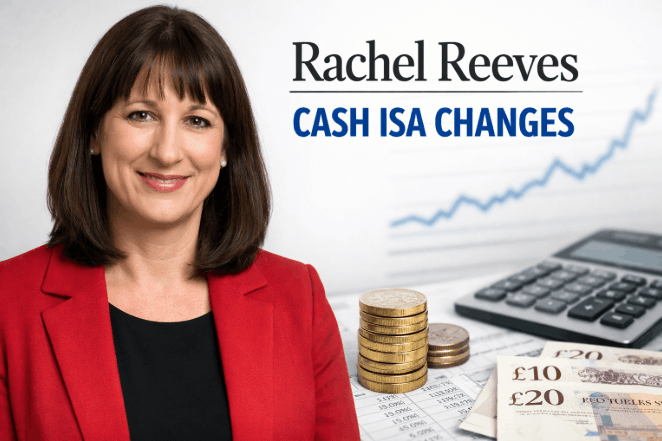
Rachel Reeves Cash ISA Changes: Cut To £12,000, Over-65 Exemptions, And The New 22% Levy
The Rachel Reeves cash ISA changes, announced in the Autumn Budget 2025, reduce the annual cash ISA limit for savers under 65 from £20,000 to £12,000 from 6 April 2027. Savers aged 65 and over retain the full £20,000 cash allowance.
The overall ISA allowance remains unchanged at £20,000. Three anti-circumvention rules accompany the limit cut, though not all have been legislated as of June 2026.
Key Takeaways
- From 6 April 2027, the cash ISA limit for under-65s drops from £20,000 to £12,000, confirmed in HMRC Tax-Free Savings Newsletter 19.
- The overall ISA allowance remains at £20,000, the remaining £8,000 can be directed into a Stocks and Shares ISA or Innovative Finance ISA.
- Savers aged 65 and over are fully exempt and retain the £20,000 cash ISA allowance without restriction.
What Are the Rachel Reeves Cash ISA Changes?
The Rachel Reeves cash ISA changes confirm a permanent reduction to the annual cash ISA subscription limit for under-65s, effective from the start of the 2027/28 tax year.
The reform was announced on 26 November 2025 as part of the Autumn Budget 2025 and formally documented in paragraph 4.228 of the HM Treasury Budget document and HMRC Tax-Free Savings Newsletter 19, the authoritative primary source for ISA rule changes.
According to HMRC Tax-Free Savings Newsletter 19, the annual cash ISA limit for savers under 65 will be set at £12,000 from 6 April 2027, within an overall ISA allowance that remains at £20,000.
This is a reduction of £8,000 from the current position, where savers of all ages can place their full £20,000 ISA allowance into cash. Crucially, existing cash ISA balances are unaffected, the reduction applies only to new contributions from April 2027 onwards.
Three anti-circumvention rules accompany the allowance cut, designed to prevent savers from routing cash savings through other ISA types to sidestep the new limit.
What Is the New Cash ISA Limit from April 2027?
From 6 April 2027, the cash ISA limit for savers under 65 is £12,000, down from the current £20,000.
The overall annual ISA allowance remains at £20,000, meaning the £8,000 difference can be allocated to a Stocks and Shares ISA, Innovative Finance ISA, or split across both.
The Office for Budget Responsibility projects that this change will affect millions of the UK’s estimated 22 million active ISA holders.
ISA Allowance: Before and After April 2027
| ISA Type | 2025/26, All Ages | 2027/28, Under 65 | 2027/28, Age 65+ |
|---|---|---|---|
| Cash ISA | £20,000 | £12,000 | £20,000 |
| Stocks and Shares ISA | £20,000 | £20,000 | £20,000 |
| Innovative Finance ISA | £20,000 | £20,000 | £20,000 |
| Overall ISA allowance | £20,000 | £20,000 | £20,000 |
The £12,000 cash ISA limit sits within the £20,000 overall allowance, it does not add to it. Figures confirmed as of June 2026 via HMRC Tax-Free Savings Newsletter 19.
The £8,000 gap is the most consequential figure for savers to understand.
Under-65s who currently use their full £20,000 ISA allowance in cash will face a binary decision from April 2027: accept a reduced tax-free cash position or allocate the surplus to an investment ISA, which carries market risk most cash savers have actively chosen to avoid.
Are Over-65s Exempt from the Cash ISA Limit Cut?
Savers aged 65 and over on 6 April 2027 are fully exempt from the cash ISA allowance reduction.
HMRC Tax-Free Savings Newsletter 19 confirms that the £20,000 annual cash ISA limit is retained in full for this age group, and the anti-circumvention rules, including the transfer ban, do not apply to them.
The over-65 exemption was a direct outcome of lobbying by the Building Societies Association and advocacy from consumer finance figures, including MoneySavingExpert’s Martin Lewis, who publicly called for age-based protection during the Budget consultation period.
The exemption covers new contributions and transfers. Savers who turn 65 during the 2027/28 tax year sit in a different position, the age threshold is assessed at the point of contribution, so providers should be contacted directly to confirm eligibility before subscribing.
- Savers who reach age 65 on or before 6 April 2027 retain the full £20,000 annual cash ISA subscription limit, no age-based sub-limit applies to this group
- Existing cash ISA balances are protected for all savers, regardless of age, no retrospective limit applies to money already saved
- Over-65s are not subject to the transfer ban from Stocks and Shares ISAs into cash ISAs
- The Lifetime ISA (LISA) is unaffected by these changes, the £4,000 annual LISA limit and its withdrawal rules remain in place for eligible savers
For a full breakdown of how the allowance reduction is structured across all ISA types, the UK cash ISA allowance reduction page covers the broader policy context.
The Anti-Circumvention Rules: Transfer Ban and the 22% Charge
HMRC confirmed three anti-circumvention rules in Tax-Free Savings Newsletter 19, each designed to prevent under-65s from maintaining effective cash ISA access beyond the £12,000 limit.
These rules are structured as a package, removing one without the others would leave an obvious route to bypass the allowance cap.
- Transfer ban: From 6 April 2027, transfers from Stocks and Shares ISAs and Innovative Finance ISAs into cash ISAs are prohibited for savers under 65. Transfers from cash ISAs into Stocks and Shares ISAs remain permitted in both directions for over-65s.
- Cash-like investment test: HMRC will apply tests to determine whether assets held in a Stocks and Shares ISA constitute genuine investments or function as cash equivalents. Holdings such as money market funds, short-dated instruments offering near-cash returns, may be reclassified as non-qualifying assets under this test.
- Charge on cash interest in Stocks and Shares ISAs: Interest earned on cash held within a Stocks and Shares ISA or Innovative Finance ISA will be subject to a tax charge from April 2027. The proposed rate is 22%, aligning with the savings income basic rate rising across all tax bands in April 2027, mirroring the pre-2014 regime, when a 20% charge applied to idle cash in investment ISAs before George Osborne abolished it.
The transfer ban is confirmed. The legislative status of rules 2 and 3 is addressed in the section below. The mechanics of the proposed rate and its impact on investors are covered in detail on the Rachel Reeves investment ISA levy.
Which of These Rules Are Actually Confirmed?
Not all the Rachel Reeves cash ISA changes carry the same legislative status, and the difference between what is confirmed and what remains under consultation matters considerably for savers making decisions now.
The £12,000 cash ISA allowance cut and the transfer ban from Stocks and Shares ISAs into cash ISAs are confirmed and will proceed from 6 April 2027.
The 22% charge on interest earned from cash held within Stocks and Shares ISAs and the cash-like investment tests are subject to active HMRC consultation and have not been legislated as of June 2026.
The 22% charge has already hit a significant implementation obstacle.
In May 2026, wealth managers identified a mechanism, widely reported as the 1p loophole, under which purchasing a nominal equity holding of one penny within a Stocks and Shares ISA would technically satisfy the draft legislation’s definition of an active investment account, bypassing the charge entirely.
HM Treasury formally paused publication of the draft rules following the discovery. HM Treasury confirmed in a statement that it is working at pace with industry on the detailed rules and will update on next steps in due course.
AJ Bell data, sourced via an HMRC Freedom of Information request, estimated that 2.64 million savers could face tax on savings interest without a cash ISA wrapper, a figure HM Treasury has cited in justifying the pace of the anti-circumvention legislation.
Savers holding uninvested cash in a Stocks and Shares ISA face no confirmed additional tax charge beyond April 2027 under current draft legislation, though that position will be revisited once final rules are published.
What Should Savers Do Before April 2027?
Two full tax years remain before the cash ISA limit drops for under-65s. The 2025/26 and 2026/27 allowances operate entirely under current rules, no cash sub-limit applies until April 2027.
Two tax years at the full £20,000 rate is a meaningful window, and it closes permanently on 5 April 2027.
- Use the full £20,000 cash ISA allowance in 2025/26 and 2026/27: Both tax years permit cash ISA contributions up to £20,000 with no restriction. The window to build tax-free cash savings at the full rate closes at midnight on 5 April 2027.
- Review any uninvested cash sitting in a Stocks and Shares ISA: Once the final 22% charge legislation is published, this cash may attract a tax charge on interest earned. Monitor HMRC newsletters for the confirmed rate, scope, and effective date.
- Complete any planned transfers from a Stocks and Shares ISA into a cash ISA before the deadline: This transfer route is blocked for under-65s from 6 April 2027. Any saver intending to derisk by moving funds into cash should act before that date.
- Confirm age eligibility: Savers who reach age 65 on or before 6 April 2027 are exempt from the £12,000 limit and the transfer ban. Providers may require confirmation of date of birth at the point of subscription.
Savers splitting their allowance across multiple ISA types should check how many ISAs can I have for the current rules on holding multiple ISAs within the same tax year.
Why Is Rachel Reeves Cutting the Cash ISA Allowance?
HM Treasury’s stated rationale is to redirect UK retail savings from cash into equities, framing the current ISA structure as a drag on investment and economic growth.
During the Budget speech, Rachel Reeves cited the UK’s position as having some of the lowest levels of retail investment in the G7 as the central justification, with the Office for Budget Responsibility projecting that the change will generate a measurable increase in retail investment flows, though the timeline for that effect remains uncertain.
Bank of England Money and Credit data shows £57bn was subscribed into cash ISAs during 2025 alone, with December recording £5.2bn, a record for a non-tax-year-end month, driven largely by savers acting ahead of the Budget announcement.
Between 2021/22 and 2023/24, money flowing into Stocks and Shares ISAs fell by 9%, while cash ISA inflows more than doubled.
- HM Treasury’s position: Cash ISAs divert savings from investment; equities have historically outperformed cash over the long term, and the reform will make savers better off
- Building Societies Association’s concern: The cap disproportionately affects lower and middle-income savers who use cash ISAs for security and emergency access, not long-term growth, the BSA’s lobbying is credited with raising the limit from an original reported proposal of £10,000 to the confirmed £12,000
- OBR projection: The change is forecast to increase retail investment flows, though behavioural uptake timelines remain uncertain in official modelling
- Paragon Bank polling (1,400 cash ISA savers): The majority of respondents said they would not move into stocks and shares ISAs, they would switch to regular savings accounts, potentially increasing their income tax exposure on savings interest rather than driving investment as intended
Conclusion
The Rachel Reeves cash ISA changes confirmed for April 2027 are partly legislated and partly unresolved. The £12,000 limit and the transfer ban are proceeding. The 22% charge on cash held in Stocks and Shares ISAs remains subject to active consultation.
For under-65s, the 2025/26 and 2026/27 tax years represent the last opportunity to contribute at the full £20,000 rate.
FAQ
Is the cash ISA being abolished entirely?
No. The cash ISA remains a fully operational tax-free savings account. The Rachel Reeves cash ISA changes reduce the annual subscription limit for under-65s to £12,000 from April 2027, they do not abolish the product. Over-65s retain the full £20,000 annual cash ISA allowance without restriction.
What happens to money already saved in a cash ISA after April 2027?
Existing balances are fully protected. The £12,000 limit applies only to new contributions made from 6 April 2027 onwards. Savers with existing cash ISA balances, of any size, face no retrospective reduction, and those funds remain in the tax-free ISA wrapper.
Can savers under 65 still transfer from a cash ISA into a Stocks and Shares ISA?
Yes. Transfers from a cash ISA into a Stocks and Shares ISA remain permitted for savers of all ages. The transfer ban confirmed in the anti-circumvention rules runs in one direction only, it blocks transfers from Stocks and Shares ISAs and Innovative Finance ISAs into cash ISAs for under-65s from 6 April 2027.
What is the Personal Savings Allowance and how does it interact with cash ISAs?
The Personal Savings Allowance (PSA) allows basic rate taxpayers to earn up to £1,000 in savings interest annually without paying income tax, and higher rate taxpayers up to £500. A cash ISA sits outside the PSA entirely, interest earned within a cash ISA wrapper is tax-free regardless of the PSA limit. For savers whose savings interest exceeds their PSA, the cash ISA remains the most direct route to tax-free interest income.
Will the cash ISA changes affect Junior ISAs or Lifetime ISAs?
No. HMRC Tax-Free Savings Newsletter 19 confirms the Junior ISA annual limit remains at £9,000 and the Lifetime ISA (LISA) limit at £4,000, both unchanged until at least April 2031. The £12,000 cash sub-limit applies exclusively to adult cash ISAs held by savers under 65.
Disclaimer: The information provided in this article is for educational and informational purposes only, based on legislative rules as of June 2026 and should not be construed as professional financial or legal tax advice; readers should consult a qualified independent financial adviser before making any investment or savings decisions.