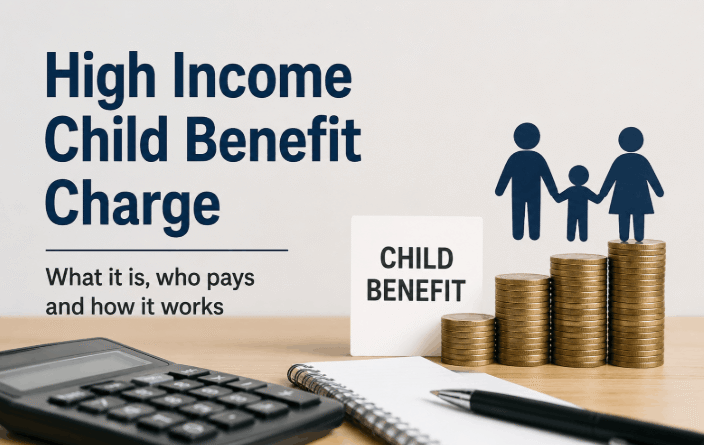
High Income Child Benefit Charge 2026/27: Rates, Threshold and How to Reduce It
The high income child benefit charge is a UK tax charge that claws back some or all of a family’s Child Benefit once one partner’s adjusted net income passes £60,000 a year, rising to a full repayment at £80,000.
For the 2026/27 tax year, HMRC collects this charge through Self Assessment or PAYE.
Key Takeaways
- The high income child benefit charge applies once an individual’s adjusted net income exceeds £60,000, with Child Benefit fully withdrawn at £80,000 under 2026/27 rules.
- The government cancelled plans to base the charge on household income at the Autumn Budget on 30 October 2024, so individual income rules remain in place for 2026/27.
- Increasing pension contributions can reduce adjusted net income below £60,000, cutting or eliminating the charge entirely.
What Is the High Income Child Benefit Charge?
The high income child benefit charge, known as HICBC, is the mechanism HMRC uses to claw back Child Benefit from higher earning households through the tax system, rather than restricting eligibility upfront.
The charge is based on adjusted net income, not gross salary.
Adjusted net income is total taxable income, including savings interest and dividends, reduced by pension contributions and Gift Aid donations before Personal Allowances apply.
According to HMRC, this figure determines whether an individual sits above the £60,000 starting threshold for 2026/27.
Unlike most tax charges, HICBC does not stop Child Benefit payments arriving.
A family keeps receiving the money every four weeks; the charge is then repaid afterwards through Self Assessment or PAYE, which separates everyday cash flow from the eventual tax bill.

Who Has to Pay the High Income Child Benefit Charge?
The charge always falls on the partner with the higher income in a household, regardless of who submitted the Child Benefit claim or whose child the payments are for.
HMRC defines a partner for this purpose as someone who is:
- Married to the claimant or in a civil partnership with them
- Living with the claimant as if married or in a civil partnership
- Not permanently separated from the claimant
The legal basis for this individual income test sits in ITEPA 2003, so household circumstances alone do not determine who is liable.
This produces some sharp inconsistencies: a single parent earning £80,000 loses their entire Child Benefit, while two partners each earning £59,000, with a combined household income of £118,000, keep every penny.
Couples who want certainty should check their own adjusted net income separately, since it is entirely possible for a lower earner to be the Child Benefit claimant while their partner carries the tax liability.
High Income Child Benefit Charge Rates and Thresholds for 2026/27
For the 2026/27 tax year, Child Benefit rates rose to £27.05 a week for an eldest or only child and £17.90 for each additional child, a 3.8% increase confirmed by HM Treasury in line with the September 2025 Consumer Prices Index figure.
The Tax Credits Act 2002 places HM Treasury under a statutory duty to review these rates annually.
The high income child benefit charge threshold has not moved since April 2024, so the increase in Child Benefit itself does not change who is liable, only how much is at stake.
| Detail | 2026/27 figure |
|---|---|
| Eldest or only child | £27.05 a week |
| Each additional child | £17.90 a week |
| Charge starting threshold | £60,000 adjusted net income |
| Full withdrawal threshold | £80,000 adjusted net income |
| Taper rate | 1% of Child Benefit per £200 over £60,000 |
A family with one child and a higher earner on £70,000 would repay roughly £703 of their £1,406.60 annual Child Benefit for 2026/27, using this taper.
Anyone unsure of their own figures can check the exact amount owed using HMRC’s Child Benefit tax calculator.

Why Was the Household Income Reform to HICBC Scrapped?
Yes, the plan to base the high income child benefit charge on household income rather than individual income was cancelled at the Autumn Budget on 30 October 2024, and it remains cancelled for the 2026/27 tax year.
Widely circulated claim: Some guidance still in circulation states that HICBC will move to a household income basis from April 2026.
Correct position: The government confirmed at Autumn Budget 2024 that this reform would not proceed because implementing it was forecast to cost around £1.4 billion by 2029/30.
Source: House of Commons Library research briefing CBP-8631 and HM Treasury’s Autumn Budget 2024 policy document.
The household income basis for the high income child benefit charge, first proposed at Spring Budget 2024, was formally dropped six months later.
HMRC has proposed no further design changes to HICBC since that decision, meaning the individual income test remains the operating rule through 2026/27 and beyond.
Older guidance suggesting a household based system starts in April 2026 is now out of date.
How Do You Pay the High Income Child Benefit Charge?
You can pay the high income child benefit charge in one of two ways, through PAYE or through a Self Assessment tax return, and since September 2025 more people qualify for the simpler option.
- Check whether you already file Self Assessment for another reason, such as self employment or savings income over £10,000. If so, you must declare HICBC on that return.
- If HICBC is your only reason to file, register for HMRC’s PAYE collection service instead, which adjusts your tax code so the charge is taken automatically from your salary.
- Pay by 31 January following the end of the tax year if you’re using Self Assessment, or let the tax code adjustment spread the cost across the following year if you’re using PAYE.
- Contact HMRC directly if you need to switch from Self Assessment to PAYE, since this change has to be requested rather than happening automatically.
Missing the registration deadline can trigger separate failure to notify penalties on top of the charge itself.
How Can You Reduce the High Income Child Benefit Charge Legally?
You can reduce or eliminate the high income child benefit charge by lowering your adjusted net income below £60,000, and pension contributions are the most direct way to do this.
- Increase personal pension contributions. Money paid into a workplace or personal pension reduces adjusted net income pound for pound, so a higher earner on £65,000 contributing £5,000 could bring their income to £60,000 and remove the charge entirely.
- Make Gift Aid donations. Charitable giving under Gift Aid is grossed up and deducted from adjusted net income in the same way as pension contributions.
- Use salary sacrifice where an employer offers it, since sacrificed pay reduces gross salary before the adjusted net income calculation even begins.
- Elect to opt out of Child Benefit payments if income sits well above £80,000 and reducing it isn’t realistic, while still registering to protect National Insurance credits.
According to LITRG, both partners’ adjusted net income is worth checking every year, since a bonus or pay rise can push a previously unaffected household over the threshold without warning.
HMRC’s calculator can also confirm whether a specific pension contribution brings adjusted net income below the threshold entirely.
What Happens If Your Circumstances Change?
If your income falls, you’re made redundant, or you separate from a partner, your liability for the high income child benefit charge can change from one tax year to the next.
A genuine drop in household income, for example after redundancy or reduced hours, can also open up wider parts of the support system that weren’t previously relevant, including the Universal Credit child element for families whose earnings have fallen enough to qualify.
If you previously opted out of Child Benefit payments because of the charge, you can restart them at any point your income drops, and in some cases request up to two previous tax years’ payments to be reinstated by contacting the Child Benefit office directly.
Which Children Qualify for Child Benefit?
Child Benefit eligibility extends further than many parents expect, and you can claim for any child you’re responsible for raising.
A child qualifies if they are:
- Under 16, with no other conditions attached
- Aged 16 to 19 and in approved full time education or training
- Not your biological child, provided you’re the one responsible for their upkeep
There’s no limit on how many children you can claim, and the person claiming doesn’t need to be a parent. Guardians, foster carers, and other relatives raising a child can all apply.
Families raising a child with additional needs may find the disabled child element of Universal Credit relevant too, since it sits alongside Child Benefit rather than replacing it, and eligibility for one doesn’t affect the other.
Common Myths About the High Income Child Benefit Charge
Several persistent myths about the high income child benefit charge continue to circulate, and some directly contradict how HMRC applies the rules.
| Myth | Reality |
|---|---|
| Only single parents are hit unfairly | A single higher earner on £80,000+ loses everything, while two earners on £59,000 each keep it all, so any solo higher earner faces the same issue, not just single parents |
| You get nothing back above £80,000 | National Insurance credits and a child’s automatic NI number are protected even when 100% of the cash is repaid |
| Only the Child Benefit claimant is liable | The charge always falls on the higher earner, even if their partner made the claim |
| The charge stops Child Benefit payments | Payments continue as normal; the charge is repaid separately afterwards |
| Self Assessment registration is always required | Since September 2025, many people can pay through PAYE instead |
Confusion between these points is a common reason taxpayers get caught out by HMRC’s failure to notify penalties.
When Did the High Income Child Benefit Charge Start?
The high income child benefit charge started on 7 January 2013, introduced under the Finance Act 2012 as a way of recovering Child Benefit from higher income households through the tax system.
The original threshold was £50,000, with Child Benefit fully withdrawn at £60,000.
This stayed unchanged for over a decade, meaning wage growth alone pulled increasing numbers of taxpayers into the charge each year without any policy change.
At Spring Budget 2024, the then Chancellor raised the threshold to £60,000 and halved the taper, moving full withdrawal to £80,000 from 6 April 2024.
These are the figures still in force for 2026/27, since the household income reform proposed alongside them was later cancelled.

Conclusion
For 2026/27, the high income child benefit charge remains an individual income test triggered at £60,000 and fully applied at £80,000, with the household basis reform confirmed dead rather than delayed.
Pension contributions and PAYE registration remain the most practical tools for managing it. High income child benefit charge means a real but manageable tax cost for higher earning parents in 2026/27.
FAQ
How much is the high income child benefit charge?
The charge equals 1% of Child Benefit received for every £200 of adjusted net income above £60,000, reaching 100% at £80,000. A family with one child on £70,000 would repay around £703 of their £1,406.60 annual Child Benefit in 2026/27.
Can you reduce the high income child benefit charge legally?
Yes. Increasing pension contributions, making Gift Aid donations, or using salary sacrifice can all lower adjusted net income below £60,000, reducing or removing the charge entirely.
Is it worth claiming Child Benefit if you earn over £60,000?
Yes. Claiming protects National Insurance credits toward the State Pension and secures a child’s automatic National Insurance number at 16, even if some or all of the payment is later repaid through the charge.
Is the high income child benefit charge based on household income?
No. The charge is still assessed on individual income, not combined household income, since the planned reform to change this was cancelled at the Autumn Budget 2024.
This article is for general information only and is not financial or tax advice, consult HMRC or a qualified adviser for guidance on your own circumstances.