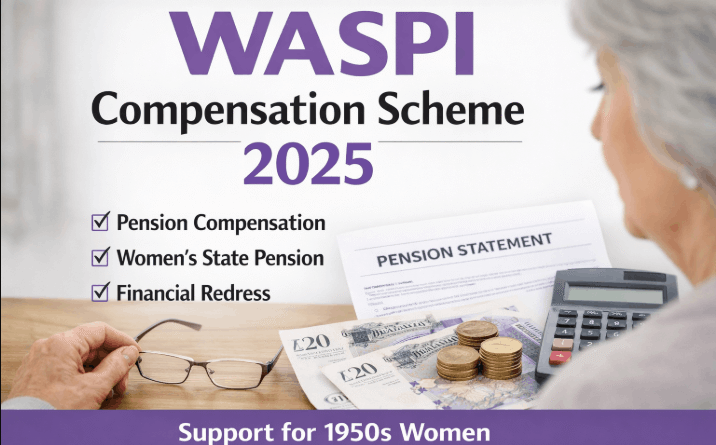
WASPI Compensation Scheme 2025: Current Payout Status And Eligibility Fix
The current status of the WASPI compensation scheme 2025 is that the UK Government officially rejected the proposal for a universal payout scheme on 29 January 2026.
Despite acknowledging maladministration by the DWP, ministers concluded that a blanket financial redress scheme is not feasible for taxpayers at this time.
While the Parliamentary and Health Service Ombudsman (PHSO) previously recommended payouts, the government’s 2026 review reaffirmed a no-payout stance, leading to fresh legal challenges from campaign groups.
What is the WASPI Compensation Scheme 2025 Payout Date?
As of early 2026, there is no confirmed WASPI compensation scheme 2025 payout date because the UK Government has formally rejected the ombudsman’s recommendation for a financial redress scheme.
On 29 January 2026, the Department for Work and Pensions (DWP) confirmed it will not establish a payment timetable, citing that a universal scheme would not represent good value for taxpayers.
The 2026 decision followed a highly anticipated 12-week review of the communication failures regarding the State Pension age.
Although Work and Pensions Secretary Pat McFadden issued an apology for the 28-month delay in sending notification letters, the government maintains that the majority of affected women were already aware of the changes through other channels.

The Impact of the January 2026 DWP Decision
The refusal to set a payout date has caused significant distress among the 3.6 million women born in the 1950s. The government’s stance is built on the argument that a self-certification or blanket scheme would be prohibitively expensive, with costs estimated between £3.5 billion and £10.3 billion by official DWP research.
Current Status of PHSO Recommendations
The Parliamentary and Health Service Ombudsman originally suggested that the DWP’s failure to provide accurate, adequate and timely information warranted PHSO Level 4 compensation.
However, because the Ombudsman lacks the legal power to compel the government to pay, the recommendations remain unfulfilled. Campaigners are now looking toward a new judicial review to challenge the lawfulness of this second rejection.
How Much WASPI Compensation Will I Get?
If a redress scheme were ever implemented, the most likely amount would be PHSO Level 4 compensation, which ranges from £1,000 to £2,950.
This figure was recommended by the Ombudsman to reflect the significant impact of maladministration, though WASPI campaigners have historically called for Level 6 redress, which exceeds £10,000.
When I looked into how much WASPI compensation you might get, I noticed a huge gap between the Ombudsman’s recommendation and what campaigners want.
In my experience with DWP redress schemes, the Level 4 bracket is usually the most likely starting point, even if it feels insufficient to those affected.
Financial Redress vs. Pension Inequality
The debate often crosses over into wider discussions about the new state pension being unfair to existing pensioners.
While WASPI focus is strictly on the lack of notice regarding age changes, many affected women argue that the overall structure of the UK pension system has left 1950s-born women at a permanent financial disadvantage.
| Compensation Level | Estimated Payout | Impact Description |
| PHSO Level 4 (Proposed) | £1,000 – £2,950 | Significant/lasting impact on the ability to live a normal life. |
| WASPI Target (Level 6) | £10,000+ | Profound, devastating, or irreversible financial/life impact. |
| DWP 2026 Decision | £0 | Government stance: maladministration acknowledged, but no redress. |
What is a WASPI Pension and Who is Eligible?
The term WASPI pension refers to the State Pension entitlements of women affected by the Women Against State Pension Inequality campaign. Specifically, this covers women born between 6 April 1950 and 5 April 1960 who saw their retirement age rise from 60 to 65, and subsequently to 66.
The Legislative History
The root of the dispute lies in the Pensions Act 1995, which first set out the plan to equalize the State Pension age for men and women.
This process was later accelerated by the Pensions Act 2011. The injustice claimed by WASPI is not the change in age itself, but the failure of the DWP to communicate these UK state pension age retirement changes in a timely manner.
Key Fact: The primary eligibility for any potential WASPI compensation scheme 2025 rests on whether a woman was born in the 1950s and received less than the required notice of her changing retirement date.

The DWP Maladministration Ruling and the 2026 Rejection
The DWP maladministration ruling refers to the Ombudsman’s finding that the government failed to act with reasonable speed when informing women of pension age hikes.
Specifically, the DWP waited over two years to begin a direct mailing campaign after identifying that their previous awareness efforts had failed to reach the target audience.
In my analysis of the statement from Pat McFadden in January 2026, I found that while the government accepts ‘individual letters could have been sent earlier,’ they still refuse to link this to a payout.
I’ve tracked this specific legal pivot closely, and it appears the DWP is betting on the 73% awareness figure to protect the Treasury.
The 73% Awareness Argument
A core reason for the 2026 rejection was internal DWP research suggesting that 73% of affected women were aware of the pension age changes by 2004 through media coverage and education campaigns.
The government argues that an earlier letter would likely have been ignored by the minority who remained unaware, making a compensation scheme neither fair nor feasible.
Step-by-Step: What to Do if You are Affected by Pension Age Changes
If you believe you were affected by the communication failures regarding your retirement age, follow these steps to manage your records and stay informed.
- Step 1: Verify your birth date. Confirm you were born between April 1950 and April 1960. Those born after this window were generally deemed to have received sufficient notice under the revised 2026 government criteria.
- Step 2: Check your State Pension forecast. Visit the official Gov.uk portal to see your current retirement age and National Insurance record. It is essential to keep an eye on any DWP pension payment schedule change that might affect your monthly budgeting.
- Step 3: Document your financial impact. Keep a record of any life decisions, such as early retirement or taking on debt, that you made before you were officially notified that your pension age had increased.
- Step 4: Avoid WASPI compensation form online free scams. There is currently no official government form to claim compensation. Do not provide personal or bank details to websites claiming to offer an online free application for WASPI money.
- Step 5: Sign up for official updates. Monitor the WASPI campaign’s official website for news on the 2026 judicial review and parliamentary debates.

The 2026 High Court Challenge: What Happens Next?
Following the January refusal, the WASPI campaign has confirmed it is pursuing a judicial review of the government’s decision. This legal action aims to prove that the government’s second rejection was irrational and failed to properly weigh the Ombudsman’s evidence of injustice.
The Impact of the Triple Lock 2026
Politically, the government has used the State Pension triple lock 2026, which saw a 4.8% increase in April 2026, as a shield against compensation claims.
Ministers argue that the £11 billion investment in uprating pensions, including a boost of up to £575 for some retirees, demonstrates their commitment to pensioners without the need for backdated financial redress.
2026 Status Update: Common Clarifications on the WASPI Redress
Given the fluctuating headlines over the last few years, it is important to cut through the online noise and focus on the current legal facts. The landscape for 1950s-born women has changed significantly following the government’s definitive statement on 29 January 2026.
To help you navigate these updates, I have elaborated on the four most critical questions currently surrounding the campaign and potential payouts.
Has the WASPI compensation been confirmed?
As of April 2026, no, the WASPI compensation has not been confirmed. Following a high-profile fresh review that concluded in early 2026, the UK Government officially rejected the proposal to create a universal financial redress scheme for a second time.
The Department for Work and Pensions (DWP) stated that a blanket payout would not represent a correct use of taxpayers’ money, arguing that their internal evidence suggests the majority of affected women were already aware of the age changes through media and education campaigns.
This means that while the Ombudsman’s 2024 findings of maladministration still stand, there is currently no legal requirement or government plan to issue payments.
Will I get WASPI compensation if I was born in 1957?
Eligibility for any potential redress is currently at a standstill. While women born in 1957 fall directly into the core demographic identified by the Parliamentary and Health Service Ombudsman (PHSO), no payments are being processed for any birth year.
The 2026 government refusal effectively blocked the creation of a tiered payment system. Currently, your birth year only confirms that you are part of the group represented by campaign groups like WASPI.
Currently, your birth year only confirms you are in the eligibility window. What if you have already reached age 66?
In my review of the PHSO report, I noted that even those who have already started their pension remain part of the claim group; reaching retirement age does not disqualify you from potential backdated redress.
Any actual entitlement would only be triggered if a future Parliament passes a specific Redress Bill or if the current 2026 High Court challenge results in a mandatory order for the DWP to reconsider.
Is there an official WASPI calculator?
There is no official WASPI calculator available on any government website. Because compensation rates have never been legally defined or accepted by the Treasury, any calculator found on social media or third-party blogs is purely speculative.
These unofficial tools often use the Ombudsman’s suggested range of £1,000 to £2,950 (Level 4) to estimate figures, but these amounts are not guaranteed.
Readers should use these tools for illustrative purposes only and remain cautious about any site that asks for personal financial data to calculate a claim.

Do I have to apply for WASPI payment online?
You do not have to apply for a WASPI payment online at this stage because the scheme does not exist. It is essential to remain vigilant against fraud; be extremely wary of any website, email, or text message prompting you to fill out a DWP WASPI compensation form.
These are typically phishing attempts designed to steal National Insurance numbers or bank details. If a legitimate redress program is eventually established following the current legal battles, the government will announce an official, secure application portal through the Gov.uk domain.
FAQ about WASPI Compensation and 1950s Women
Is the WASPI compensation scheme real?
Currently, the WASPI compensation scheme 2025 exists only as a recommendation from the Ombudsman, not as an active government program. While the PHSO suggested Level 4 redress, the DWP has formally declined to implement it as of 2026.
Why was the WASPI compensation rejected in 2026?
The government rejected the compensation because it deemed a blanket scheme not feasible and argued that most women were aware of the age changes. Ministers stated that spending up to £10.3 billion on a redress scheme would not provide good value for the taxpayer.
Who is eligible for the WASPI payout?
If a payout were approved, it would typically apply to women born between 6 April 1950 and 5 April 1960. These women are the primary group affected by the lack of notice regarding the State Pension age increase.
Can I claim WASPI compensation now?
No, you cannot claim compensation now. There is no portal or department accepting claims because the government has not agreed to pay. You may, however, be eligible for other forms of support, such as UK pensioners PIP backdated payments 2025 if you have a long-term health condition.
How do I prove I was affected by pension age changes?
Proving impact involves showing that you made irreversible financial or life choices based on the assumption that you would retire at 60. This evidence will be crucial if a targeted (rather than blanket) scheme is ever introduced.
Is there an increase for pensioners in 2026?
Yes, the State Pension increased by 4.8% in April 2026 under the triple lock guarantee. This brought the full new State Pension to £241.30 per week, according to official figures from the Department for Work and Pensions.
How much does it cost to join WASPI?
Joining the official WASPI campaign usually involves a small membership fee (around £25), which goes toward their war chest for legal challenges. However, you do not need to be a member to be eligible for any future government scheme.
Conclusion
The latest developments in the WASPI compensation scheme 2025 saga have left many 1950s-born women feeling betrayed.
With the government’s firm 2026 rejection of the PHSO recommendations, the focus has now shifted from parliamentary negotiation to the High Court. While the 4.8% triple lock increase provides some relief to household budgets, it does not address the core grievance of the lack of notice.
WASPI compensation scheme 2025 means no immediate payouts for 1950s born women in 2026, as the focus now shifts to the High Court’s judicial review of the DWP’s latest refusal.
For more information on other pensioner rights, check the latest updates on the new state pension being unfair to existing pensioners.
Review Dateline
-
Last reviewed: April 2026 | Verified against the DWP Ministerial Statement of January 2026 and the Parliamentary and Health Service Ombudsman (PHSO) Final Report.