
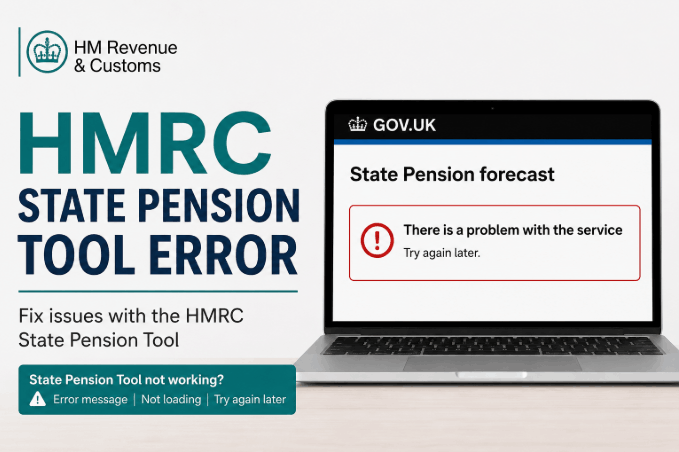
HMRC State Pension Tool Error: How It Affects Your Forecast And Steps To Fix Your Gap
The HMRC state pension tool error refers to a flaw in the Check your State Pension forecast service that overstated entitlements for around 800,000 people who had contracted out of the additional state pension. HM Revenue and Customs corrected the tool on 13 February 2026 after the issue went unfixed for nine years.
Key Takeaways
- HMRC fixed the state pension forecast tool on 13 February 2026, nine years after the error first appeared in February 2016.
- Up to 800,000 people who contracted out of the additional state pension may have received forecasts that were too high.
- The full new state pension is currently £230.25 a week and requires 35 qualifying years of National Insurance contributions.
What Was the HMRC State Pension Tool Error?
The error meant the online forecast tool failed to subtract deductions owed for years spent contracted out of the additional state pension. People were shown figures suggesting they would receive a full pension when their actual entitlement was lower.
HMRC launched the forecast service through GOV.UK in February 2016, shortly before the new state pension system began. The tool was meant to help people plan retirement and decide whether to make voluntary National Insurance contributions.
Instead, the tool overstated pension forecasts for users who had previously contracted out of the additional state pension, leaving them with an inflated sense of security about their future income. Some people retired earlier than they otherwise would have, relying on numbers that did not hold up.

How Many People Were Affected Including in Scotland?
Government estimates put the number of affected users at up to 800,000, though the true figure is not precisely known. HMRC has said it cannot confirm exactly how many people remain affected even after the fix.
Regional coverage, including reporting in Scotland, has highlighted that the error applied UK-wide rather than to one nation specifically. By 2019, around 360,000 people had already received incorrect estimates within the tool’s first three years of operation.
The Department for Work and Pensions works alongside HMRC on state pension administration, and both bodies have acknowledged the scale of the problem without naming every individual affected.
The situation is compounded by the UK state pension age increase, which means a growing number of people approaching retirement will encounter these corrected forecasts for the first time in the years ahead.
What Caused the Error Contracted Out Years Explained?
The fault traces back to the now abolished system that let employees redirect part of their National Insurance contributions into a private or workplace pension instead of the State Earnings Related Pension Scheme, known as SERPS.
- Workers who contracted out paid lower National Insurance contributions toward the additional state pension.
- Their final state pension was meant to reflect a deduction for those years, since some retirement saving had already happened elsewhere.
- The forecast tool never applied this deduction correctly, so contracted out years were effectively ignored in the calculation.
This created a gap between what people were told and what they would actually receive once they reached state pension age.
The broader debate about the new state pension being unfair to existing pensioners is longstanding, and the forecast tool error added a specific, documented dimension to that argument.

When Did HMRC Fix the State Pension Tool Error?
HMRC applied the correction on 13 February 2026 and published an apology the same day. The department asked anyone reaching state pension age after April 2029 to wait until 14 February before checking an updated forecast.
An HMRC spokesperson said the update would ensure customers reaching state pension age after April 2029 receive forecasts that properly account for contracted out years, adding that HMRC was sorry for problems some people experienced with the tool in the past.
The statement followed an investigation by The Telegraph, which brought the scale of the problem to public attention.
State Pension Rates and Qualifying Years at a Glance
These are the figures that matter most if you are trying to work out where you stand. Those approaching 66 and wanting a clearer picture of how much State Pension they will get at 66 should treat these figures as the current baseline following the February 2026 correction.
| Detail | Current Figure |
|---|---|
| Full new state pension | £230.25 per week |
| Qualifying years required for full pension | 35 years |
| Minimum qualifying years to claim anything | 10 years |
| Cost to top up a missing National Insurance year | Up to £907 |
| Date the forecast tool was corrected | 13 February 2026 |
Figures confirmed as of February 2026 via HMRC and GOV.UK.
How to Check If You Were Affected?
Four steps cover the process from start to finish.
- Sign in to your Government Gateway account and open the Check your State Pension forecast service on GOV.UK.
- Compare your current forecast against any figure you were given before 13 February 2026, particularly if you contracted out of the additional state pension at any point.
- If you cannot access the online service, request a forecast by post using the BR19 application form or by contacting the Future Pension Centre.
- Note your National Insurance record and qualifying years shown on the updated forecast, since this determines your final entitlement.
You should treat any forecast received before the February update with caution if you have contracted out years on your record.

What to Do If Your Forecast Was Wrong?
A lower forecast is not necessarily the final figure, there are routes to close the gap.
- Check whether you have gaps in your National Insurance record that voluntary contributions could fill, since this can directly raise your weekly entitlement.
- Contact HMRC to ask whether you qualify for backdated voluntary contributions at the rate that applied when you first received the incorrect forecast. The department has confirmed this is available to those who can demonstrate the error affected them.
- Speak to the Pension Service if you are already receiving your pension and believe the error affected your payments, since separate correction routes apply once payments have started.
Delaying costs more, the price of topping up a missing year rises over time.
Is There an Official HMRC State Pension Tool Error Checker?
There is no dedicated checker built solely for this error. The existing Check your State Pension forecast service on GOV.UK is now the corrected tool, and it is the only official route to a current figure.
- The forecast service shows your qualifying years, your forecast amount, and whether you have gaps to fill.
- It does not flag retrospectively whether your previous forecast was wrong, so comparing old and new figures is down to the individual.
- HMRC has stated that affected customers who come forward and can be verified will be offered backdated voluntary contribution rates.
The GOV.UK forecast service is the only official source, no third party tool carries the same authority or access to your National Insurance record.
HMRC State Pension Tool Error Versus the Separate Tax Overcharge Story
Widely circulated claim: Some coverage has blended this forecast tool error with a separate story involving HMRC overcharging pensioners through self assessment.
Correct position: These are two distinct issues. The forecast tool error concerns contracted out years being miscalculated in pension predictions. The self assessment matter concerns roughly 1.7 million pensioners being overcharged through tax calculations, a separate process entirely.
Source: HMRC statements and GOV.UK guidance on each issue confirms they involve different systems and different affected groups.
If you are looking into one of these issues, the rules and contact routes for each are entirely separate. Pensioners navigating this error are also contending with the state pension tax threshold freeze, a separate pressure that applies to retirement income regardless of forecast accuracy.
Conclusion
The HMRC state pension tool error misled hundreds of thousands of people for nine years before being corrected on 13 February 2026. Anyone who contracted out of the additional state pension should recheck their forecast now.
FAQ
Is there a State Pension error?
Yes. HMRC confirmed an error in its forecast tool affecting people who contracted out of the additional state pension, corrected on 13 February 2026.
Who is affected by the HMRC state pension tool error?
Up to 800,000 people who contracted out of the additional state pension and reach state pension age after April 2029 may have received an inflated forecast.
How do I know if I was given an incorrect state pension forecast?
Compare a forecast obtained before 13 February 2026 with your updated GOV.UK forecast, especially if you had contracted out years on your National Insurance record.
Has there been a problem with State Pension payments?
The confirmed error affected forecasts, not payments already in payment. However, people who retired early based on an overstated forecast will likely receive less than they planned for.
Disclaimer: This article is for informational purposes only and does not constitute financial or legal advice; please consult HMRC or a certified financial advisor regarding your specific pension record.