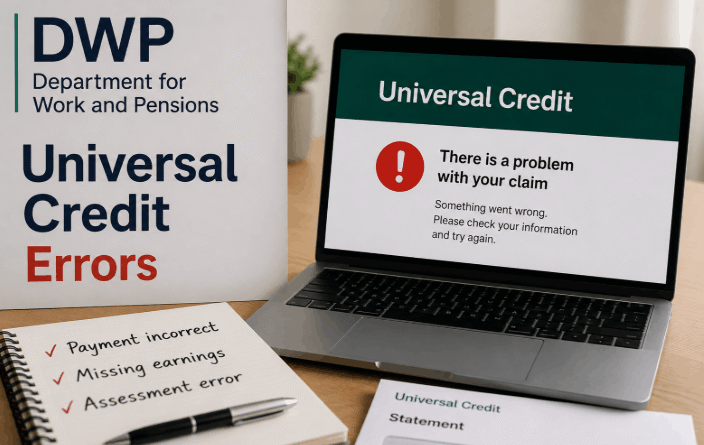
Navigating DWP Universal Credit Errors: How to Challenge Overpayments and Deductions
Official statistics confirm that DWP universal credit errors reached an overpayment rate of 8.5% of total spending in the financial year ending 2026, worth £6.72 billion, while a further £610 million was overpaid specifically due to DWP’s own mistakes rather than fraud or claimant error.
These figures, published by the Department for Work and Pensions in May 2026, set out clearly what counts as an error and what options a claimant has in response.
Key Takeaways
- The Universal Credit overpayment rate was 8.5% (£6,720 million) in the financial year ending 2026, down from 9.5% the previous year.
- Official Error overpayments on Universal Credit stood at 0.8% (£610 million) in the same period.
- The maximum deduction DWP can take from most Universal Credit awards is capped at 15% of the standard allowance, following the Fair Repayment Rate introduced in April 2025.
- Claimants have one month from a decision letter to request a mandatory reconsideration before appealing to a tribunal.
What Counts as a DWP Universal Credit Error?
A DWP Universal Credit error falls into one of three categories, and which one applies changes what happens next. DWP itself defines these through its own Benefit Overpayment Recovery Guide, and the distinction matters because it decides whether a claimant faces a civil penalty, an investigation, or simply a repayment plan.
Official Error
An Official Error is a mistake made entirely by DWP, a local authority, or HMRC, where the claimant did nothing wrong. This might happen if a reported change was never actioned, or if a work coach gave incorrect advice that was later relied upon.
Official Error overpayments on Universal Credit still generally have to be repaid in full, unlike some other benefits such as Carer’s Allowance.
Claimant Error and Fraud
Claimant Error covers honest mistakes, such as misreporting income from self employment. Fraud requires evidence of deliberate misrepresentation, such as knowingly hiding a partner’s income.
Only Fraud and some Claimant Error cases attract a £50 civil penalty, and only genuine Fraud can lead to prosecution or an administrative penalty.
Which category applies is often the deciding factor in whether a challenge succeeds, and it explains why a UK Universal Credit change tends to bring a fresh wave of reporting errors as claimants get used to new rules.

How Common Are DWP Universal Credit Errors in 2026?
Universal Credit had an incorrectness rate of 24 in every 100 claims for the year to 2026, according to the newest GOV.UK fraud and error statistics.
This means close to a quarter of all awards contained some kind of payment mistake, though most of these were small and driven by fraud rather than DWP’s own conduct.
| Category | FYE 2026 rate | Monetary value |
|---|---|---|
| Total UC overpayments | 8.5% | £6,720 million |
| UC overpayments due to Fraud | 6.8% | £5,420 million |
| UC overpayments due to Claimant Error | 0.9% | £690 million |
| UC overpayments due to Official Error | 0.8% | £610 million |
| Total UC underpayments | 0.4% | £350 million |
The National Audit Office has separately confirmed that the overall benefit overpayment rate across all working age benefits fell from 3.3% to 3.2% year on year, and the House of Commons Public Accounts Committee continues to scrutinise DWP’s progress in reducing these figures each year.
The Official Error share has stayed comparatively stable, which suggests the cause lies more with DWP’s own processes than with claimant behaviour.
Why Universal Credit Overpayments Happen?
Most Universal Credit overpayments trace back to an unreported change in circumstances rather than deliberate wrongdoing. A change as small as a partner moving in, a child leaving home, or savings crossing the £6,000 threshold can trigger an overpayment weeks or months before anyone notices.
Consider a claimant whose adult child moves out but who forgets to update their Universal Credit journal for two assessment periods.
DWP continues paying the same amount, the household element stays unchanged, and by the time the claimant reports it, an overpayment has quietly built up that neither side intended.
This kind of mismatch often only comes to light later, when a claimant applies for extra support and DWP checks their most recent circumstances against one of the common Universal Credit advance payment reasons.
Other frequent causes include:
- Self employment income being estimated incorrectly during an assessment period.
- Employer earnings reported to HMRC through Real Time Information not matching what DWP expected.
- Housing costs changing because of a house move or a change in rent.

The Way DWP Reviews and Detects Universal Credit Errors
DWP now has legal powers to request limited bank account information, a scheme that began in 2022 and had reviewed 1.15 million claims by March 2025, generating estimated savings of £581 million.
If a claimant receives a DWP Universal Credit payments review request, it usually means their account has been flagged for a routine check rather than suspicion of wrongdoing.
A review notice typically asks for proof of identity, recent bank statements, or confirmation of living arrangements, sent through the claimant’s online account.
The scheme has already exceeded its own savings target by 11%, and the government confirmed in the Autumn Budget that Targeted Case Review will continue for at least two more years.
Parliament is separately considering the Public Authorities (Fraud, Error and Recovery) Bill, which would give DWP further powers to detect and recover incorrect payments across the wider benefit system.
What DWP Can Take Back From Your Universal Credit?
DWP can currently take a maximum of 15% of a claimant’s standard allowance each month to recover a Universal Credit overpayment, following the Fair Repayment Rate introduced on 30 April 2025.
Widely circulated claim: Several guides still state that DWP can deduct up to 25% or even 40% of a claimant’s standard allowance depending on whether fraud was involved.
Correct position: Since the Fair Repayment Rate took effect for assessment periods starting on or after 30 April 2025, the overall deduction cap for nearly all Universal Credit debts fell from 25% to 15% of the standard allowance.
This cap can only be exceeded for a small set of last resort deductions, such as child maintenance, rent arrears, or energy arrears, none of which relate to overpayment recovery itself.
Source: GOV.UK Universal Credit deductions statistics, confirming that around 21% of households had deductions capped at 15% as of February 2026.
Deductions follow a fixed order of priority:
- Universal Credit advance payments are repaid first.
- Third party debts, such as rent or utility arrears, are repaid next.
- Government debts, including overpayments, are repaid last.
Claimants struggling with these deductions can request Breathing Space, which pauses recovery for up to 60 days, or, in rare cases, ask DWP to waive the debt entirely under its discretion not to recover, a power set out in the Social Security Administration Act 1992.

How to Challenge a Universal Credit Error or Overpayment?
You have the right to challenge a Universal Credit overpayment decision, and the process must begin with a mandatory reconsideration within one month of the decision letter.
This single step decides whether you can later appeal to a tribunal, so missing the deadline without good reason can close off your options.
The formal route runs as follows:
- Request a written statement of reasons if DWP has not already given one.
- Ask for a mandatory reconsideration through your Universal Credit journal within one month, extended if you are waiting on the statement of reasons.
- Appeal to the First-tier Tribunal within one month of receiving the mandatory reconsideration outcome.
Strengthen your case with:
- Screenshots of any incorrect advice given in your journal.
- Payslips, bank statements, or tenancy documents relevant to the disputed period.
- A written note of any calls made to DWP, including names and dates.
Charities including Citizens Advice, Turn2us, and the Child Poverty Action Group all provide free templates for this process, and CPAG’s guidance highlights that DWP has a public law duty to properly consider hardship evidence before refusing a waiver.
Public Law Project has separately argued that Universal Credit’s recovery test is unfair compared with Housing Benefit, where official error debt can only be recovered if the claimant could reasonably have realised they were overpaid.
Universal Credit currently has no equivalent protection, and this gap is a specific point campaigners are raising during the passage of the Public Authorities (Fraud, Error and Recovery) Bill.
Underpayments: When DWP Owes You Money?
DWP underpaid Universal Credit claimants by 0.4% of total expenditure, worth £350 million, over the same period, and these are always classed as Official Error, since they happen only when DWP has miscalculated the award.
The four leading causes of underpayment each accounted for around 0.1% of Universal Credit expenditure:
- Missing or incorrect additional elements beyond the standard allowance.
- Housing costs awarded at the wrong amount.
- Household composition not properly reflected, including changes relevant to the Universal Credit child element.
- Childcare costs paid at the wrong amount, which can leave a household short while an underlying error is worked out, sometimes prompting a separate claim under one of the recognised Universal Credit advance payment reasons.
Unlike overpayments, underpayments are usually corrected automatically once identified, and any arrears owed are added to a future payment rather than requiring a separate claim.

Can DWP Check Your Bank Account for Universal Credit Errors?
DWP now has legal powers to request limited bank account information for Universal Credit, Pension Credit, and Employment and Support Allowance claimants, though State Pension is permanently excluded from these checks.
DWP is the government department that administers Universal Credit, not a separate scheme, and this distinction is worth keeping in mind when reading about DWP Universal Credit bank account checks, since the two are often confused.
Banks respond to Eligibility Verification Notices with strictly limited data rather than full transaction histories, and the government expects the system to uncover between 50,000 and 100,000 incorrect payments a year once fully operational.
The £16,000 savings threshold for Universal Credit eligibility remains unchanged by these checks, and DWP has stated that being asked for information does not imply any wrongdoing on the claimant’s part.
Conclusion
DWP Universal Credit errors remain common, with Official Error alone costing £610 million in the latest financial year, but claimants have clear rights to challenge, negotiate, or in limited cases have these debts waived entirely.
Understanding which category an error falls into, and acting within the one month challenge window, gives claimants the strongest possible position. DWP Universal Credit errors carry real financial risk, though claimants across the UK still have manageable recourse in 2026.
FAQ
Do I have to pay back a Universal Credit overpayment?
Yes, in almost all cases. Universal Credit overpayments above £65.01 must be repaid regardless of whether the mistake was DWP’s fault, though amounts below this small overpayments limit are usually written off automatically.
What is the difference between official error and fraud on Universal Credit?
Official Error means DWP made the mistake with no wrongdoing by the claimant, while Fraud requires evidence of deliberate misrepresentation. Only Fraud cases can lead to prosecution, while Official Error cases still require repayment but carry no penalty.
How many people are affected by fraud and error in the benefit system?
Around 24 in 100 Universal Credit claims contained some overpayment or underpayment error over the latest measured year. Most of this was driven by Fraud rather than official mistakes or claimant error.
Is DWP the same as Universal Credit?
No. DWP is the government department that administers Universal Credit alongside other benefits such as Pension Credit and State Pension. Universal Credit is one specific benefit within DWP’s wider responsibilities.
Can DWP take money from my wages for a Universal Credit overpayment?
Yes, if a claimant is no longer receiving benefits, DWP can arrange a direct earnings attachment with an employer to recover the debt, calculated as a percentage of net income after tax and other deductions.
Disclaimer: The information in this article is for educational purposes only and does not constitute formal legal or financial advice.