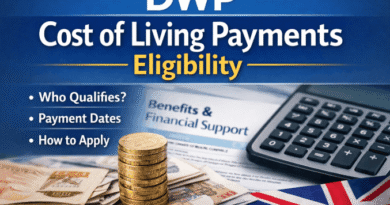

2026 Guide: How Pensioners Can Secure Ongoing DWP Cost Of Living Support Payments
Cost of living support payments for pensioners refer to the financial help available to older people on low incomes through Pension Credit, the Winter Fuel Payment, and council administered hardship schemes.
The original national Cost of Living Payment scheme ended in February 2024, and support since then runs through these separate, ongoing channels. Figures reflect April 2026 rates confirmed by the Department for Work and Pensions.
Key Takeaways
- Pension Credit tops up weekly income to £238 for single pensioners and £363.25 for couples under 2026/27 rates.
- The Household Support Fund ended on 31 March 2026 and has been replaced by the Crisis and Resilience Fund.
- No new national Cost of Living Payment has been confirmed for 2026, despite a circulating rumour about a £725 payment.
Why Pensioners Are Still Searching for a Cost of Living Payment?
Pensioners keep searching for this payment because the scheme that created it ran for two years and built strong public habit before it stopped.
Between 2022 and early 2024, the government paid out billions in direct cash support during a period widely described as the cost of living crisis, and many older people still expect a similar payment each winter.
Many pensioners have simply not updated that expectation since the scheme closed. Search behaviour around this topic spikes every autumn, usually around the same time as Winter Fuel Payment announcements.
Pensioners who received automatic payments in 2022 and 2023 often assume a similar lump sum will arrive again without any action needed. That assumption no longer reflects how support works.
The support itself has not gone away. It now sits within permanent, means tested structures such as Pension Credit, rather than one off emergency payments tied to inflation spikes.

Is the 725 Pound Payment Rumour True?
There is no confirmed 725 pound Cost of Living Payment for January 2026. The Department for Work and Pensions has not announced any new national scheme of this kind, and claims circulating on social media about it are inaccurate.
The £725 figure appears to have spread through unverified social media posts rather than any government announcement. DWP confirms that no nationwide Cost of Living Payment has been scheduled since the final £299 instalment in February 2024.
Pensioners checking will I get cost of living payment tomorrow should rely on GOV.UK rather than forwarded messages or unofficial calculators.
Anyone contacted by text or phone about this payment should be wary, since it has become a common angle for benefit scams targeting pensioners.
DWP never asks claimants to apply for a payment by text message, as genuine payments are issued automatically to existing claimants.
What Cost of Living Payments Existed Before 2024?
- From May to July 2022, a £650 payment was made in two instalments to recipients of means-tested benefits, including Universal Credit and Pension Credit.
- In September 2022, a separate £150 Disability Cost of Living Payment was made to people receiving qualifying disability benefits.
- In winter 2022 and winter 2023, pensioner households received a £300 top-up paid alongside the Winter Fuel Payment.
- Spring 2023 through February 2024, three further payments totalling up to £900 were made to means-tested benefit recipients, with the final £299 instalment closing the scheme.
Anyone wanting a full breakdown of the DWP cost of living payment 2025 figures and how the final rounds were calculated can find the complete payment history covered separately.
Across its full lifetime, the scheme cost the Treasury more than £15 billion. The scheme was intended as temporary inflation relief rather than a lasting welfare structure, and it closed once energy prices began to stabilise.

How Much Pension Credit Pays in 2026-27?
Pension Credit tops up weekly income to £238 for single pensioners and £363.25 for couples under 2026/27 rates, making it the main ongoing route to extra income for low income pensioners.
It sits apart from the State Pension and is assessed on income rather than National Insurance contributions.
| Pension Credit Element | Single Rate 2026 27 | Couple Rate 2026 27 |
|---|---|---|
| Guarantee Credit minimum income | £238.00 per week | £363.25 per week |
| Severe disability addition | up to £86.05 per week | up to £86.05 per week |
| Carer addition | up to £48.15 per week | up to £48.15 per week |
| Savings Credit maximum | up to £17.96 per week | up to £20.10 per week |
Pension Credit also passports recipients to a free TV licence at 75, full Council Tax Reduction, and Cold Weather Payments. An estimated 800,000 eligible pensioners are still not claiming it, according to DWP figures cited by Age UK.
Who Still Qualifies for the Winter Fuel Payment?
Pensioners who have reached State Pension age by the qualifying week in late September 2026 generally qualify for the Winter Fuel Payment, regardless of whether they receive Pension Credit. This marks a reversal from the stricter rules introduced in 2024.
Qualifying Week Explained
The qualifying week for winter 2026/27 runs from 21 to 27 September 2026. Eligibility depends on a person’s circumstances during that specific seven day period, including their age and living arrangements.
The 35000 Pound Clawback Rule
Anyone with a taxable annual income above £35,000 will initially receive the payment but will have it recovered by HMRC, either through a tax code adjustment or via Self Assessment.
Eligible pensioners can receive between £200 and £300 depending on age and household composition. Care home residents and couples receive different rates, and anyone wanting to opt out must contact the Winter Fuel Payment Centre before 20 September 2026.

The Household Support Fund Has Ended and This Is What Replaced It?
The Household Support Fund closed permanently on 31 March 2026 after running since 2021 in various forms, and it has now been replaced by the Crisis and Resilience Fund.
Several council websites have not yet caught up with this change, which leaves some pensioners still searching for a scheme that no longer exists.
The Crisis and Resilience Fund is a three year programme covering April 2026 to March 2029, designed to provide more stable, longer term financial resilience support rather than short, repeatedly renewed emergency funding rounds.
Local delivery plans are still being finalised, so the type and amount of help on offer differs from one council area to another.
Repeated short term extensions of the Household Support Fund had made it difficult for councils to plan ahead, which is part of why the new fund runs on a longer cycle.
Anyone who previously relied on the cost of living payment 2025 when will it be paid Universal Credit timing, to anticipate council top-ups will need to check their local authority’s new Crisis and Resilience Fund arrangements instead.
Eligibility still depends on financial hardship, though the application process and the type of help on offer, from food vouchers to energy top-ups and essential household items, is decided locally rather than nationally.
Where Else Pensioners Can Get Help With Bills?
- Apply for Council Tax Reduction through the local council, which can reduce or remove the Council Tax bill entirely for low income pensioners.
- Check eligibility for the Warm Home Discount, worth £150 off an electricity bill for qualifying low income households.
- Register for Cold Weather Payments, which pay £25 automatically during periods of unusually cold weather in the local area.
- Contact the local council directly to ask about Crisis and Resilience Fund support for food and energy costs.
Ofgem confirmed the energy price cap fell by 7 percent from April 2026, automatically reducing average bills for pensioners on standard tariffs.
Pensioner Cost of Living Support: Myth vs Reality
| Widely Believed Claim | What Is Actually True |
|---|---|
| A new 725 pound payment is coming in 2026 | No such payment has been confirmed by DWP or HMRC |
| The Household Support Fund is still running through councils | It closed on 31 March 2026 and was replaced by the Crisis and Resilience Fund |
| Only Pension Credit recipients get the Winter Fuel Payment | Most pensioners over State Pension age now qualify regardless of Pension Credit |
| Pension Credit only helps with small amounts | It can be worth around £3,900 a year on average and unlocks several other benefits |
| Claiming Pension Credit affects the State Pension | Pension Credit is separate and does not reduce State Pension entitlement |
According to the Department for Work and Pensions, Pension Credit remains the single biggest gateway to wider support, unlocking help that thousands of eligible pensioners are still not claiming. Figures confirmed as of April 2026 via DWP and the House of Commons Library.
Conclusion
For pensioners, the real cost of living support in 2026 sits with Pension Credit, the Winter Fuel Payment, and the new Crisis and Resilience Fund, not a single national scheme. Checking Pension Credit eligibility remains the fastest route to extra income for low-income pensioners in 2026.
FAQ
Is there a cost of living payment for pensioners in 2026?
No. The national Cost of Living Payment scheme ended in February 2024 and has not been revived for 2026.
How much is Pension Credit in 2026?
Pension Credit tops up weekly income to £238 for single pensioners and £363.25 for couples under current rates.
Has the Household Support Fund ended?
Yes. It closed on 31 March 2026 and was replaced by the three year Crisis and Resilience Fund.
What support is available for pensioners with the cost of living?
Several schemes remain active, including Pension Credit, the Winter Fuel Payment, and local Crisis and Resilience Fund grants.
Will pensioners get a Winter Fuel Payment in 2026?
Yes. Most pensioners over State Pension age qualify automatically, though high earners face a tax clawback.
Disclaimer: This article is for informational purposes only; rates and eligibility criteria are subject to change by the DWP and HMRC.