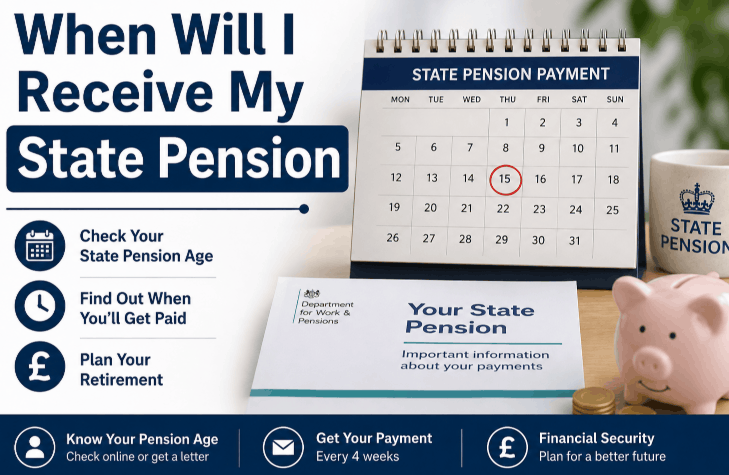
When Will I Receive My State Pension? Age, Claim and Payment Dates
So, when will you receive your State Pension? It comes down to your State Pension age, your claim date and your chosen payment start date. You reach State Pension age on one date, choose a payment start date when claiming, and receive the first payment no later than five weeks later.
The Department for Work and Pensions (DWP) then pays every four weeks, as of the 2026/27 tax year.
The full new State Pension is £241.30 a week in 2026/27. It is not paid automatically, so a claim is needed, and due to recent UK state pension age retirement changes, the State Pension age is now rising from 66 to 67 month by month.
Key Takeaways
- People born 6 April 1960 to 5 March 1961 reach State Pension age at 66 years 1 month to 66 years 11 months.
- The first payment arrives within five weeks of the chosen start date, then every four weeks.
- Claiming is not automatic: an online code opens three months before State Pension age, phone claims four months before.
When Will I Receive My State Pension? State Pension Age by Date of Birth
State Pension age depends on date of birth, and it is no longer 66 for everyone. People born from 6 October 1954 to 5 April 1960 reach it on their 66th birthday. From 6 April 1960, each month of birth adds one month to the age, until births from 6 March 1961 reach 67.
The first group affected reached its age on 6 May 2026, and the phase-in finishes on 6 March 2028. As at 24 October 2026, people born up to 5 July 1960 have already reached their age.
| Date of birth | State Pension age | When it is reached |
|---|---|---|
| 6 October 1954 to 5 April 1960 | 66 | On the 66th birthday |
| 6 April to 5 May 1960 | 66 years 1 month | 6 May to 5 June 2026 |
| 6 May to 5 June 1960 | 66 years 2 months | 6 July to 5 August 2026 |
| 6 June to 5 July 1960 | 66 years 3 months | 6 September to 5 October 2026 |
| 6 July to 5 August 1960 | 66 years 4 months | 6 November to 5 December 2026 |
| 6 August to 5 September 1960 | 66 years 5 months | 6 January to 5 February 2027 |
| 6 September to 5 October 1960 | 66 years 6 months | 6 March to 5 April 2027 |
| 6 October to 5 November 1960 | 66 years 7 months | 6 May to 5 June 2027 |
| 6 November to 5 December 1960 | 66 years 8 months | 6 July to 5 August 2027 |
| 6 December 1960 to 5 January 1961 | 66 years 9 months | 6 September to 5 October 2027 |
| 6 January to 5 February 1961 | 66 years 10 months | 6 November to 5 December 2027 |
| 6 February to 5 March 1961 | 66 years 11 months | 6 January to 5 February 2028 |
| 6 March 1961 to 5 April 1977 | 67 | On the 67th birthday, from 6 March 2028 |
| 6 April 1977 to 5 April 1978 | A set date between 67 and 68 | 2044 to 2046, subject to a government review |
| From 6 April 1978 | 68 | On the 68th birthday, subject to review |
A person born on the 31st of a month is treated as reaching the age on the 30th when the month concerned has only 30 days.
Use the GOV.UK State Pension age tool to confirm the exact date, because the table shows monthly groups.
Who Is Eligible to Start Receiving the State Pension?
A person qualifies for the new State Pension by reaching State Pension age with at least 10 qualifying years on their National Insurance record. The new State Pension covers men born on or after 6 April 1951 and women born on or after 6 April 1953.
If you are wondering, how much State Pension will I get at 66? you may qualify for the following, depending on your qualifying years:
- 35 or more years: The full £241.30 a week.
- 10 to 34 years: A proportion of the full amount. Each qualifying year is worth one thirty-fifth of the full new State Pension, so 10 years gives about £69 a week and 20 years about £138 a week.
- Fewer than 10 years: Usually no State Pension.
Qualifying years come from work, National Insurance credits (for example while receiving certain benefits) or voluntary contributions. People with contributions before April 2016 may have a starting amount, so the forecast figure is the one to rely on.
If you are asking yourself how can I check my state pension, you can easily view your State Pension forecast on GOV.UK or in the HMRC app to see the years on record, the amount on track, and the exact date it can be claimed.

From State Pension Age to First Payment: Where You Are and What Happens Next
Use your State Pension age from the table above to see what happens at each claiming stage below. State Pension age, the start date and the first payment are three separate dates, which is why payment does not simply begin on the 66th birthday.
The first payment arrives no later than five weeks after the chosen start date. GOV.UK adds that a part payment may come before the first full payment, and the confirmation letter explains which applies.
| Your stage | What happens |
|---|---|
| More than four months before State Pension age | Nothing can be claimed yet; check the age and forecast |
| Within four months | A claim can be made by phone on 0800 731 7898 |
| Within three months | An invitation code can be requested online, and the claim made online |
| Past State Pension age, no claim made | The pension is deferred automatically until a claim is made |
| Claim made | First payment no later than five weeks after the chosen start date |
| After the first payment | A full payment every four weeks |
Opting for a state pension deferral increase raises the weekly amount by 1% for every nine weeks, just under 5.8% a year, but it delays every payment.
The basic State Pension follows a different rule. It covers men born before 6 April 1951 and women born before 6 April 1953, and its first payment comes at the end of the first full week of the chosen start.
Avoid these common mistakes:
- Waiting for a letter instead of requesting a code at the three-month mark
- Expecting payment on the birthday rather than after the chosen start date
- Budgeting for a monthly date when payments follow a four-week cycle
- Assuming the basic State Pension’s first-payment rule applies to the new State Pension
What You Need to Claim the State Pension and When the Invitation Letter Arrives
The State Pension is not paid automatically, so a claim is required. MoneyHelper states that there is no time limit for applying once the invitation code is in hand.
The State Pension invitation letter, which carries the code, arrives around four months before State Pension age, according to MoneyHelper. The dependable trigger is the three-month mark, when an online code can be requested.
These steps show how to claim the State Pension:
- Confirm your State Pension age on GOV.UK.
- Within four months, phone the Pension Service claim line on 0800 731 7898 (Monday to Friday, 8 AM to 6 PM, except public holidays).
- Within three months, request an invitation code on GOV.UK if no letter has arrived, then claim online.
- Choose your start date when asked; the first payment follows within five weeks.
- In Northern Ireland, you can also claim online through GOV.UK. From abroad, contact the International Pension Centre.
Have these details ready:
- Your National Insurance number and, for an online claim, the invitation code
- Your bank or building society details
- The date of your most recent marriage, civil partnership or divorce, if any
- The dates you lived or worked abroad, plus any foreign social security numbers
The Pension Service, part of DWP, can confirm if anything more is needed. Once the claim is made, the payment weekday below sets which day the money lands.

State Pension Payment Dates: Every Four Weeks and Your Payment Day
The new State Pension is usually paid every four weeks. GOV.UK sets State Pension payment days by the last two digits of the National Insurance number. Use the GOV.UK State Pension age and payment guidance to confirm the day that applies to your National Insurance number.
| Last two digits of National Insurance number | Payment day |
|---|---|
| 00 to 19 | Monday |
| 20 to 39 | Tuesday |
| 40 to 59 | Wednesday |
| 60 to 79 | Thursday |
| 80 to 99 | Friday |
If the normal payday falls on a bank holiday, check with the Pension Service because payment timing can be affected. A four-weekly payment cycle drifts through the calendar, so there is no fixed day of the month. It also means 13 payments a year, so £12,547.60 works out at about £1,045.63 a month for budgeting.
A full new State Pension of £241.30 a week is £965.20 per four-week payment and £12,547.60 a year in 2026/27. In 2025/26 the weekly rate was £230.25, or £921.00 per four weeks, so each payment rose by £44.20, a 4.8% increase from April 2026.
To change the account the pension is paid into, tell the Pension Service.
State Pension Not Received: Who to Contact and When to Wait
Check the five-week rule above before treating a payment as missing. Then work through these steps:
- Count five weeks from the start date chosen; the first payment can take that long.
- Check whether the payment day fell on a bank holiday, as payment timing can be affected.
- Check the account details held by the Pension Service.
- Phone the Pension Service using the main DWP contact number on 0800 731 0469 (Monday to Friday, 8 AM to 6 PM). If no claim has been made yet, use the claim line, 0800 731 7898.
- From abroad, contact the International Pension Centre. In Northern Ireland, contact the Northern Ireland Pension Centre.
The two numbers serve different purposes: 0800 731 0469 handles payment enquiries and changes, while 0800 731 7898 is the claim line. Relay UK users can dial 18001 before either number.
Keep the National Insurance number, the chosen start date and the bank details to hand when calling.
Do You Still Get the State Pension If You Move Abroad or Hold Dual Citizenship?
Moving abroad permanently
The State Pension can be paid abroad when the National Insurance record qualifies. Yearly increases apply to residents of the European Economic Area, Switzerland and certain countries with a UK social security agreement that provides for them. The pension stays frozen in places such as Canada and New Zealand.
A person abroad must be within four months of State Pension age to claim through the International Pension Centre, by email, phone or the international claim form. A move abroad should be reported to the Pension Service, and GOV.UK notes that different payment rules apply overseas.
Dual citizenship
The UK State Pension is based on the UK National Insurance record. The amount therefore follows that record, and the country of residence affects increases. Contact the International Pension Centre to check a specific case.
Is the State Pension Taxable When You Receive It?
Yes, the State Pension counts as taxable income, but it is paid with no tax taken off. Because of the ongoing state pension tax threshold freeze, the 2026/27 Personal Allowance remains £12,570, so a full new State Pension of £12,547.60 leaves just £22.40 of allowance unused.
HMRC collects any tax due on other income, usually by changing the tax code or through Self Assessment. Anyone with other income should check the tax code notice from HMRC.
If your only income is the State Pension and it exceeds the Personal Allowance, check how HMRC will collect any tax due; the position can depend on your circumstances and the tax year.
At Budget 2025, the government said it would ease the administrative burden for people whose only income is the basic or new State Pension, without increments, so they do not have to pay small amounts of tax through Simple Assessment from 2027-28 where their pension exceeds the Personal Allowance.

Conclusion
When will I receive my State Pension? Your payment date depends on your State Pension age, when you claim, and the start date you choose. The first payment follows within five weeks of that start date.
The practical order is to check the age on GOV.UK, claim within the windows, then expect payments every four weeks.
FAQs
When will you receive your State Pension if you were born in 1960?
People born 1 January to 5 April 1960 reach State Pension age at 66. Those born 6 April to 5 December 1960 reach it between 66 years 1 month and 66 years 8 months, from May 2026 to August 2027. People born 6 December 1960 to 5 January 1961 reach it at 66 years 9 months, between September and October 2027. The rise to 67 completes in 2028, for births from 6 March 1961.
What are the State Pension payment dates for 2026?
There is no single calendar: payment comes every four weeks on one weekday, from Monday for National Insurance digits 00 to 19 to Friday for 80 to 99. If a payday falls on a bank holiday, payment timing can be affected.
How can you check your State Pension forecast?
The GOV.UK Check your State Pension service, also reached through the HMRC app, shows the amount on track and when it can be claimed. It cannot be used once you are receiving the State Pension or have deferred claiming it.
Can a husband and wife both get the State Pension?
Yes: each person receives it on their own National Insurance record, so two people with 35 qualifying years each get £241.30 a week, £482.60 combined. Partners cannot normally claim on each other’s record under the new State Pension.
Can you claim the State Pension and keep working?
Yes: GOV.UK allows a claim while still working. If you are employed, you usually stop paying National Insurance when you reach State Pension age. If you are self-employed, Class 4 contributions stop from the start of the following tax year. Earnings still count towards your taxable income.
How long is the State Pension paid for?
Payments are based on the individual’s National Insurance record and generally stop when the person dies. A surviving spouse or civil partner may be able to inherit an extra payment on top of their own new State Pension, depending on the circumstances. A death should be reported to the DWP Bereavement Service.
Disclaimer: This article is for informational purposes only and does not constitute professional financial advice.