Beat The HMRC July Tax Deadline: Reduce Payments On Account Safely And Avoid Interest
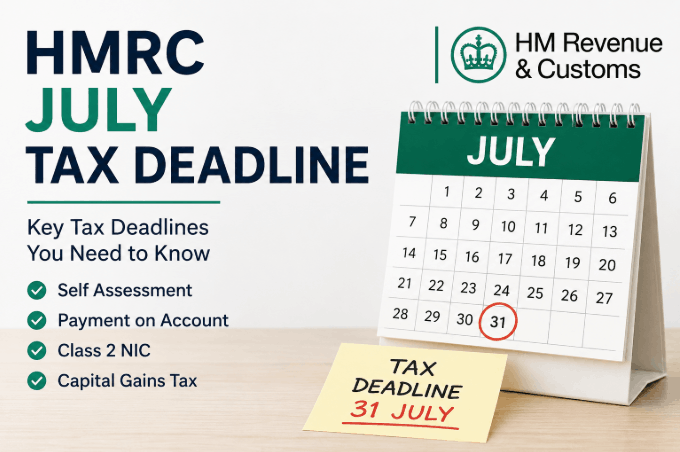
The HMRC July tax deadline falls on 31 July 2026, when most Self Assessment taxpayers must make their second payment on account for the 2025 to 2026 tax year. Each instalment equals half of the tax owed the previous year, split between January and July to avoid one large January bill. Figures confirmed as of June 2026 via GOV.UK.
Key Takeaways
- The second payment on account for the 2025/26 tax year is due by midnight on 31 July 2026.
- Payments on account only apply if last year’s Self Assessment bill exceeded £1,000 and less than 80% of tax was collected through PAYE.
- HMRC’s current late payment interest rate is 7.75%, calculated as the Bank of England base rate plus 4%, effective from 9 January 2026.
What Is the HMRC July Tax Deadline This Year?
The HMRC July tax deadline is 31 July 2026, and it covers the second payment on account for the 2025/26 tax year. This date carries no filing obligation. No form or return is needed on this date. What matters is that the payment clears HMRC’s account by midnight on the day.
Each instalment is calculated as half of the tax bill owed for the previous tax year. The first half was due on 31 January 2026, and the second falls six months later. Missing it triggers daily interest rather than a fixed late-filing penalty, though the amount owed still grows the longer it’s left.
Taxpayers can confirm the exact amount owed through their HMRC online account or the HMRC app. The figure should already reflect last year’s submitted return, since HMRC calculates the instalment directly from that filed bill rather than asking for a fresh estimate.
Anyone who hasn’t yet filed last year’s return should still expect a payment request based on the most recent figure HMRC holds on record, which may change once that return is actually submitted.
- Deadline date: 31 July 2026
- Payment covers: Second instalment, 2025/26 tax year
- Action required: Payment only, no return to file
Who Has to Make a Payment on Account?
Payments on account apply only when two specific conditions are both met for the previous tax year. Most PAYE-only employees never encounter this system at all.
- The last Self Assessment tax bill was more than £1,000.
- Less than 80% of the tax owed was collected at source, such as through a tax code or savings interest deductions.
If either condition fails, no payment on account is due. This typically catches sole traders, landlords, company directors with dividend income, and anyone juggling multiple income streams outside standard payroll. Pensioners are not exempt either.
Someone drawing a private pension alongside other untaxed income can end up owing a payment on account for the first time once their combined income crosses that threshold.
It’s one reason HMRC pensioner tax codes often deserve closer attention than people expect, especially once a new income source moves someone out of PAYE coverage and into Self Assessment.
How Is Your July Payment on Account Calculated?
Working out what’s owed for the HMRC July tax deadline starts with last year’s tax bill, not this year’s income. HMRC simply halves the previous year’s liability and asks for that amount twice.
The table below shows how this plays out for different bill sizes, assuming the 2024/25 figure is used to set both 2025/26 instalments.
| 2024/25 Tax Bill | January 2026 Payment | July 2026 Payment |
|---|---|---|
| £2,000 | £1,000 | £1,000 |
| £6,000 | £3,000 | £3,000 |
| £10,000 | £5,000 | £5,000 |
| £15,000 | £7,500 | £7,500 |
Capital gains tax and student loan repayments are excluded from this calculation entirely. Once the 2025/26 return is filed, HMRC checks what was paid against the actual amount owed, then either issues a refund or requests a balancing payment the following January.
Why HMRC Structures Payments This Way
HMRC splits tax into two instalments because it assumes income stays roughly flat from one year to the next, and that assumption is what catches people out. Rather than collecting a full year’s tax in one January bill, the system spreads the estimated cost across two dates six months apart.
The common misunderstanding is treating each instalment as a fresh tax charge rather than an advance against a bill that hasn’t been finalised yet. Someone whose income drops mid-year is still assessed against last year’s figure unless they actively request a change.
That mismatch between assumed and actual income is exactly where most payment-on-account confusion originates, and it explains why the January bill often feels disproportionately large: it usually contains a balancing payment for the year just ended on top of the first instalment for the new one.
Quarterly reporting under Making Tax Digital is intended to narrow that gap over time, since HMRC will hold more current income data rather than relying solely on the prior year’s filed result.
What Is the Current HMRC Late Payment Interest Rate?
HMRC currently charges 7.75% interest on late payments, a rate that has been in effect since 9 January 2026. This figure is calculated as the Bank of England base rate plus a 4 percentage point margin, not the older 2.5 percentage point margin still quoted across many tax guides published before April 2025.
- Late payment interest rate: 7.75% (from 9 January 2026)
- Formula: Bank of England base rate plus 4%
- Repayment interest rate: 2.75%, calculated as base rate minus 1%
Widely circulated claim: several online guides state the late payment interest rate as the Bank of England base rate plus 2.5%.
Correct position: that margin changed on 6 April 2025. The rate has been base rate plus 4% since that date, putting the live figure at 7.75% as of 9 January 2026.
Source: GOV.UK’s rates and allowances page for HMRC interest on late and early payments.
Interest accrues daily from the day after the deadline until the balance clears, with no compounding involved.

Can You Reduce Your Payment on Account?
Yes, a reduction is possible if current-year income is genuinely expected to fall below last year’s figure. This is one of the most underused options available to Self Assessment taxpayers.
- Estimate the expected tax liability for the current year as accurately as possible.
- Submit the reduction either through the Self Assessment online return or via form SA303 in the HMRC online account.
- Pay the reduced amount by the relevant deadline, keeping records of how the estimate was reached.
Reducing payments too aggressively carries a real cost. If the actual liability ends up higher than the reduced estimate, HMRC charges interest on the shortfall from the original due date, regardless of how reasonable the original guess looked at the time.
What Happens If You’re New to Self Assessment?
First-year Self Assessment filers do not make payments on account at all. The full tax bill for that first year is simply paid in one go by 31 January, with payments on account only starting from the second year onward. This rule catches people in unexpected ways.
Someone who has just become self-employed, started letting a property, or crossed into Self Assessment because savings interest pushed their untaxed income over the threshold will pay one lump sum first, then face a noticeably larger January bill the following year once the first payment on account is added.
Retirees are a common example, since a pension lump sum or a growing savings balance can quietly trigger this for the first time. It’s also why HMRC notices for UK pensioners savings sometimes turn up alongside a Self Assessment requirement that simply wasn’t there the year before.
How to Pay HMRC Before 31 July?
HMRC accepts several payment methods, and the best choice usually depends on how close the deadline is rather than personal preference.
- Pay via online or telephone banking using HMRC’s sort code and account number, with the 10-digit Unique Taxpayer Reference (UTR) as the payment reference.
- Use the HMRC app for instant payment and to track payment history directly.
- Set up a Direct Debit through the HMRC online account to pay automatically on the due date.
- For same-day urgency, arrange a CHAPS transfer through a bank, which may carry a fee.
If You Can’t Pay on Time
Anyone unable to meet the deadline should contact HMRC before 31 July rather than after. A Time to Pay arrangement allows the bill to be spread across a payment plan, and acting early generally results in a more flexible outcome than waiting for HMRC to chase the debt.
New customers signing up for HMRC’s digital services are now asked to register through GOV.UK One Login, though existing customers can continue using their current Government Gateway sign-in without changes for now.

What’s Changing for the 2026/27 Tax Year?
Beyond the payment dates themselves, two changes are altering how Self Assessment will work in the years ahead.
- Sole traders and landlords with qualifying income above £50,000 must now use Making Tax Digital for Income Tax, submitting quarterly updates rather than one annual return.
- From mid-2026, around 300,000 Self Assessment customers have their Child Benefit payment information pre-populated automatically, reducing manual entry errors around the High Income Child Benefit Charge.
These changes reflect a wider shift in how government departments track and report public spending.
HMRC voluntary sector funding 2027 plans follow a similar pattern, moving toward more frequent, data-led reporting across public finance, much like the real-time visibility quarterly MTD submissions are designed to give individual taxpayers.
Conclusion
Paying on or before 31 July keeps next January’s bill more predictable and avoids interest charges that are easily avoided. Anyone unsure of the exact amount owed should check their HMRC online account now, rather than leaving it until the deadline is on top of them.
The HMRC July tax deadline means a payment of half last year’s tax bill is due for most Self Assessment taxpayers in the UK in 2026.

FAQ
How can payments on account be reduced?
Yes, a reduction is possible by submitting an estimate of lower expected income, either through the Self Assessment return or form SA303. The estimate must be reasonable, since underpaying based on an inaccurate guess results in interest charged on the shortfall from the original due date.
Is the July payment a balancing payment?
No, the July payment is not a balancing payment. It is the second of two advance instalments for the current tax year. Any balancing payment, covering the gap between what was paid and what was actually owed, falls due the following January instead.
What happens if the 31 July deadline is missed?
Missing it triggers daily interest at HMRC’s current rate of 7.75%, calculated from the day after the deadline until the balance clears. There is no fixed late-filing penalty for missed payments specifically, but unpaid interest accumulates the longer the balance remains outstanding.
Do payments on account apply to everyone who files Self Assessment?
No, payments on account only apply when last year’s tax bill exceeded £1,000 and under 80% of tax was collected at source. Most PAYE employees with no significant additional income fall outside this system entirely, as do first-year Self Assessment filers.
Disclaimer: This article is for informational purposes only and does not constitute professional tax advice.