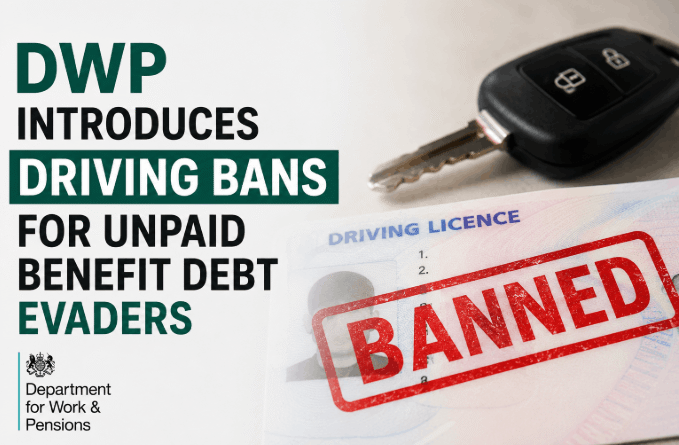
DWP Introduces Driving Bans For Unpaid Benefit Debt Evaders: How To Avoid Licence Loss
The DWP driving ban for unpaid benefit debt evaders is a new power letting a court suspend a licence when a former claimant will not repay what is owed. It applies only once the debt reaches 1,000 pounds and started on 24 June 2026 under the Public Authorities Fraud Error and Recovery Act.
Key Takeaways
- The DWP can seek a driving ban when a former claimant owes at least 1,000 pounds and can afford to repay.
- Enforcement under the Public Authorities Fraud Error and Recovery Act began on 24 June 2026, with full rollout from October 2026.
- A driving ban remains suspended while the debtor keeps to an agreed repayment plan.
What Is the DWP Driving Ban for Unpaid Benefit Debt Evaders?
The Department for Work and Pensions can now ask a court to order a driving ban for unpaid benefit debt. This power sits inside the Public Authorities Fraud Error and Recovery Act, which the government has described as one of its toughest crackdowns yet on welfare debt.
GOV.UK confirmed in June 2026 that the related savings target stands at 14.6 billion pounds over five years.
Before this law, DWP debt enforcement relied on deductions from benefits or PAYE earnings. The Department for Work and Pensions has acknowledged that this approach only worked while someone stayed employed or claiming, leaving a gap for people who left the system still owing money.
Many of these cases built up over several years, since there was no real recovery route once someone moved off benefits entirely.
The new power closes that gap with a court route that did not exist before. It works alongside existing deduction powers rather than replacing them, so most debt recovery still happens without ever reaching a courtroom.
This shift decides who can now be pursued through the courts, not only through benefit deductions.

Who Can Be Banned From Driving Over Benefit Debt?
You could face this driving ban only if you have stopped claiming benefits, are not paid through PAYE, and owe the DWP at least 1,000 pounds. What counts as benefit debt evasion under the new rules is narrow, covering deliberate and persistent non payment rather than ordinary arrears or a short term financial setback.
Who could be affected
- Former claimants of Universal Credit, PIP, or other DWP benefits who left the system still owing money.
- People who can afford to repay but have ignored repeated contact from the DWP about a repayment plan.
- Anyone whose case has reached the later stages of DWP recovery action with no agreement in place.
Who is excluded
- Anyone still receiving benefits, since deductions are taken from ongoing payments instead of pursued through court.
- Anyone in PAYE employment, since the DWP can recover debt through their employer directly.
- Anyone who can show they genuinely cannot afford repayment, since the power targets the ability to pay, not financial hardship.
Universal credit overpayments are the most common debt type behind these cases, often built up after changes in income or household circumstances went unreported.
These overpaid balances are frequently identified during a routine DWP Universal Credit payments review, where past claims are audited for accuracy. The detail matters here, since most current claimants are not actually in scope at all.
This narrows the real audience to a smaller group of former claimants, and the actual debt threshold sets the bar even higher.

How Much Benefit Debt Triggers a Driving Ban?
A driving ban can only be sought once benefit debt reaches 1,000 pounds, and the DWP uses two distinct recovery routes depending on the circumstances of the case.
GOV.UK confirms that courts can only impose a driving ban where the debt is at least 1,000 pounds and no essential need for the licence exists.
| Recovery Route | Who It Applies To | Debt Threshold | Court Order Needed | Likely Outcome |
|---|---|---|---|---|
| Direct Deduction Order | Former claimants with available income or savings | No set minimum | No | Regular deductions taken straight from a bank account |
| Driving Disqualification Order | Persistent evaders who can pay but will not | 1,000 pounds or more | Yes | Suspended driving licence, paused while repaying |
The wider enforcement framework also draws on the Social Security Fraud Act 2001, which already governed how the DWP investigates suspected fraud before these new powers existed. That older legislation still shapes how evidence is gathered ahead of any court application today.
Most cases stay on the deduction route, and the courts treat a driving ban as the last resort rather than a default response to any overdue balance.
What Is the Step by Step DWP Disqualification Process?
Reaching an actual driving ban takes several stages, since the DWP only turns to court action once every other option has been tried.
- The DWP debt enforcement team contacts you by letter and phone over about four weeks to agree a voluntary repayment plan.
- If you do not respond, the DWP can ask your bank for limited account information to assess what you can realistically afford.
- The DWP may then issue a direct deduction order, taking agreed amounts straight from your account without needing a court order first.
- In the most serious and persistent cases, where the debt is 1,000 pounds or more, the DWP applies to a court for a driving disqualification order instead.
- The court only grants a ban if you had the means to repay and chose not to, and any ban pauses immediately once repayments resume.
The whole sequence is governed by the DWP Direct Deduction and Disqualification from Driving Orders Code of Practice, which sets out the safeguards staff must follow at every stage.
Work and Pensions Minister for Transformation Andrew Western has said the changes are designed to recover money from people who could pay but choose not to, while keeping the door open for anyone willing to engage.
This sequence means a ban only follows repeated refusal, never a single missed letter or a temporary lapse in contact.
What Happens If You Ignore a DWP Debt Letter?
Ignoring a DWP debt letter does not stop enforcement. It simply moves your case toward the next and more serious stage of recovery.
Unanswered cases get escalated by the DWP debt management team to its enforcement team, which makes further contact attempts, then considers a direct deduction order, and in persistent cases moves toward court action.
Each stage is recorded, and that record becomes part of the evidence used if a case eventually reaches a court for a driving disqualification order.
The amount of debt needed before DWP takes action follows a clear threshold. The threshold for a driving disqualification order is 1,000 pounds, but a direct deduction order on a bank account carries no minimum amount and can apply to far smaller debts once a former claimant stops engaging entirely.
Acting early always keeps more options open than waiting for a letter to escalate into something harder to reverse.
Who Is Protected From a Driving Ban?
Several safeguards limit when a driving ban can actually be used against a former claimant.
- No one can be disqualified if they have an essential need for the licence, such as work that depends on driving or caring responsibilities for a family member.
- Any ban is suspended automatically as long as the debtor keeps to an agreed repayment plan with the DWP.
- Cases are governed by the DWP Direct Deduction and Disqualification from Driving Orders Code of Practice, which followed a public consultation before these powers took effect.
The same legislation also introduces the Eligibility Verification Measure, a separate power allowing the government to monitor financial assets via DWP Universal Credit bank account checks, letting banks flag possible overpayments directly to the department.
Although that mechanism does not itself lead to a driving ban, it serves as an early identification tool for hidden capital or extra income.
The two powers are easy to mix up, since both stem from the same piece of legislation, but only persistent non payment after leaving the benefits system can trigger a disqualification order.
These limits mean the ban exists to deter genuine refusal, not to hang over every debtor as a routine risk.
How Can You Avoid a DWP Driving Disqualification?
Contacting the DWP before enforcement escalates is the only guaranteed way to avoid a ban reaching a courtroom at all.
- Get in touch with the DWP within four months of receiving a debt letter to prevent these powers being applied to your case.
- Set out your income and expenses so a debt adviser or DWP officer can agree what you can realistically afford each month.
- Ask about a benefit debt repayment plan that spreads what you owe into manageable instalments rather than one lump sum.
- Seek free advice from a debt charity such as Money Wellness if you are unsure what to say or which figures to share.
- Keep to whatever plan is agreed, since missing payments restarts the risk of enforcement and can bring a case back to square one.
Every route through this process stays open to anyone willing to engage early, and DWP guidance states that contact remains possible even after a letter is sent.

Is This Crackdown Fair? What Critics and Charities Say
Reaction to the new powers is split between support for recovering taxpayer money and concern for how vulnerable debtors might be treated.
Cabinet Office Minister Satvir Kaur has said the powers protect hardworking taxpayers from people who try to cheat the system, framing the reform as overdue fairness for those who pay in.
Big Brother Watch has criticised the related benefit claimant bank account checks introduced alongside these powers, arguing the wider reform risks treating claimants as suspects by default rather than people in genuine need.
Debt charities including Money Wellness have welcomed accountability for deliberate evasion while warning that people coping with serious illness, poor mental health, or caring duties could be wrongly caught up in enforcement if their non engagement is mistaken for refusal.
That tension between deterrence and compassion is likely to shape how the Code of Practice is applied in real cases over the coming months.
Whichever side of the debate is right, contacting the DWP early remains the simplest way to avoid the harshest outcomes.
Conclusion
DWP driving bans for unpaid benefit debt evaders mean former claimants who can pay but will not now face court-ordered consequences in 2026. Most debtors avoid this entirely by contacting the DWP early and agreeing a workable repayment plan.
FAQ
Has the DWP introduced driving bans for unpaid benefit debt evaders?
Yes. Since 24 June 2026, courts can suspend a driving licence for former claimants who owe at least 1,000 pounds and refuse to repay.
Who can be banned from driving by the DWP?
Only former benefit claimants who are not in PAYE employment, owe 1,000 pounds or more, and have ignored repeated contact about repayment.
How much do you have to owe before a driving ban applies?
A driving disqualification order requires a debt of at least 1,000 pounds, though smaller debts can still trigger a direct deduction order.
Can the DWP take money from your bank account without a court order?
Yes. A direct deduction order lets the DWP take agreed amounts directly, but a driving ban still needs a separate court application.
Does a DWP driving ban affect your licence record or give penalty points?
No. A driving disqualification order does not add penalty points or create a criminal record, and it ends once the debt is repaid.
Disclaimer: This article is for informational purposes only and does not constitute professional legal or financial advice.