
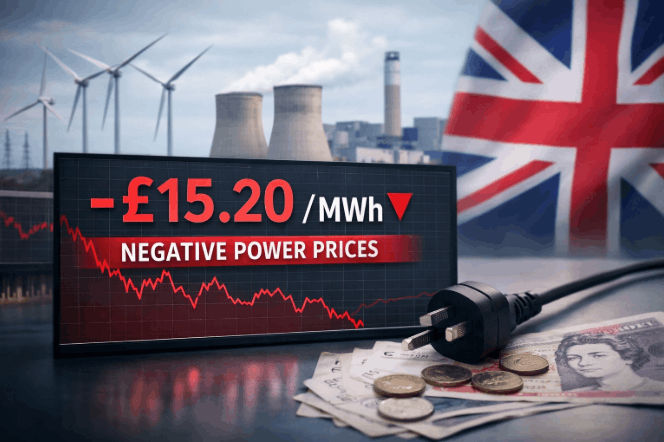
UK Negative Power Prices: What They Are, Why They’re Rising and What It Means for Your Bill
UK negative power prices occur when wholesale electricity supply exceeds demand to the point that the N2EX day-ahead market and Epex Spot exchange clear at prices below zero, generators pay to offload surplus power onto the grid rather than receive payment for it.
In April 2026, 16.9% of midday half-hour settlement periods recorded negative wholesale prices, confirming this is now a structural feature of Britain’s energy market.
Key Takeaways
- The N2EX day-ahead market recorded over 176 hours of negative wholesale prices in 2024, a figure already surpassed in the first half of 2026 alone, driven by record offshore wind output and solar generation.
- Constraint payments, paid by the National Energy System Operator (NESO) to switch off generators that the grid cannot absorb, cost British bill payers over £1.5 billion per year, embedded in every unit rate regardless of tariff type.
- BloombergNEF projects the UK will exceed 1,000 hours of negative wholesale electricity prices annually by 2027, making dynamic tariffs such as Octopus Agile an increasingly valuable financial tool for households with flexible demand.
What Are UK Negative Power Prices?
UK negative power prices occur when electricity generation exceeds what the grid can absorb or transmit, causing the N2EX and Epex Spot exchanges to clear at prices below zero. Generators don’t simply earn nothing, they pay other market participants to take their power.
The National Energy System Operator (NESO) must maintain grid frequency within a narrow band. When generation cannot be matched with demand or exported through interconnectors, the conditions for negative pricing are fully established.
April 2026 illustrated the scale of the shift: 16.9% of all midday half-hour settlement periods recorded negative prices, a figure that would have been almost unimaginable five years earlier.
UK negative power prices are no longer rare anomalies. They are a structural feature of a renewables-led electricity market, increasing in frequency and depth alongside every new capacity addition.

Why UK Power Prices Are Going Negative More Often?
Three structural forces are converging to push negative electricity prices higher in frequency and duration.
Rapid expansion of renewable capacity, a transmission grid built for a centralised fossil fuel system, and subsidy contracts that incentivise generators to keep running regardless of market price, and all three are reinforcing each other.
The drivers behind this shift are:
- Offshore and onshore wind capacity growth. On 25 March 2026, UK wind generation reached a record 23.88 GW, more than the total installed capacity of most European countries’ entire power systems. Wind output is concentrated in Scotland and northern England, far from major demand centres in the south.
- Solar PV expansion and seasonal patterns. Solar generation peaks at midday and is highest between April and September. Bank holidays and weekends compound the effect, industrial and commercial demand drops sharply while generation continues. This is why 16.9% of April 2026 midday half-hours went negative. Renewable energy outpacing electricity demand is a weekend and bank holiday phenomenon as much as a seasonal one.
- North-to-south transmission constraints. The high-voltage transmission network connecting Scottish wind capacity to English demand centres cannot carry the full volume of power being generated in the north. NESO must instruct generators to curtail output, paying constraint payments to do so, rather than allow frequency to destabilise.
- CfD and Renewables Obligation subsidy incentives. Generators with subsidy contracts have financial reasons to keep producing even when wholesale prices fall below zero. The mechanics of why are examined below.
The issue is not the volume of renewable energy, it is a grid and market structure that has not kept pace with it.
How Contracts for Difference Keep Generators Running at Negative Prices?
Wind and solar farms keep generating through negative price periods because shutting down is often more costly than continuing to run.
Under Contracts for Difference, generators receive top-up payments to a guaranteed strike price when the market falls below it. Stopping output means forfeiting both revenue and subsidy, making curtailment financially irrational for many operators.
Contract generation matters here. Under AR1 and AR2 CfDs, generators received top-up payments even during negative price periods, with no financial penalty for continuing to run, directly prolonging negative price events.
AR4+ contracts introduced a correction: CfD support is suspended after a consecutive six-hour negative pricing threshold. However, a large volume of legacy AR1/AR2 contracts remain active and will continue contributing to negative price events until those assets reach end-of-life or are repowered under newer terms.
The gradual shift to AR4+ narrows the incentive to generate through negative price periods, but does not remove it entirely.

The Hidden Cost on Your Bill: How Constraint Payments Add Up?
Standard-tariff households don’t benefit from negative wholesale prices, but every one of them pays to manage them.
When NESO instructs a Scottish generator to switch off because the transmission network can’t carry its output south, it pays that generator a constraint payment.
Those payments are recovered through Balancing Services Use of System (BSUoS) charges, costs that flow from NESO to suppliers, and from suppliers into the unit rates on every household bill.
The scale is significant: constraint payments now exceed £1.5 billion per year, rising in direct proportion to renewable capacity additions and forecast to continue climbing until the Great Grid Upgrade reduces the north-to-south bottleneck.
Every UK household funds grid imbalance management regardless of tariff type, including those purchasing new homes discounted by 100k, where energy running costs form a material part of the long-term affordability picture. Knowing where that cost originates is what puts households in a position to act on it.
How to Benefit From Negative Electricity Prices in the UK?
Ordinary households can benefit from UK negative power prices, but only through a time-of-use or dynamic tariff that passes half-hourly wholesale prices directly to the consumer.
Standard fixed and variable tariffs insulate consumers from both the costs and the benefits of negative pricing events.
To capture value from periods when wholesale prices fall below zero, there are four practical steps to capturing that value:
- Switch to a dynamic tariff. Octopus Agile is the most established dynamic pricing tariff in the UK market. It passes half-hourly N2EX wholesale prices, including negative rates, directly to consumers. During negative price periods, Octopus Agile customers are credited for every unit of electricity they consume. Other dynamic tariff options are entering the market as Ofgem has signalled support for time-of-use pricing as a demand management tool.
- Shift high-draw appliances to forecast negative periods. Washing machines, dishwashers, and tumble dryers can be scheduled to run when prices are forecast negative. The Octopus Agile app and its publicly accessible price API publish half-hourly price forecasts up to 24 hours ahead, giving you sufficient notice to act. Weekends and bank holidays between April and September are statistically the highest-probability windows.
- Programme a home battery to charge during negative price windows. If you have a home battery system, configuring it to charge during negative price periods and discharge during peak pricing hours turns grid volatility into a direct financial gain. This is the single most effective way to capture the value of negative pricing consistently.
- Register for the Demand Flexibility Service. The National Grid ESO Demand Flexibility Service (DFS) pays eligible households and businesses to reduce consumption during peak demand periods. While DFS operates at peak rather than negative price moments, participation alongside a dynamic tariff creates a dual-sided financial benefit, earning on both ends of the price curve.
The households best positioned to capture value from negative pricing are those combining a dynamic tariff, a home battery, and an EV, a combination that consistently converts grid volatility into a measurable bill reduction.
UK Negative Power Price Hours: Year-on-Year Growth
Data: N2EX Day-Ahead Market and Epex Spot Exchange. Sources: Modo Energy, BloombergNEF, FutureChange.uk, Stage 2A live SERP data. The 2026 figure is partial-year (January–June 2026).
| Year | Negative Hours (N2EX) | Approx. % of All Trading Hours | Primary Driver |
|---|---|---|---|
| 2021 | ~25 hours | <0.3% | Early offshore wind expansion |
| 2022 | ~38 hours | <0.5% | Wind capacity growth; gas price volatility masking scale |
| 2023 | ~90 hours | ~1.0% | Accelerated offshore wind; solar expansion |
| 2024 | ~176 hours | ~2.0% | Record wind output; grid constraint worsening |
| 2025 | ~310 hours | ~3.5% | AR4+ CfD rules partially active; battery investment lagging |
| 2026 (Jan–Jun) | ~210 hours | ~4.8% (annualised) | April midday spike; June nine-hour event at −£25/MWh |
Figures confirmed as of June 2026 via Modo Energy, BloombergNEF, and Epex Spot exchange data. Check NESO’s published Balancing Mechanism data for the most current half-hourly figures.
Can the Grid Keep Up? The Infrastructure Fixes Underway?
The Great Grid Upgrade, the largest overhaul of Britain’s electricity transmission infrastructure since the national grid was built in the 1950s, is the UK’s primary structural response to the north-to-south transmission bottleneck driving negative power prices.
Its delivery timeline spans the late 2020s and early 2030s, meaning the fixes are real but not imminent. The infrastructure programme currently underway includes:
- Great Grid Upgrade HVDC links. High-voltage direct current connections running the length of Britain are central to the upgrade. These links will more than double the transfer capacity between Scottish generation zones and English demand centres, directly reducing the volume of wind output that must be curtailed during high-generation periods.
- Viking Link. The 1.4 GW interconnector between the UK and Denmark, now operational, provides an export route for surplus British power during negative price events. Export capacity reduces the volume of generation that must be paid to curtail.
- Eastern Green Links 1 and 2. These subsea cables running from Scottish offshore wind zones to northern England provide targeted transmission relief for the constraint hotspot that generates the largest share of UK curtailment payments.
- Battery storage expansion. BloombergNEF’s projection of 1,000+ annual negative price hours by 2027 is itself driving a wave of grid-scale battery investment. Large battery installations can absorb surplus power during negative price periods and discharge it during peak demand, reducing both negative price duration and constraint payment volume.
- REMA workstream. The Review of Electricity Market Arrangements, an ongoing government-led structural review, is examining whether the UK’s wholesale market design, including CfD contract rules and balancing mechanism structures, requires fundamental reform for a grid that is now predominantly renewable. Green hydrogen production through Hydrogen Allocation Rounds is also under evaluation as a long-term mechanism for absorbing surplus generation at scale.
These infrastructure investments will take years to fully deploy. In the interim, negative pricing hours are forecast to continue rising before grid upgrades and market reforms bring them back under structural control.
What UK Negative Power Prices Mean for the Future of Energy Bills?
BloombergNEF projects the UK will exceed 1,000 hours of negative wholesale electricity prices annually by 2027, placing Britain among Europe’s most structurally negative power markets.
The June 2026 nine-hour event at −£25/MWh confirmed the direction of travel the data had been signalling for two years.
For bill payers, the split is sharp. Standard tariff holders will face a growing BSUoS burden as constraint payments rise. Dynamic tariff holders with home batteries will find an expanding window of negative price periods to exploit.
The financial gap between households that capture negative price value and those absorbing balancing costs through their unit rate will widen materially as renewable capacity grows. Where most consumers land will depend on how quickly policy and infrastructure can respond.
Conclusion
UK negative power prices have moved from a technical footnote to a defining feature of Britain’s electricity market.
The causes are structural, renewable capacity expanding faster than the grid can absorb it, subsidy contracts that keep generators running regardless of price, and a transmission network built for a different energy system. The infrastructure response is real, but its full effect is still years away.
FAQ
Why do UK electricity prices go negative?
When renewable generation, mainly wind and solar, exceeds what the grid can absorb or transmit, supply overwhelms real-time demand and N2EX/Epex Spot prices clear below zero. Subsidy contracts that incentivise generators to keep running regardless of price, combined with Scotland-to-England transmission constraints, compound the effect.
What is curtailment and why are wind farms paid to switch off?
Curtailment is when NESO instructs generators to reduce output to maintain grid frequency. Generators receive constraint payments as compensation for lost revenue. These payments, now exceeding £1.5 billion annually, are recovered through BSUoS charges embedded in every UK electricity bill.
Do consumers benefit from negative electricity prices?
Only consumers on dynamic time-of-use tariffs benefit directly. Standard tariff holders absorb the balancing cost through BSUoS charges instead. Octopus Agile is the primary route to capturing negative price value.
Will negative electricity prices reduce household bills?
Not automatically. Standard tariff holders see no direct reduction and may face rising bills as constraint costs grow. Households on dynamic tariffs with flexible demand, home batteries, or EVs can meaningfully reduce bills, but it requires an active tariff switch and behavioural change.
What is the Great Grid Upgrade?
The UK’s largest electricity transmission overhaul since the 1950s. It includes new HVDC links designed to more than double transfer capacity between northern generation zones and southern demand centres, directly targeting the curtailment and negative pricing caused by today’s north-to-south bottleneck.
Disclaimer: The financial and energy market data presented in this article is for informational purposes only and does not constitute formal financial, investment, or legal advice.