Mastering HMRC Pensioner Tax Codes: How to Spot Costly Coding Errors and Reclaim Overpaid Tax
HMRC pensioner tax codes are alphanumeric instructions sent to pension providers under the Pay As You Earn (PAYE) system, telling them how much Income Tax to deduct before each payment.
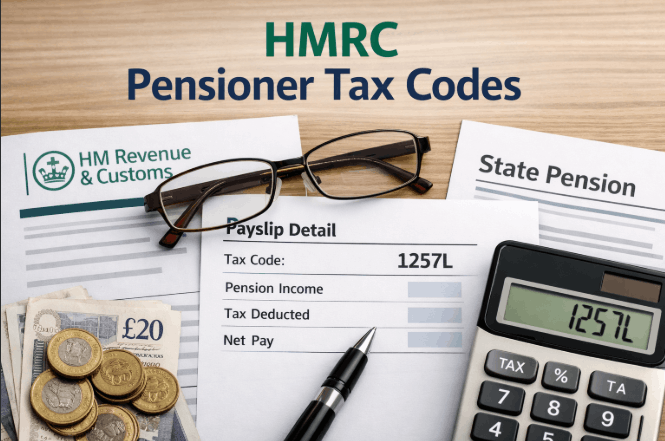
For 2026/27, the standard code is 1257L, reflecting the £12,570 tax-free personal allowance. Pensioners with multiple income sources typically receive a separate code for each pension.
Key Takeaways
- The standard HMRC pensioner tax code for 2026/27 is 1257L, meaning the first £12,570 of pension income is free of Income Tax under the PAYE system.
- The state pension is paid gross by the Department for Work and Pensions, HMRC collects any tax owed on it by reducing the allowance in the tax code applied to an occupational or private pension.
- Pensioners who receive an emergency W1/M1 code on a first flexible withdrawal are routinely overtaxed in many cases by over £1,000, with the overpayment fully recoverable using HMRC forms P55, P53Z, or P50Z.
What Tax Code Do Pensioners Get from HMRC?
Most pensioners receive tax code 1257L from HMRC in 2026/27, the same code applied to employed workers with a single income source and no adjustments. The number 1257 is derived directly from the personal allowance: £12,570 divided by 10 equals 1,257, and the letter L confirms that standard personal allowance applies.
Each pension source receives its own separate HMRC tax code. A pensioner drawing income from both a workplace pension and a private pension will hold two active codes simultaneously, one for each provider.
HMRC allocates the full personal allowance to the primary pension and assigns a secondary code, often BR, to any additional source.
Pensioners based in Scotland receive codes prefixed with S, for example, S1257L, reflecting Scottish Income Tax bands, which apply different rates from the rest of the UK from the starter rate upwards.
Welsh-resident pensioners receive a C prefix under the same mechanism. The Income Tax (Earnings and Pensions) Act 2003 provides the legislative framework governing how these codes are calculated and applied across all pension types.
Where two or three pension sources are in payment simultaneously, HMRC’s allowance allocation process is where most coding errors originate.

Why HMRC Pensioner Tax Codes Go Wrong and the Three Most Common Errors?
Most pensioner tax code errors trace back to the sequence HMRC uses to allocate the personal allowance across multiple pension income streams, pension providers have no authority to change it.
The three most common errors, in order of frequency, are:
Error 1: The state pension triple lock rise redistributes the personal allowance.
Each April, the state pension increases under the triple lock. When the new rate pushes the state pension figure closer to or beyond the £12,570 personal allowance, HMRC must reduce the allowance left for the occupational pension code.
If the adjustment is delayed or miscalculated, the occupational pension receives a K code or 0T code, meaning the pensioner is taxed with no remaining allowance, or charged as though carrying a negative allowance.
This is the most frequent cause of excess tax deduction among pensioners drawing both state and occupational pension income simultaneously.
Error 2: A new private pension or drawdown income is treated as a secondary source at inception.
When a pensioner begins drawing from a private pension or flexible drawdown pot for the first time, HMRC has no prior coding instruction on record for that provider.
The pension provider applies a BR code by default, taxing all income from that source at the 20% basic rate with no personal allowance applied, until HMRC redistributes the allowance across the two sources.
Error 3: The DWP-to-HMRC notification lag causes temporary overtaxation.
When the DWP notifies HMRC of a pensioner’s annual state pension increase, a processing lag occurs before the PAYE coding notice for the occupational pension is updated.
During this window, the occupational pension provider continues to operate on the old code, systematically over-deducting tax until the revised P2 PAYE coding notice arrives.
Each error produces a specific, identifiable code, and HMRC can correct all three once the pensioner raises the issue.

How to Read Your HMRC PAYE Coding Notice as a Pensioner?
The P2 PAYE coding notice is the document HMRC sends to pension providers instructing them how much tax-free income to allow, any coding error will be visible here before it becomes a tax problem.
HMRC sends a revised P2 whenever a code changes; the same information appears in the HMRC Personal Tax Account online and via the HMRC app, though in a different layout.
A pensioner’s P2 coding notice is divided into five distinct sections:
- Allowances section: Lists the personal allowance (£12,570 for 2026/27) and any marriage allowance or blind person’s allowance applied. This is the starting point for the code number.
- Deductions section: Shows any amounts subtracted from the allowance, such as untaxed state pension income, underpaid tax being collected in-year, or employment benefits. A K code appears when deductions exceed allowances.
- Pension income estimates: HMRC’s projection of how much each pension will pay in the current tax year. An inaccurate estimate here flows directly into an inaccurate code.
- State pension entry: The annualised state pension figure HMRC has received from the DWP. If this entry is missing or outdated, the entire coding calculation is built on incorrect data.
- The resulting code number: The final instruction sent to the pension provider. The number represents the tax-free amount divided by 10.
If any entry in these sections does not match actual income, contact HMRC immediately via the Personal Tax Account. Pension providers have no authority to amend a code, only HMRC can issue a revised P2 coding notice.
For further context on how HMRC formally notifies pensioners of changes to their tax position, see HMRC notices for UK pensioners savings.
HMRC Pensioner Tax Code Letters: Full Reference Table
Each letter in an HMRC pension tax code tells the provider how, and whether, to apply the personal allowance to that income source.
| Code | What It Means for Pensioners | Common Cause | Action Required |
|---|---|---|---|
| 1257L | Standard code, full personal allowance of £12,570 applied | Single pension, no adjustments | None, verify annually |
| BR | Basic rate tax (20%) on all income, no personal allowance | Second or new pension source | Contact HMRC to redistribute allowance |
| OT | No personal allowance, all income taxed at applicable rate | Allowance fully used by another source | Contact HMRC to check allocation |
| K | Negative allowance, extra tax collected above standard rate | State pension exceeds remaining allowance | Check P2 coding notice immediately |
| NT | No tax deducted | Specific low-income or exemption circumstances | Verify with HMRC, not standard for most pensioners |
| W1/M1 | Emergency code, month 1 or week 1 basis taxation | First withdrawal from a new pension | Reclaim overpaid tax using correct HMRC form |
| D0 | All income taxed at higher rate (40%) | High combined pension income | Confirm total income, contact HMRC if incorrect |
| S | Scottish Income Tax bands apply | Scottish resident | No action if correct |
| C | Welsh Income Tax rates apply | Welsh resident | No action if correct |
| T | HMRC requires additional review of personal allowance | Income estimated above £100,000 | Contact HMRC to confirm |
Figures confirmed as of April 2026 via HMRC and the Low Incomes Tax Reform Group (LITRG).
Of all the codes in the table, W1/M1 carries the greatest financial risk for pensioners accessing flexible pension income, the month 1 tax calculation it triggers can produce an overpayment running into thousands of pounds on a single withdrawal.
Emergency Tax Codes on Pension Withdrawals and How to Reclaim Overpaid Tax
Why the Emergency Code Applies on First Withdrawal?
The W1/M1 emergency code applies because the pension provider has received no HMRC coding instruction for a first-time flexible withdrawal.
In the absence of an HMRC coding notice, the provider defaults to a month 1 calculation, the mechanics of which, and the overpayment it typically generates, are explained below.
When the W1/M1 emergency code is applied to a first flexible pension withdrawal, the pension provider calculates tax by multiplying the withdrawal by 12 and taxing the result as annual income.
A single £10,000 withdrawal is therefore treated as £120,000 annual income, triggering higher-rate tax deductions on a sum that may fall entirely within the basic rate band when assessed correctly. Overpayments of several thousand pounds are common.
The Pension Freedoms Act 2015 created the right to access defined contribution pension pots flexibly from age 55, but it did not resolve the pre-existing PAYE mechanism that generates emergency coding on first withdrawals.
According to the HMRC Pension Schemes Newsletter, HMRC refunded more than £190 million to pensioners in a single year due to incorrect taxation on flexible withdrawals.
How to Reclaim Overpaid Pension Tax Using the Correct HMRC Form?
Selecting the wrong reclaim form delays the refund. Use this sequence to identify the correct form:
- Check whether the pension pot has been fully emptied. If yes, and the pensioner has stopped working, use form P50Z.
- Check whether the pension pot has been fully emptied, but the pensioner is still working or receiving other taxable income. If yes, use form P53Z.
- Check whether flexible income was taken, but the pot was not fully emptied. If yes, use form P55, the most commonly used form for partial drawdown withdrawals.
- Submit the correct form to HMRC. Refunds are typically processed within 30 days. Forms are available via the HMRC Personal Tax Account or by calling HMRC telephone number free 0800 0345 opening times.
Pensioners who do not submit a reclaim form will receive a correction through HMRC’s annual PAYE reconciliation, typically completed between June and November following the end of the tax year, meaning the wait for a refund can stretch to 12 months or more.

How the State Pension Affects Your HMRC Tax Code?
The state pension is paid gross by the DWP, no tax is deducted before the payment reaches the pensioner. HMRC collects any Income Tax owed on it by reducing the personal allowance in the PAYE code applied to the pensioner’s occupational or private pension.
For 2026/27, the full new state pension stands at approximately £11,973 per year, based on the DWP’s confirmed annual rate.
For a pensioner receiving the full state pension alongside an occupational pension, HMRC subtracts the state pension figure from the £12,570 personal allowance, leaving £597 in remaining allowance.
On those figures, £12,570 minus £11,973 leaves £597 in remaining allowance, producing a code of 59L on the occupational pension in place of the standard 1257L.
This calculation is illustrative; the actual code will vary depending on the confirmed state pension award from DWP.
When the state pension begins mid-year, HMRC typically issues a week 1 or month 1 code to the occupational pension provider to account for the part-year state pension income accurately.
LITRG advises that if no revised coding notice arrives shortly after the state pension begins, the pensioner should contact HMRC directly to confirm the DWP award notification has been received and processed.
A failure to update the code at this point is one of the most common sources of K codes for pensioners, where the deductions from the personal allowance exceed the allowance itself, resulting in additional tax being collected on top of the standard rate.
Pensioners who suspect their occupational pension code does not reflect their current state pension position should check their P2 coding notice for the state pension entry. For background on HMRC’s active enforcement of pension income tax obligations, see HMRC wage raid payroll checks.
Conclusion
HMRC pensioner tax codes determine how much Income Tax is deducted from every pension payment under PAYE, and errors are far more common than HMRC’s standard guidance implies.
Reading the P2 coding notice, identifying the source of any error, and selecting the correct reclaim form are what separate pensioners who overpay for months from those who resolve the issue quickly.
For UK pensioners in 2026/27, an accurate HMRC tax code is the difference between a correct deduction and a recoverable overpayment that should never have occurred.

FAQ
What is an emergency tax code on a pension?
An emergency W1/M1 pension tax code is a temporary PAYE instruction applied when no prior tax code exists for a pension provider, typically on a first flexible withdrawal. It causes the provider to tax the payment as though the same amount will be received every month of the tax year, which routinely results in a substantial tax overpayment on a payment that would attract far less or no tax if assessed on the correct annual basis.
Can overpaid pension tax be reclaimed from HMRC?
Yes, overpaid pension tax is fully reclaimable using HMRC forms P55, P53Z, or P50Z, depending on whether the pension pot was fully emptied and whether other income is still being received. Refunds are typically processed within 30 days of a correctly submitted form.
Why has my pension tax code changed?
HMRC pension tax codes change when income estimates are revised, when the state pension rises under the triple lock, when a new pension source begins, or when HMRC collects underpaid tax from a previous year through an adjusted code. Each change triggers a revised P2 PAYE coding notice, pensioners should check it promptly, as the new code takes effect from the next pension payment.
How do pensioners check their tax code with HMRC?
The current pension tax code is visible in the HMRC Personal Tax Account at gov.uk/personal-tax-account and via the HMRC app. Both show the code, the allowances applied, and the deductions used to calculate it. The P60 certificate issued by the pension provider each May also confirms the code in use at the tax year end.
Disclaimer: The information provided in this article is for educational purposes only and does not constitute formal financial or legal advice; readers should consult HMRC or a certified financial advisor regarding their personal tax circumstances.