How Much State Pension Will I Get At 66? 2026/27 Full Rates, Eligibility, And Payment Dates
As of April 2026, the full New State Pension in the UK is £241.30 per week, following a 4.8% increase under the Triple Lock mechanism. To receive this maximum amount at age 66, you typically need 35 qualifying National Insurance years. Those with at least 10 but fewer than 35 years receive a pro-rata payment.
This significant uplift means the annual State Pension for the 2026/27 tax year reaches £12,547.60. This uplift forms the bedrock of retirement planning for millions, though the final figure rests on a forensic assessment of your specific National Insurance history.
At a Glance: 2026 Retirement Thresholds
- Full Weekly Rate: £241.30 for those with 35 qualifying years.
- Annual Total: £12,547.60 paid in four-weekly installments.
- Minimum Threshold: 10 qualifying years are required to receive any payment.
- Triple Lock Impact: The 4.8% rise was driven by average earnings growth between May and July 2025.
How much State Pension will I get at 66?
From 6 April 2026, the Department for Work and Pensions (DWP) pays a maximum of £241.30 per week to individuals reaching State Pension age with a full contribution record.
This follows a series of updates regarding the DWP State pension age change 2026 which has altered the timeline for thousands of retirees.
This New State Pension applies to men born on or after 6 April 1951 and women born on or after 6 April 1953.
New State Pension Increase for April 2026
The government confirmed the 4.8% increase to ensure the pension keeps pace with the UK economy. Payments are non-static; if your entitlement begins mid-cycle, the initial deposit is often a part-payment covering only the opening days.
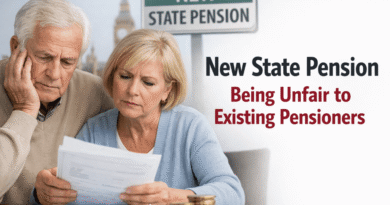
While the full rate is the headline figure, your personal forecast might differ if you were contracted out of the Additional State Pension in previous decades. These variations in payouts often lead to discussions regarding the new state pension being unfair to existing pensioners who remain on the older, basic system.
For those in traditional workplace schemes, these historical differences remain a common factor in their final DWP assessment.
How much State Pension will I get at 66 per year?
Securing the maximum annual entitlement of £12,547.60 hinges on a full 35-year record of contributions or credits. This does not necessarily mean 35 years of full-time employment; credits for childcare, illness, or unemployment also count toward this total.
Calculating Your Annual Entitlement
If you have exactly 35 years, your gross annual income from the state will be £12,547.60. A common pitfall involves assuming the pension is distributed in equal monthly chunks. Instead, the DWP pays in 13 installments every four weeks. If your NI record is between 10 and 34 years, your annual amount is scaled accordingly.
How much State Pension will I get at 66 after 20 years?
If you reach age 66 with 20 qualifying years, you are entitled to approximately £137.89 per week in the 2026/27 tax year. This is calculated as 20/35ths of the full £241.30 rate.
Why Your 20-Year Figure Might Vary
Forecasts typically reveal a Contracted Out deduction for those previously enrolled in defined benefit schemes. If you were part of a defined benefit pension scheme before 2016, a COPE(Contracted Out Pension Equivalent) amount is deducted from your starting total because you paid lower NI contributions at the time.
Common State Pension Misconceptions and Facts
| Myth | Reality |
| Everyone gets the full £241.30 at 66. | You only get the full amount with 35 qualifying NI years. |
| You get paid on your 66th birthday. | Payments are made in arrears, usually 4 weeks after your birthday. |
| 30 years is enough for a full pension. | Since 2016, 35 years are required for the New State Pension. |
| Pensions are paid automatically. | You must actively claim your pension when you receive your DWP invitation. |
| You can’t work and claim the pension. | You can claim your pension while working, though it may be taxed. |
How Long After My 66th Birthday Will I Get My State Pension?
Reaching age 66 is the eligibility milestone, but it is not your first pay date. The State Pension is paid in arrears, meaning you are paid for the period of time that has already passed.
Understanding the Payment Lag
Your payment day is determined by the last two digits of your National Insurance number. Because payments are made every four weeks, your first payment might arrive up to five weeks after your 66th birthday.
How to Claim and Receive Your First Payment:
- Receive your DWP letter: Look for an invitation 4 months before you turn 66.
- Claim online: Use the Get your State Pension service on GOV.UK.
- Choose your account: Provide details for a UK bank or building society.
- Wait for the decision letter: This confirms your weekly rate and first pay date.
- Identify your pay day: Check your NI number to see if you are paid on Monday, Tuesday, Wednesday, Thursday, or Friday.
- Receive the part-payment: Note that your first deposit may be smaller than a full 4-week cycle.
- Regular cycle begins: Full payments of approximately £965.20 (4 x £241.30) will then arrive every 4 weeks.

How much State Pension will i get at 66 married couple?
Under the New State Pension rules, there is no longer a married person’s pension based on a spouse’s record. Since payments are now strictly individual, many couples are also looking at wider estate planning, including what happens to your private pension when you die UK to ensure household security.
Every individual’s payment is strictly determined by their own National Insurance history.
The End of Category B Pensions
For couples reaching age 66 in 2026, the maximum combined household income from the state is £482.60 per week (£241.30 each), provided both have 35 years of contributions.
Regulatory history shows that women who historically opted for the ‘married woman’s stamp’ often face smaller individual records.
2026/27 Weekly Rate Comparison
| Qualifying Years | Weekly New State Pension (Approx) | Annual Total (2026/27) |
| 35 Years (Full) | £241.30 | £12,547.60 |
| 30 Years | £206.83 | £10,755.16 |
| 25 Years | £172.36 | £8,962.72 |
| 20 Years | £137.89 | £7,170.28 |
| 10 Years (Minimum) | £68.94 | £3,584.88 |
Using the Official State Pension Forecast Tool
The most accurate way to verify your future income is through the official government forecast tool. Relying on third-party calculators can be risky, as they may not account for your specific NI gaps or Contracted Out history.
Accessing Your DWP Forecast
To use the official calculator tool service, you will need a Government Gateway ID. This tool pulls live data from HMRC to show you exactly how many qualifying years you have and how much you can increase your pension by working more years or paying voluntary Class 3 NI contributions.
Current Benefit Rates for the 2026 Tax Year
| Pension Type | Weekly Rate (Full) | Monthly Equivalent |
| New State Pension | £241.30 | £1,045.63 |
| Basic State Pension (Pre-2016) | £184.90 | £801.23 |
| Pension Credit (Single Guarantee) | £231.10 | £1,001.43 |

Final Summary
Understanding your projected income at age 66 is essential for realistic retirement budgeting. Staying informed on the UK State Pension age retirement changes ensures you aren’t caught off guard by shifting eligibility dates.
With the full rate now at £241.30 per week, the first step for any retiree is to obtain a formal forecast from the DWP.
If you have gaps in your 35-year record, the current tax year remains a critical window to consider voluntary contributions before the cost of buying back years increases.
FAQ
Can I get a full pension with 30 years?
No. For those reaching age 66 under the New State Pension rules (after April 2016), 35 qualifying years are generally required for the full rate. 30 years would provide 30/35ths of the maximum amount.
Will the pension rise again in 2027?
Yes. The State Pension is protected by the Triple Lock. It will rise in April 2027 by the highest of earnings growth, CPI inflation (September 2026), or 2.5%.
Does the State Pension start automatically?
Payments do not trigger automatically on your birthday, a common misunderstanding that can lead to significant delays.
What is the highest State Pension amount you can get?
The highest amount exceeds the standard £241.30 if you defer (delay) claiming your pension. For every 9 weeks you defer, your pension increases by 1%, totaling roughly 5.8% for a full year.
Is the State Pension backdated to my birthday?
Yes, but only if you claim within a certain timeframe. If you delay claiming without choosing to defer, you can usually backdate your claim for up to 12 months.
Can I buy extra years to reach 35?
Yes. You can often pay for voluntary Class 3 National Insurance contributions to fill gaps in your record from the last six tax years, potentially boosting your annual income.
How much state pension will i get if i have never worked?
If you have 0 qualifying NI years, you will not receive a State Pension. However, you may be eligible for Pension Credit, which provides a minimum income guarantee for those of pension age.
Disclaimer: This guide provides general information based on current DWP and HMRC regulations and does not constitute regulated financial, legal, or tax advice. You should verify your specific forecast with the official Government Pension Service before making any retirement decisions.