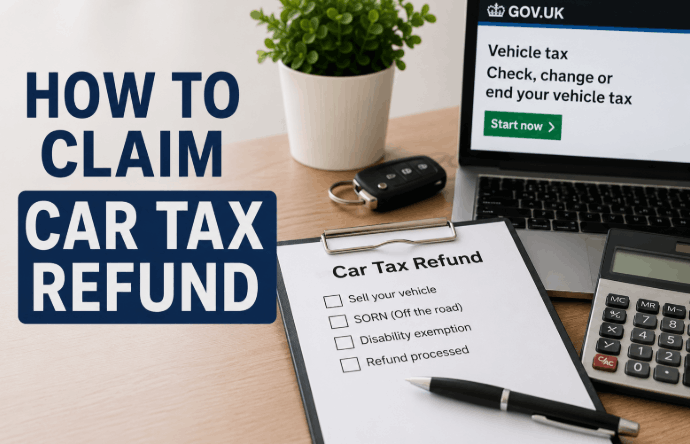
How to Claim Car Tax Refund: Step-by-Step DVLA Rules, Payout Times, and Exemption Guide
A car tax refund starts when you tell DVLA why the tax is ending, for example, because you have sold the car, declared it off the road or moved to a disability exemption. DVLA then cancels the tax and refunds any full months of Vehicle Excise Duty left, usually by cheque, without a separate application form.
A car tax refund is the amount DVLA repays for any complete calendar months of Vehicle Excise Duty (VED) left after the tax is cancelled for an accepted reason, such as selling or scrapping the vehicle, declaring it off the road with a SORN, or qualifying for a disability exemption.
The refund is based on the date DVLA is notified, not the date the change actually happened, and is paid automatically once the tax cancellation is processed.
Key Takeaways
- Refunds cover full remaining calendar months of VED only; no part-month is repaid.
- DVLA calculates the refund from the date it receives notification, not the date the car was sold, scrapped or taken off the road.
- Refunds are sent by cheque to the name and address on the vehicle’s V5C log book.
- Cheques typically arrive within 8 weeks for postal applications, 6 weeks for phone or online applications, and 4 weeks for SORN confirmations made by phone.
- A vehicle moving onto a PIP-based tax exemption is refunded from the date the tax class changes, not backdated to the PIP award date.
When You’re Owed a Car Tax Refund
A car tax refund is due when DVLA cancels Vehicle Excise Duty before the end of the taxed period for an accepted reason. The following circumstances can qualify for a refund:
- The vehicle has been sold or transferred to someone else
- It has been declared off the road with a Statutory Off Road Notification (SORN)
- An insurer has written it off
- It has been scrapped at an authorised treatment facility
- It has been reported stolen
- It has been permanently exported from the UK
- It has been registered as exempt from vehicle tax, including under a disability exemption
Simply leaving a car parked on a driveway does not qualify on its own. The vehicle needs a SORN before its tax can be cancelled, as DVLA cannot tell whether an unused taxed car is still being driven on the road.
How to Claim Car Tax Refund
You do not need to fill in a separate form to claim a car tax refund. The process starts by telling DVLA what has happened to the vehicle through the relevant GOV.UK service. Selling, declaring SORN, writing off, scrapping and exporting each have their own notification route.
Once DVLA processes the notification, the tax is cancelled, and the refund is worked out automatically:
- Notify DVLA of the change, using the V5C log book reference or the relevant online service.
- DVLA cancels the vehicle tax, and if it was paid by Direct Debit, cancels that instruction automatically.
- DVLA calculates the refund based on any complete months of tax remaining.
- DVLA sends the refund, usually by cheque, to the name and address shown on the V5C.
The important date is when DVLA receives the notification, not when the car was sold or stopped being used. Telling DVLA promptly helps protect the amount you get back, as any delay can reduce the number of full months left to refund.
How Much Refund You’ll Get
DVLA only refunds full calendar months of Vehicle Excise Duty left when the tax is cancelled. Part months are not refunded.
If DVLA receives the notification partway through a month, the refund starts from the beginning of the following month rather than the date of notification.
A car taxed until March, with notification received in the middle of August, would be refunded from September onwards rather than for the second half of August.
Refunds exclude:
- Any credit card processing fee
- The 5% surcharge applied to some Direct Debit payments
- The 10% surcharge charged on a single six-month payment
A different rule applies to a vehicle’s first tax payment when it is newly registered. DVLA uses whichever is lower, the first-year rate actually paid or the standard rate that applies from the second payment onwards, rather than refunding the full higher first-year amount.
PIP and Disability Vehicle Tax Refunds
When a vehicle moves onto a disability tax exemption, DVLA refunds the full months remaining from the date the tax class changes. It does not use an earlier date, such as when a Personal Independence Payment (PIP) award was approved or backdated.
This can be confusing because PIP awards can be backdated for months, so some drivers assume the vehicle tax refund works in the same way. It does not. The refund starts only after DVLA has processed the exemption and changed the vehicle’s tax class.
Once an exemption is confirmed, some drivers also look at what it means for their vehicle choices, particularly under the Motability scheme, including which models and brands are available and how the tax rules apply.
There has also been uncertainty about whether disability-linked vehicle support is being reduced or changed, particularly as some claimants move from DLA to PIP.
Anyone unsure whether their current arrangement is affected should check the facts about PIP and DLA Motability payments before assuming their vehicle tax status is about to change.
How Long a DVLA Car Tax Refund Takes
DVLA gives three different timeframes for a refund cheque, depending on how the cancellation was reported. The waiting time starts from the date DVLA received the notification, not the date the car stopped being used.
| Application method | Typical wait before contacting DVLA |
|---|---|
| Postal application | 8 weeks |
| Phone or online application | 6 weeks |
| SORN confirmation by phone | 4 weeks |
Figures confirmed as of August 2026 via GOV.UK.
Some comparison sites quote a flat “4 to 6 weeks” for every refund, but this does not match DVLA’s own guidance, which gives different times depending on how the application was made. The table above, based on GOV.UK guidance, gives a more accurate idea of how long different refunds can take.
What to Do If Your Refund Hasn’t Arrived
If your refund cheque has not arrived within the relevant timeframe, check a few things first: make sure enough time has passed since you notified DVLA, that the name and address on the V5C log book are correct, and that the original notification was submitted successfully.
If everything is correct, you can contact DVLA by phone, webchat or post. If the cheque has been issued in the wrong name, it can be returned for correction. DVLA advises allowing another 4 weeks for a replacement cheque after the incorrect one has been returned.
If the issue is with a PIP award or exemption status rather than the refund cheque, it is better to contact DWP rather than DVLA. Checking the correct PIP benefits phone number first can help you avoid contacting the wrong department.
What Information DVLA Needs From You
The paperwork DVLA needs depends on why the tax is being cancelled, and providing the wrong information can cause delays.
| Circumstance | Information typically needed |
|---|---|
| Sold or transferred | V5C log book reference and new keeper’s details |
| Declared SORN | V5C reference or tax reminder details |
| Written off | V5C details plus the insurer’s name and postcode |
| Scrapped | V5C details and the treatment facility’s information |
Drivers dealing with a disability exemption may also have several vehicle-related documents to manage at the same time. If you also hold or are applying for a disabled parking permit, it may be useful to look at the Blue Badge requirements at the same time, as some of the supporting evidence may overlap.
Conclusion
Getting a car tax refund comes down to one main step: telling DVLA promptly why the vehicle tax should end, whether because of a sale, SORN, scrapping or a disability exemption.
DVLA then cancels the tax and refunds any full months remaining without a separate application, usually within 4 to 8 weeks depending on how the change was reported.

FAQs
Is car tax automatically refunded when you sell a car?
Yes, provided DVLA is told about the sale. The tax is cancelled once DVLA receives notification, and any full months of tax remaining are refunded automatically to the name and address on the V5C log book. The new owner must then tax the vehicle separately.
How do I get my DVLA refund on my car tax?
No separate refund application is needed. Refunds are triggered automatically once DVLA processes the reason the tax is ending, whether that’s a sale, a SORN, a write-off, scrapping, or a disability exemption, and the cheque follows without any further request.
Can I apply for a tax refund directly?
There is no standalone refund application. Notifying DVLA of the underlying change, through the relevant GOV.UK service for selling, SORN, writing off or scrapping a vehicle, is what starts the refund process; a refund cannot be requested on its own.
Disclaimer: This article provides general informational guidance only; please consult official DVLA or GOV.UK channels for definitive, up-to-date legal and tax advice.




Pingback: How to Cancel Road Tax: Quick Steps to Claim a DVLA Refund