
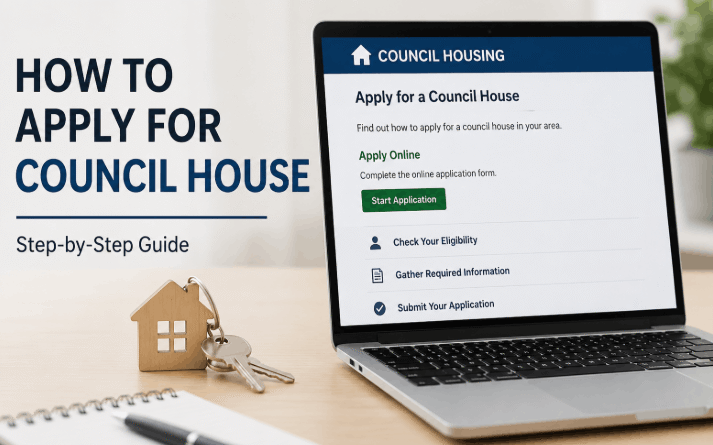
How to Apply for a Council House: Step-by-Step Guide
To apply for a council house, you register with your local council’s housing register, usually online, so your household can be assessed for social housing and added to the waiting list based on need. Local authorities across all four UK nations run the process differently; the guidance below reflects policy confirmed as of August 2026.
Key Takeaways
- Applications go through the local council where a person lives, usually via an online housing register form.
- The Housing Act 1996 requires every English council to publish an allocation scheme showing how priority is decided.
- Anyone aged 18 or over can normally apply, though some councils accept applications from 16 year olds.
How to Apply for a Council House Online?
The first step in applying for a council house online is finding the right local authority through GOV.UK. Applications go through your council, not central government. MHCLG issues the statutory guidance every English council must follow when designing a housing register form, though the layout varies by council.
- Enter a postcode on GOV.UK to find the responsible council, since England alone has more than 300 separate housing authorities.
- Register for an online account with that council, a step required before any housing needs assessment can begin.
- Complete the housing register application, giving details of income, savings, household members and any medical or overcrowding needs.
- Upload supporting documents, including proof of identity, address history and immigration status where relevant.
- Submit the form and wait for written confirmation that the application has joined the register.
Most councils confirm receipt within a few weeks, though a full eligibility decision often takes longer.

Who Is Eligible for Council Housing?
Eligibility for council housing depends on immigration status, income and a genuine housing need, judged against the criteria each council sets under Part 6 of the Housing Act 1996.
Applicants should also expect a check for local connection, meaning time spent living, working or having family in the area. Many councils also take into account whether a household is already receiving local cost of living support, as this can help evidence genuine financial hardship.
Who typically qualifies:
- British or Irish citizens living in the UK
- People with settled status under the EU Settlement Scheme
- People with indefinite leave to remain or refugee status
- People with a right to reside confirmed through their immigration documents
Who usually does not qualify:
- Visitors with no right to remain in the UK
- Most people still going through the asylum process
- Anyone whose immigration papers state no recourse to public funds
Meeting these immigration rules confirms eligibility, but priority still depends on separately assessed housing need.
How to Apply for a Council House When Homeless?
If you’re homeless, applying for a council house works differently to a standard application, and you should start the process the same day you become homeless or are at risk of losing your home.
- Contact the council’s housing options team immediately, rather than waiting to complete a full housing register form.
- Explain the circumstances clearly, including any date a tenancy ends, or an eviction notice was served.
- Ask whether the council owes a homelessness duty under Part 7 of the Housing Act 1996, which is legally separate from Part 6 housing register allocation.
- Accept any offer of temporary accommodation while the council carries out a full assessment.
- Continue pursuing a housing register application at the same time, since a homelessness duty does not automatically secure a permanent home.
Many applicants assume these two routes are the same thing, but a council can owe a homelessness duty long before it allocates permanent housing. If you’re unsure which duty applies to your situation, Shelter’s advice service is a good place to check.

Council House Applications in England, Scotland, Wales and Northern Ireland
Each UK nation runs council housing applications under its own legal framework, though the underlying goal stays the same, joining a list assessed by need.
| Nation | Applies Through | Legal Framework | Local Connection Rule |
|---|---|---|---|
| England | Local council housing register | Housing Act 1996, Part 6 | Usually required, set by each council |
| Scotland | Local council or Common Housing Register | Housing (Scotland) Act 2001 | Removed or relaxed in most areas |
| Wales | Local council housing register | Housing Act 1996 as applied in Wales, with Welsh Government guidance | Usually required |
| Northern Ireland | Northern Ireland Housing Executive | Housing Selection Scheme | Assessed differently to Great Britain rules |
Scotland’s approach is the most distinct of the four, since many local authorities have dropped the local connection requirement entirely to make it easier for applicants to move for work or family reasons.
How to Apply for a Council House in Scotland?
In Scotland, you apply by registering directly with the relevant council or housing association, as there’s no single national application system.
Many Scottish councils operate a Common Housing Register, letting one social housing application cover both council homes and local housing association properties at once.
Applicants should visit mygov.scot to find the correct council contact, then check whether that authority uses a points based or choice based system, since the two work differently once properties become available.
Anyone aged 16 or over can apply in Scotland, two years earlier than the standard threshold used across most of England.
What Happens After You Apply?
After an application is accepted, most councils place the household on a waiting list and confirm this through choice based lettings, where available properties are advertised rather than allocated directly.
- Check the council’s website or app regularly for properties advertised under the applicant’s priority band.
- Express interest, known as bidding, on suitable homes, though most councils cap this at around three bids per week.
- Wait for the council to review all interest and offer the property to the applicant with the highest priority.
- Respond quickly if an offer is made, since most councils give only a short window, sometimes 24 to 48 hours, to accept or decline.
Anyone wondering how to get a council house sooner should update their application whenever circumstances change, since a new medical condition can move a household into a higher band.
Citizens Advice recommends checking waiting list status directly with the council rather than relying on estimated timescales.
Why Council House Waiting Lists Are So Long?
Waiting lists stay long simply because demand for social housing far outpaces the number of homes that become available each year.
More than a million households were recorded on local authority waiting lists in England alone in recent housing data, while only a small fraction of that number of social homes are built or become available annually.
This gap between demand and supply, rather than any error in how an individual application is handled, explains most long waits.
Recent government landlord tax hikes have also affected the private rental market, prompting some landlords to sell rather than continue letting.
Fewer affordable private rentals pushes more households towards the council housing register, adding further pressure to an already stretched system. Waiting times therefore depend heavily on location and property size, and high demand areas always move more slowly than rural ones.

Common Myths About Council Housing and What Is Actually True
Council housing comes with plenty of persistent myths, and most of them can be checked straight against current GOV.UK and council guidance.
| Myth | Reality |
|---|---|
| There is a trick to jump the waiting list | No shortcut exists; priority is decided only by assessed need under the council’s allocation scheme |
| Council housing is only for people on benefits | Many tenants are in low to middle income employment; there is no blanket benefits requirement |
| Anyone can get a home within months | Waits of several years are common in high demand areas such as London |
| Council housing is completely free | Rent is charged, though usually below private market rates |
| Savings automatically disqualify an applicant | Savings are considered but rarely disqualify outright; the effect depends on the specific council |
| Applying to one council is enough | Applicants can register with several councils at once in most parts of the UK, which can shorten the wait |
The safest way to avoid a wasted application is to check any claim you’ve heard against your own council’s allocation scheme.
Other Support and Housing Alternatives While You Wait
Waiting for a council home does not mean a household has no other options in the meantime.
- Applicants open to buying instead of renting could also compare new homes with discounts of up to £100k under current government-backed affordability schemes.
- Households already receiving benefits or on a low income may also qualify for support such as the EON Warm Home Discount toward winter energy bills.
- Existing social tenants struggling with an unsuitable property can look into a mutual exchange, swapping homes directly with another tenant instead of waiting for a new offer.
- Renting privately remains an option for many households, and Universal Credit can help cover part of the cost through its housing element.
None of these options replace a council housing application, but used alongside one, they can make the wait considerably easier.
If Your Application Is Rejected or You Disagree with a Decision
Applicants can formally challenge a council’s decision if an application is rejected or a priority band seems wrong.
- Request the reasons for the decision in writing, since councils must explain how the allocation scheme was applied.
- Ask for an internal review within 21 days, a right confirmed under Section 166A(9) of the Housing Act 1996.
- Provide any additional evidence not included in the original application, such as updated medical letters.
- Escalate to the Housing Ombudsman Service if the review process itself is mishandled or excessively delayed.
Most successful reviews succeed because new evidence was added, not because the original decision was overturned outright, so gathering strong documentation matters more than the review request itself.

Your Rights and Right to Buy Once You Are Housed
Council tenants gain secure legal rights once a tenancy begins, including protection from eviction without a court order and, in many cases, the right to buy the home after a qualifying period.
The Right to Buy scheme remains active in England, though recent UK home ownership rules changes have adjusted the maximum discount available to long standing tenants.
Scotland and Wales have abolished the scheme to protect their social housing stock, so eligibility depends on which nation a tenancy is in. A change in personal circumstances can also affect an existing application or tenancy.
Someone made redundant while still waiting for an offer, for example, may want to work out how much tax they’ll pay on a £60,000 redundancy payout before reporting the change in income to the council, since it could shift their household into a different priority band.
Keeping an application or tenancy updated protects both a household’s priority and its long term security.
Conclusion
Applying for a council house starts with registering online through the correct local authority, then giving accurate, complete details about income, household size and housing need.
Eligibility, priority banding and legal routes differ across England, Scotland, Wales and Northern Ireland, so checking local rules matters as much as the application. For eligible households across the UK, council housing still offers a route to a stable, affordable home.
FAQ
Is there a way to apply for a council house faster than the standard route?
No legal shortcut exists. Priority depends entirely on the needs assessed under a council’s allocation scheme, and applying for a council house through unofficial routes offers no advantage over the standard application.
Do you have to pay rent if you get a council house?
Yes. Council housing is not free, though rent is typically set below private market rates. The exact amount depends on the property size, location and the council’s own rent setting policy.
Can you apply for a council house if you already own a home?
No, in most cases. Council housing is intended for people who cannot otherwise afford suitable accommodation, so existing homeowners are generally not eligible unless facing an exceptional circumstance such as an unsafe property.
Is council housing means tested?
Not in the traditional sense. Most councils do not apply a strict income threshold, but income, savings and assets are all considered when assessing housing need and setting priority.
How do you qualify for council housing in the UK?
Qualification depends on immigration status, a genuine housing need, and meeting the eligibility criteria set by the relevant local council under the Housing Act 1996 or its equivalent across Scotland, Wales and Northern Ireland.
Disclaimer: This guidance is for informational purposes only; check your local council’s website for specific, current application rules.



Pingback: Beat The England Real House Prices Decline: 2026 Action Plan