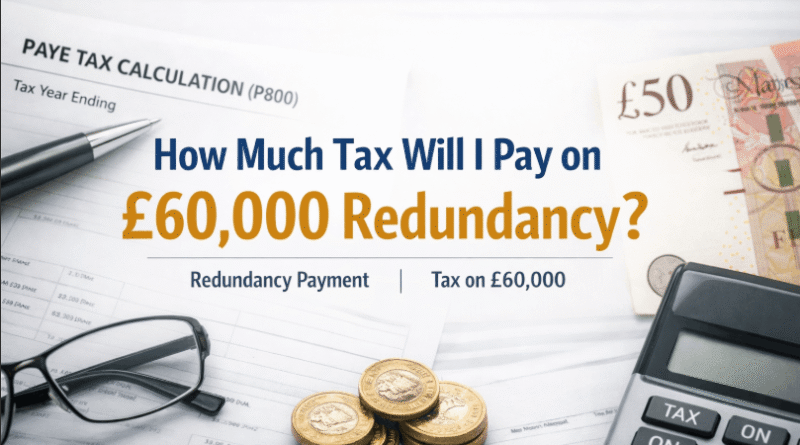
How Much Tax Will I Pay On 60,000 Redundancy? UK Payout Projections and HMRC PENP Rules
On a £60,000 redundancy payment in the UK, the first £30,000 is tax-free. Many workers facing this situation immediately ask, how much tax will i pay on 60,000 redundancy? You will pay Income Tax on the remaining £30,000 at your marginal rate (20%, 40%, or 45%). While no employee National Insurance is due on the redundancy element, your total annual income determines the exact tax deduction.
To keep as much of your payout as possible, you need to know exactly how HMRC distinguishes between a termination award and your normal salary.
Miscalculating the interaction between your salary and your redundancy package can lead to an unexpected tax cliff, particularly if the payout pushes you into a higher tax bracket or triggers the withdrawal of your personal allowance.
Redundancy tax essentials at a glance
- The £30,000 Threshold: This is a statutory limit; any redundancy amount above this is classified as taxable earnings.
- National Insurance Exemption: Employees generally do not pay National Insurance on redundancy payments, even on the portion exceeding £30,000.
- The PENP Rule: Post-Employment Notice Pay must be calculated and taxed as normal salary before applying the redundancy exemption.
- Reporting: Employers usually deduct tax via PAYE, but you must report the full amount on a Self Assessment return if you are a higher-rate taxpayer.
How much tax will I pay on 60,000 redundancy?
You will typically pay £6,000 in tax on a £60,000 redundancy if you are a basic-rate taxpayer, or £12,000 if the taxable portion falls within the higher-rate bracket. This assumes the first £30,000 is fully exempt under HMRC’s termination award rules, leaving £30,000 subject to Income Tax.
The final figure depends heavily on your total earnings for the tax year. HMRC views the taxable £30,000 as top-slice income.
If you are planning where to hold your net settlement, a recent NS&I savings rate increase may offer a secure alternative to standard high-street bank accounts for your lump sum.
If your year-to-date salary has already used up your £12,570 Personal Allowance and the 20% tax band, the entire taxable portion of your redundancy could be taxed at 40% or even 45%.

What is redundancy and how does it work in the UK?
Redundancy is a form of dismissal that occurs when an employer needs to reduce their workforce because a business, or a specific site, is closing or has a diminished need for employees to carry out work of a particular kind. It is not a reflection of individual performance but a structural change within the organisation.
Under the Employment Rights Act 1996, employees with at least two years of continuous service are entitled to statutory redundancy pay. Many employers offer enhanced or contractual redundancy packages that exceed the legal minimum.
For tax purposes, HMRC treats both statutory and enhanced redundancy as termination awards, allowing them to share the same £30,000 tax-free exemption.
Understand what qualifies for the £30,000 tax-free redundancy limit
Not every penny in a settlement agreement qualifies for the tax-free limit. HMRC distinguishes strictly between a payment for the loss of office and payments related to previous service or notice.
To qualify for the £30,000 exemption, the payment must be a genuine redundancy or compensation for loss of employment. The following items are excluded from the exemption and are taxed fully:
- Unpaid wages and holiday pay.
- Bonuses or commissions earned before leaving.
- Payments for restrictive covenants (agreements not to compete).
- Post-Employment Notice Pay (PENP).
Only the Ex-Gratia or Redundancy element of your package qualifies for the £30,000 tax-free threshold.
How Post Employment Notice Pay affects your final redundancy tax bill?
The most frequent error in redundancy planning is ignoring Post-Employment Notice Pay (PENP). HMRC rules prevent employers from disguising taxable notice pay as a tax-free redundancy lump sum.
If you do not work your full notice period, your employer must calculate how much basic pay you would have received had you worked it. This amount (PENP) is carved out of your total settlement and taxed as normal salary (with Income Tax and National Insurance).
Only the remaining balance can utilize the £30,000 exemption. If your PENP is high, you may find that significantly less of your £60,000 is tax-free than you originally anticipated.

Managing higher rate tax on redundancy payments over £30,000
When receiving a £60,000 payout, you are effectively adding £30,000 of taxable income to your existing earnings for the year. For those earning a mid-range salary, this often pushes them from the 20% Basic Rate into the 40% Higher Rate band (which starts at £50,270).
If the taxable £30,000 straddles this threshold, a portion will be taxed at 20% and the remainder at 40%. Checking your latest P60 or payslip will help you pinpoint your remaining basic rate ceiling before the payment lands.
Do you pay National Insurance on redundancy pay?
Employees do not pay National Insurance (NI) on genuine redundancy payments, regardless of the size of the payout. This represents a significant saving compared to a standard bonus. While Income Tax applies to any amount over £30,000, the NI exemption remains in place for the employee.
However, since April 2020, employers are required to pay Class 1A National Insurance (currently 13.8%) on the portion of a termination payment that exceeds £30,000.
While this does not reduce your take-home pay directly, it is a cost your employer must factor into the settlement, which can sometimes influence the total gross figure offered during negotiations.
How to avoid tax on redundancy payments legally?
The most effective way to protect a £60,000 redundancy from the taxman is through Pension Salary Sacrifice, often called a Redundancy Sacrifice. You can request that your employer pays the taxable portion of your redundancy (the £30,000 over the limit) directly into your pension scheme.
By doing this, the money enters your pension pot without being subject to Income Tax. This strategy is particularly valuable if the payout would have pushed you into the 40% bracket.
It is also worth considering how this affects your broader wealth, especially following recent UK pension inheritance tax changes that impact how pots are passed down. Another strategy involves the Tax Year Arbitrage.
If your redundancy is confirmed in March, but you can delay the final payment until after April 6th, you can utilize a fresh set of tax bands for the new financial year, potentially lowering your overall liability.

Common UK redundancy tax myths and the actual HMRC rules
| Common Myth | Actual Regulatory Truth |
| All redundancy is tax-free up to £30k. | Only the redundancy element is free; notice pay is always taxed. |
| You pay National Insurance on the excess. | Employees pay £0 NI on redundancy, even above £30,000. |
| HMRC taxes redundancy at a flat 40%. | It is taxed at your marginal rate (20%, 40%, or 45%). |
| You can’t put redundancy into a pension. | You can sacrifice the taxable portion into a pension tax-free. |
| Holiday pay is part of the £30k limit. | Holiday pay is always taxed as normal earnings. |
Avoiding the 60% Tax Trap at £100,000
If your total income for the year (salary + taxable redundancy) exceeds £100,000, your Personal Allowance is withdrawn at a rate of £1 for every £2 earned over the threshold. This creates an effective tax rate of 60% in the bracket between £100,000 and £125,140.
For a £60,000 redundancy, this is a real risk. If you have already earned £70,000 in salary, the £30,000 taxable redundancy takes your total income to £100,000. Every pound over this will be taxed at 40%, plus you lose your tax-free allowance.
In this scenario, aggressive pension contributions are the only way to pull your Adjusted Net Income back below £100,000 and restore your allowance.
What is the 70/30 rule in redundancy?
You may hear colleagues or forums mention a 70/30 rule for redundancy, but this is a common misunderstanding of UK employment law. There is no official HMRC 70/30 regulation that dictates what percentage of a payout is tax-free.
Instead, this likely refers to a rule of thumb used by some practitioners when estimating the split between a tax-free redundancy payment and taxable notice/benefits.
In reality, HMRC requires a factual calculation based on the PENP formula. Relying on an arbitrary percentage like 70/30 during a negotiation is dangerous.
If the redundancy portion is found to be artificially inflated to avoid tax, HMRC can retrospectively tax the payment and issue penalties to both the employer and employee.

Redundancy Tax Calculator UK: How to calculate your net payout
To manually calculate your net payout on a £60,000 redundancy, follow these steps:
- Identify the Exempt Amount: Subtract the first £30,000 (The tax-free element).
- Calculate PENP: Deduct any pay in lieu of notice from the remaining £30,000 and tax it as salary.
- Determine Your Tax Band: Add the remaining taxable redundancy to your year-to-date earnings.
- Apply Income Tax: Apply 20%, 40%, or 45% to the taxable balance depending on your band.
- Final Deduction: Subtract the tax from the £60,000 gross total to find your take-home amount.
Projected redundancy take-home pay for 2026/27 tax bands
| Total Annual Income (Inc. Redundancy) | Tax Rate on Excess | Estimated Net of £60k Payout |
| Up to £50,270 | 20% (Basic) | £54,000 |
| £50,271 – £125,140 | 40% (Higher) | £48,000 |
| Over £125,140 | 45% (Additional) | £46,500 |
Note: Estimates assume the full £30,000 exemption is applied. Actual figures vary based on individual tax codes.
Conclusion
Managing a £60,000 redundancy requires a strategic approach to HMRC’s thresholds. While the initial £30,000 provides a significant tax-free buffer, the remaining balance is subject to the same rigorous Income Tax rules as your standard salary.
Navigating the PENP rules and the £100,000 allowance taper is the best way to ensure you don’t lose an unnecessary portion of your settlement to the taxman.
There is often confusion regarding NI on redundancy over £30k. While employers must pay NI on the excess, employees do not pay NI on any part of a genuine redundancy payment, a position confirmed by the Social Security Contributions and Benefits Act 1992.
FAQ
How much tax will i pay on 60,000 redundancy?
You pay £0 tax on the first £30,000. On a £60,000 payment, the extra £30,000 is taxable. If you are a basic rate payer, the tax is £6,000 (20%). If you are a higher rate payer, the tax is £12,000 (40%). No employee National Insurance is deducted from the redundancy portion.
How do I calculate tax on my redundancy?
Start by setting aside the first £30,000 as tax-free. Everything else in your settlement, including notice pay, bonuses, and the redundancy balance, is added to your other income for the tax year. You then apply the 20%, 40%, or 45% tax rates to this total, just as you would with a monthly salary.
Is redundancy taxed at 40%?
Yes, but only if your total taxable income for the year exceeds the higher-rate threshold of £50,270. If the taxable part of your redundancy pushes your total annual income above this level, the portion sitting in that bracket will be taxed at 40%.
Do I pay 20% or 40% tax?
This depends on your total earnings from April 6th to the date you receive your payout. If your salary plus the taxable £30,000 of your redundancy is less than £50,270, you pay 20%. If it exceeds that amount, you pay 40% on the portion above the threshold.
Can you avoid tax on redundancy pay?
Yes, legally. By using salary sacrifice, you can have your employer pay the taxable portion of your redundancy directly into your pension. Because pension contributions are tax-exempt, you avoid the 20% or 40% hit entirely, though the money is then locked until you reach pension age.
Keep an eye on potential policy shifts too; for instance, any move toward the pension tax-free lump sum to be scrapped, would change the math on long-term withdrawals.
Do I pay National Insurance on redundancy pay?
No. According to HMRC guidelines, employees do not pay Class 1 National Insurance on redundancy payments. This applies to both the tax-free £30,000 and the taxable excess. This is a unique benefit of redundancy pay compared to standard salary or bonuses.
What is the most tax-efficient way to take redundancy?
The most efficient method is combining a pension sacrifice with timing the payment for a new tax year. If you receive a large payout in April instead of March, you can use your full personal allowance and basic rate bands for the new year to offset the taxable portion.
What is the 12 week rule for redundancy?
The 12-week rule refers to how a week’s pay is calculated for statutory redundancy. If your pay varies (e.g., due to shift work or commission), your employer must average your earnings over the 12 weeks leading up to the day you were given notice to determine your statutory entitlement.
Disclaimer: This article provides general information based on UK tax rules for 2025/26 and 2026/27 and does not constitute professional financial or legal advice; you should consult a qualified tax advisor or HMRC regarding your specific circumstances.