
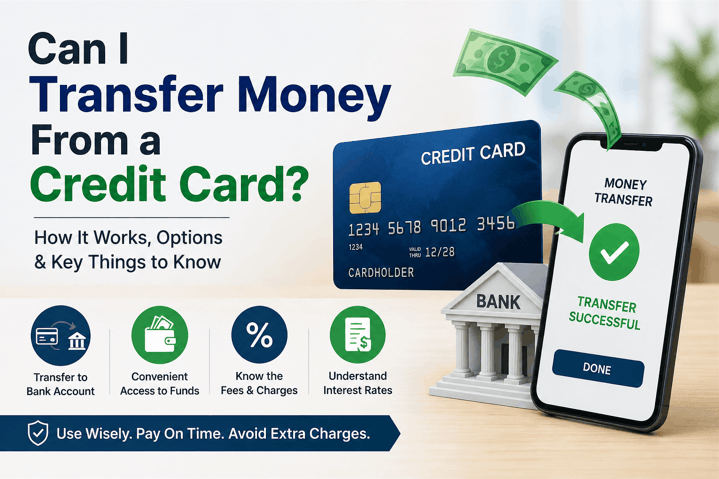
Can I Transfer Money From a Credit Card to a Bank Account? Fees, Limits and Interest Rules
Yes, a cardholder can transfer money from a credit card. A money transfer moves credit-card funds into a UK current account in the cardholder’s own name. HSBC UK says the fee is usually 2.99% to 5%, based on issuer pages checked on 1 November 2026.
Key takeaways
- Halifax, MBNA and Lloyds Bank cap a money transfer at 93% of the credit limit; Virgin Money states 95%.
- Spending transferred money falls outside Section 75, the Consumer Credit Act 1974 purchase protection (Halifax, MBNA, Lloyds Bank).
- HSBC UK says a money transfer itself does not appear on your credit report, although missed payments, exceeding your limit or borrowing more to repay an overdraft can affect your creditworthiness.
Can you transfer money from a credit card to a bank account?
Yes, a money transfer moves funds from a credit card to a UK current account held in the cardholder’s name. Halifax says transfers cannot go to other accounts, in the UK or overseas. MBNA and Lloyds Bank add that the account must be registered at the same address as the card.
Savings accounts are a separate question. None of the issuer pages checked lists a savings account as a destination, so a credit card to savings account transfer cannot be assumed to work.
To start transferring money from a credit card to a bank account online, open the issuer’s app or online banking and check that the receiving UK current account is in your name.
Can you use a credit card to transfer money? Three routes compared
Yes, but only one route is built for moving money into a bank account: the money transfer, sold on a money transfer credit card or offered as an option on other cards. The table compares it with a cash advance, which is a cash withdrawal on the card, and with card-funded top-ups of e-money or wallets.
| Route | Where the money ends up | Typical fee | When interest starts |
|---|---|---|---|
| Money transfer | UK current account in the cardholder’s name | Usually 2.99% to 5% (HSBC UK) | Interest may apply from the day of the transfer unless the card has a money-transfer-specific 0% offer (NatWest, Ulster Bank) |
| Cash advance | Cash from a cash machine | Usually around 2–3% (MoneyHelper) | From the date the transaction is added (Lloyds Bank) |
| Card-funded top-up of e-money, payment cards or mobile wallets | The wallet or payment account | A cash transaction fee may apply (Lloyds Bank) | From the date the transaction is added (Lloyds Bank) |
A balance transfer is a different product. MoneyHelper describes it as moving a balance from one credit or store card to another card with a different provider.
A money transfer sends card funds to a current account instead, and MoneyHelper says a money transfer usually involves a one-off fee, often up to 4% of the amount transferred.
Lloyds Bank says most providers charge a cash transaction fee, which may be up to 5%, and that interest runs from the date the transaction is added. It also counts topping up e-money, payment cards or mobile wallets as cash transactions, and points customers to their card terms for the full list.
Treat a cash advance as an emergency-only option, and read the card terms before using the card to top up any wallet or payment account.

What interest rate and fee apply to a credit card money transfer?
The transfer fee is a percentage of each transfer, and the interest rate is either a promotional 0% interest period or the card’s standard rate. HSBC UK says the fee is usually 2.99% to 5%, with interest on top unless a 0% money-transfer offer is running.
Ulster Bank lists 3% (minimum £3) and says interest is charged from the day of the transfer. Lloyds Bank adds the fee to the balance and says offers can be 0% for a shorter period or a low fixed rate for longer.
A summary box for one Lloyds Bank card lists a 5% non-introductory money transfer fee. No issuer page checked publishes one standard money transfer rate, because each card has its own.
Illustration only, using hypothetical round numbers: on an £800 transfer, a 3% fee adds £24 (balance £824), a 4% fee adds £32 (£832) and a 5% fee adds £40 (£840). Repaying £832 over a 12-month 0% interest period works out at £69.33 a month.
Read the summary box for the exact fee and standard rate before requesting a transfer, because both differ by card.
Check when a promotional money-transfer rate must be used. Halifax says some offers apply only to transfers made within a set period from opening the account, while Virgin Money says its 0% money-transfer offer is available on selected cards and subject to eligibility.
What rules decide whether a credit card money transfer goes through?
Whether a transfer goes through depends on the receiving account, the credit-limit cap, whether the card offers money transfers, and the issuer’s checks. The table compares six issuers using their own pages.
| Issuer | Receiving account | Maximum transfer | Usual arrival | Fee stated |
|---|---|---|---|---|
| Halifax | UK current account held in the cardholder’s name | 93% of the credit limit | Next working day | A percentage of each transfer |
| MBNA | UK bank account in the cardholder’s name, same address as the card | 93% of the credit limit | Next working day | Usually a percentage of the amount |
| Lloyds Bank | Own UK current account, same address as the card | 93%, including the existing balance | Next working day | A percentage, added to the balance |
| HSBC UK | Cardholder’s own account only | Not stated | Next working day | Usually 2.99% to 5% |
| NatWest | Any UK bank account | Not stated | Not stated | 3% or minimum £3 |
| Virgin Money | Current account | 95% of the credit limit | 2 to 3 working days if no extra checks | A fee on each transfer |
Lloyds Bank says its 93% cap includes the existing balance and allows for fees and transactions that have not yet reached the account. The transfer fee covered in the previous section therefore reduces the largest sum available.
Halifax, MBNA, Lloyds Bank and HSBC UK each state a £100 minimum; the minimum is issuer-specific.
Source conflict. NatWest’s page says money can go to any UK bank account and that only the primary cardholder can request a transfer. Four other issuers in the table restrict transfers to the cardholder’s own account.
Each issuer’s own terms decide, so the account type and owner need confirming before details are entered.
Not every credit card offers a money transfer. Lloyds Bank says transfers are subject to status and may be limited to selected products.
Halifax says not all providers offer them and that they may not be immediately available to new customers. Issuers also apply eligibility and security checks, so approval is not guaranteed.
What should you check before transferring money from a credit card?
Before requesting a transfer, check eligibility, cost, the cap, the receiving account, the repayment plan, other balances and the account details.
- Eligibility check: Run the issuer’s eligibility check before applying, and confirm the card offers money transfers.
- Fee and rate: Read the summary box for the transfer fee and the standard rate that applies after the 0% interest period.
- Cap: Keep the amount within the credit limit cap, leaving room for the fee.
- Receiving account: Choose a UK current account in your name, at the same address as the card.
- Repayment plan: Divide the transfer plus the fee by the months of the 0% interest period, so the balance clears before the standard rate starts.
- Other balances: Check how your issuer allocates payments, because this can affect whether a 0% transfer balance is cleared last. MoneyHelper advises aiming to clear the most expensive borrowing first.
- Accuracy: Double-check the amount and account details, because an approved transfer cannot be cancelled and its fee is not refunded.

How to transfer money from a credit card to a bank account online
Transferring money from a credit card to a bank account online takes six steps in the issuer’s app or online banking.
Once those checks are complete, follow the steps below.
- Log in to the card issuer’s app or online banking and open the credit card account.
- Choose the money transfer option.
- Enter the amount, at least £100 and within the cap.
- Enter the sort code and account number of the receiving UK current account.
- Review the fee and interest rate shown, then confirm.
- Complete the phone security check and wait for approval.
This process varies by issuer. NatWest says its money transfer must be arranged by contacting Credit Card Services, rather than through a standard online transfer flow.
At Lloyds Bank, the option sits under “Balance and money transfers” in the card account menu. Lloyds Bank and MBNA say approved transfers normally arrive by the next working day, while Virgin Money’s guide says 2 to 3 working days if no extra checks are needed.
Can you transfer money from a credit card to a debit card?
Not directly: issuers send the money to a current account, and the debit card or cash from that account then spends it. Ulster Bank answers the credit-card-to-debit-card question by describing a transfer of available credit to the current account, arranged through its credit card team.
Lloyds Bank says the money can then be used by debit card or cash. That route has a cost beyond the fee.
Halifax says purchases made with a debit card or cash after a money transfer are not protected by Section 75 of the Consumer Credit Act 1974, which covers only credit card purchases over £100 and up to £30,000.
For a broader explanation of card limits, interest, fees and Section 75, see our guide on how does a credit card works.
Pay for large purchases directly by credit card where the retailer accepts it, because that spending keeps the Section 75 cover.
Does a credit card money transfer affect your credit score?
HSBC UK says a money transfer itself does not appear on your credit report, although missed payments, exceeding your limit or borrowing more to repay an overdraft can affect your creditworthiness.
HSBC UK also says taking on more debt to pay off an overdraft can signal to lenders that a borrower is struggling financially, which may affect future borrowing. Lloyds Bank warns that paying late or missing a payment can bring fees, end promotional offers and damage a credit score.
MoneyHelper says a Direct Debit avoids late payment fees and the risk of losing a 0% introductory rate. Set up a Direct Debit for at least the minimum payment.

Are there alternatives to a credit card money transfer?
Yes: an overdraft, a credit union loan or a salary advance can cover a short-term gap, though each carries its own costs. MoneyHelper lists all three as borrowing alternatives.
- Arranged overdraft: MoneyHelper says standard current-account overdraft interest can be as high as 40%, and HSBC UK offers an overdraft eligibility checker that has no impact on a credit score.
- Credit union: MoneyHelper says a credit union might suit a low income and a small, short-term borrowing need.
- Salary advance: MoneyHelper includes salary advances among the borrowing options its tool compares.
If repayments already feel unaffordable, use MoneyHelper’s debt advice locator to find free, confidential debt advice before borrowing more.
Conclusion
Yes, a cardholder can usually transfer money from a credit card to a UK current account in their own name, paying a fee and interest once any money-transfer-specific 0% offer ends. A credit card to debit card transfer really lands in the linked current account, so spending it falls outside Section 75.
Compare the fee and rate in the summary box first, and weigh cheaper alternatives.
FAQs
Can you transfer money from a credit card to someone else’s bank account?
No, a standard money transfer cannot be sent to another person’s account at the issuers that publish a rule. Halifax limits transfers to the cardholder’s own account, and MBNA says transfers cannot be sent overseas or to someone else’s account. NatWest’s page says any UK bank account, so each issuer’s terms decide.
Can you transfer money from a credit card to a savings account?
The issuer pages checked name a UK current account as the destination, and none lists a savings account. A savings account therefore needs confirmation from the card issuer before any transfer is attempted.
How many times can you transfer money from a credit card per month?
No general monthly limit is published on the issuer pages checked, but rules vary. MBNA allows only one transfer of the same amount to or from an individual account in any 14-day period. Transfers are also subject to a £100 minimum, a 93% credit-limit cap and a fee on each transfer; Lloyds Bank says its cap includes the existing balance and that an approved transfer cannot be cancelled.
Is there a government-approved app or website for transferring money from a credit card?
None of the issuer pages checked refers to a government-approved app or website for this. Transfers are requested through the card issuer’s own app, online banking or phone. The Financial Conduct Authority (FCA) says its Firm Checker shows whether a financial firm is authorised and has permission to provide the services you want.
Fees, limits and availability vary by card issuer and individual circumstances. Figures reflect issuer and MoneyHelper pages checked on 1 November 2026; readers should confirm current terms with the card issuer before requesting a transfer.