Cold Weather Payment: Who Qualifies, How Much You Get and When It Is Paid
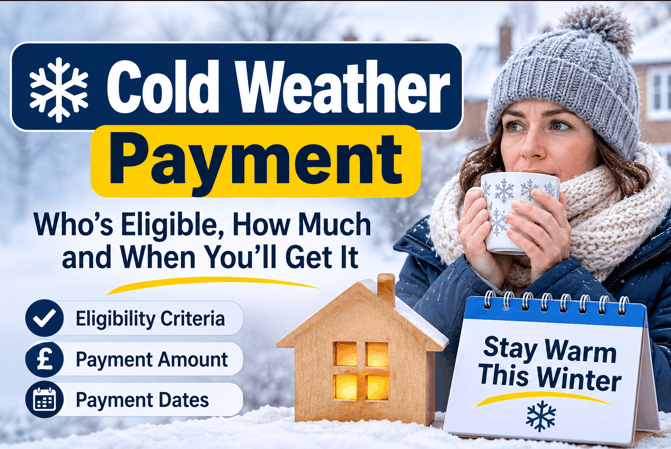
The Cold Weather Payment is a Department for Work and Pensions (DWP) top-up that pays £25 for each seven-day period of very cold weather between 1 November 2026 and 31 March 2027. It is paid automatically to eligible people in England, Wales and Northern Ireland.
Key Takeaways
- A Cold Weather Payment is £25 for each seven-day period of very cold weather between 1 November 2026 and 31 March 2027.
- Payment is automatic, needs no application and should arrive within 14 working days of each qualifying period.
- People receiving Pension Credit, income-related ESA, Universal Credit or SMI may qualify; some people receiving Income Support or income-based JSA may also qualify under legacy-benefit rules.
- Scotland is excluded, where the Winter Heating Payment applies instead.
Cold Weather Payment Eligibility: Which Benefits Qualify?
You may qualify for a Cold Weather Payment if you receive Pension Credit, income-related Employment and Support Allowance (ESA), Universal Credit or Support for Mortgage Interest (SMI). Check the table below for the extra condition attached to each benefit.
Income Support and income-based Jobseeker’s Allowance are legacy benefits that can still qualify under the Cold Weather Payment rules, although they do not appear in GOV.UK’s current headline eligibility list.
| Benefit | Extra condition needed? | What the condition is |
|---|---|---|
| Pension Credit | No | None listed; claimants usually qualify |
| Income-related ESA | Yes | In the work-related activity group or the support group |
| Income-related ESA, in neither group | Yes | A severe or enhanced disability premium, a pensioner premium, a disabled child or a child under 5 at home |
| Universal Credit | Yes | No adult on the claim is employed or gainfully self-employed, plus a health condition limiting capability for work or a child under 5 at home |
| Universal Credit with a disabled child amount | No | Qualifies whether or not anyone on the claim works |
| SMI | Yes | Treated as getting a qualifying benefit, plus a severe or enhanced disability premium, a pensioner premium, a disabled child or a child under 5 at home |
A premium is an extra amount added to a benefit for a particular circumstance, such as older age or disability. For Universal Credit, a person is generally treated as gainfully self-employed if their self-employment is organised, developed, regular and carried on in expectation of profit.
SMI claimants are usually treated as getting a qualifying benefit even if they applied for it and received nothing because their income was too high.

Who Does Not Get a Cold Weather Payment?
You will not get a Cold Weather Payment if you live in Scotland, receive no qualifying benefit or live where the weather trigger has not been met. These are eight reasons a payment may not arrive.
- You are on Personal Independence Payment (PIP) alone. PIP is not among the qualifying benefits listed by GOV.UK, so a PIP award does not trigger a payment, whatever your age or condition.
- You live in a care home or an independent hospital. The regulations exclude people residing in these settings from receiving a Cold Weather Payment.
- You live in Scotland. GOV.UK states that Scottish residents cannot get Cold Weather Payments, and the Winter Heating Payment applies there instead.
- You get Universal Credit, and you or a partner works. Work rules you out unless your claim includes a disabled child amount. For a recorded cold-weather period, neither you nor your partner may have been employed or gainfully self-employed on any day of that period. For a forecast period, the test applies on the day the Met Office provides the forecast to DWP.
- You receive a qualifying benefit but miss its extra condition. An ESA claimant in neither group, with no premium and no child under 5, is one example.
- You have not reported a new baby or a child under 5. Report a new baby or a child under 5 joining your household, because GOV.UK says you may need to report it.
- You are in hospital. Tell the Pension Service or Jobcentre Plus, because GOV.UK says a hospital stay could affect your payment.
- Your postcode area has not hit the trigger. It needs seven consecutive days at an average of 0°C or below.
A qualifying benefit alone does not guarantee a payment. In practice, a payment needs three things at once: a qualifying benefit, any extra condition met and a postcode area that hit the weather trigger.
How the Weather Trigger Works and Which Postcodes Qualify
A Cold Weather Payment triggers when the average temperature in a postcode area is recorded as, or forecast to be, 0°C or below over seven consecutive days. Forecasts count as well as recorded readings, so an area can qualify on predicted temperatures.
The DWP Cold Weather Payment postcode checker lets you check whether a postcode area in England or Wales has been triggered. Northern Ireland has a separate checker on the nidirect website.
DWP links each postcode area to a weather station and publishes a table of weather stations and postcodes for each season. Because triggers follow the weather, the postcodes paid change as winter goes on.
Each qualifying seven-day period pays £25, so three qualifying periods would total £75. A payment is not made for overlapping seven-day periods for which a Cold Weather Payment has already been made.
How Much Is the Cold Weather Payment for Pensioners?
Pensioners receive the same Cold Weather Payment as other qualifying claimants: £25 for each seven-day period of very cold weather. GOV.UK says people who get Pension Credit usually qualify, and age does not appear in its eligibility rules.
| Item | Detail for 2026/27 |
|---|---|
| Season | 1 November 2026 to 31 March 2027 |
| Amount | £25 for each seven-day period |
| Trigger | Average temperature recorded or forecast at 0°C or below for seven consecutive days |
| Payment window | Within 14 working days of each period |
| Application | None needed |
| Effect on other benefits | None |
| Where paid | England, Wales and Northern Ireland |
The 2026/27 rate matches the 2024/25 rate, when eligible people also received £25 for each seven-day period. A pensioner who receives State Pension only, with no qualifying benefit or SMI, does not qualify. DWP publishes estimated payment numbers for England and Wales each season.
Where Is the Cold Weather Payment Paid? England, Wales, Northern Ireland and Scotland
The Cold Weather Payment is paid in England, Wales and Northern Ireland but not in Scotland, where the Winter Heating Payment is available instead.
- England and Wales: The postcode checker on GOV.UK shows whether a postcode area has been triggered.
- Northern Ireland: nidirect runs a separate postcode checker and publishes its own guidance for claimants.
- Scotland: No Cold Weather Payment exists. Social Security Scotland pays the Winter Heating Payment instead, set at £62.00 for winter 2026/27 and paid regardless of the weather.
- The Winter Fuel Payment: GOV.UK states that Cold Weather Payments are different to Winter Fuel Payments, so each has its own rules.
When Will the Cold Weather Payment Be Paid?
A Cold Weather Payment should arrive within 14 working days of each qualifying seven-day period. Working days exclude weekends and bank holidays, so the wait can run longer than a fortnight. Payment goes into the same bank or building society account as the qualifying benefit, with no claim form.
Payment follows each seven-day period counted under the trigger rule above, so the date depends on when that period ends. Be cautious of any message asking for bank details. Check official GOV.UK or nidirect guidance before responding to an unexpected request.
Cold Weather Payment Myths: What the Official Guidance Says
Five common beliefs about Cold Weather Payment eligibility and amounts conflict with the official guidance.
| Myth | Official position |
|---|---|
| Anyone on PIP gets the payment | PIP is not among the qualifying benefits listed by GOV.UK. |
| You must apply for it | Payment is automatic for people who qualify; you do not need to apply. |
| Pensioners get a bigger payment | The rate is £25 for each seven-day period, with no separate age-based rate. |
| The payment is worth £140 | The rate is £25 for each seven-day period. |
| It is the same as the Winter Fuel Payment | Cold Weather Payments and Winter Fuel Payments are different payments. |
Source: GOV.UK Cold Weather Payment
When Did the Cold Weather Payment Start and Why?
The Social Fund is a government fund for specific needs, and the governing regulations define a cold weather payment as a payment to meet expenses for heating.
- 7 November 1988: The Social Fund Cold Weather Payments (General) Regulations 1988 came into force and set the rules for the scheme.
- 1 November 2013: Universal Credit became a route into the scheme under amending regulations.
- 2026/27: The payment is £25 for each qualifying seven-day period.
What to Do If You Think You Are Owed a Cold Weather Payment
Check your postcode first, confirm that you meet your benefit’s condition, and contact DWP only after the 14-working-day window has passed.
- Note which qualifying benefit you receive and whether it carries an extra condition in the eligibility table.
- Enter the first part of your postcode, the letters and numbers before the space, in the DWP checker for England and Wales, or the nidirect checker for Northern Ireland.
- Read the result to see whether your postcode area has been triggered.
- Work out when the Cold Weather Payment will be paid: allow 14 working days after each qualifying period ends.
- If nothing arrives, tell the Pension Service or Jobcentre Plus. If you claim Universal Credit, sign in to your account and add a note to your journal. If you do not have an online account, ring the Universal Credit helpline instead; the number is on letters about your Universal Credit claim.
- Report a hospital stay, a new baby or a child under 5 joining your household.
- Ignore any text or email that asks for your bank details, and report it as a suspicious message.
The Bottom Line
If you receive Pension Credit, income-related ESA, Universal Credit or SMI, you could get a Cold Weather Payment of £25 for each seven-day period of very cold weather this winter, without applying.
Check your postcode with the official checker after each cold spell, and report household changes promptly so your payment is not delayed. You may also be able to get help through other cost-of-living support, including the Warm Home Discount.
FAQs
Do you need to apply for a Cold Weather Payment?
No. You do not need to apply, because payment is automatic if you qualify. You may only need to report a new baby or a child under 5 joining your household.
Can you get a Cold Weather Payment if you are on PIP?
Not on PIP alone. Personal Independence Payment is not on GOV.UK’s list of qualifying benefits. You can still qualify if you also receive Pension Credit, income-related ESA, Universal Credit or SMI and meet that benefit’s condition.
Is the Cold Weather Payment the same as the Winter Fuel Payment?
No. GOV.UK treats them as different payments. A Cold Weather Payment depends on the weather in your postcode area and on a qualifying benefit, so check the Winter Fuel Payment rules separately.
How do you check whether a Cold Weather Payment is due in your area?
Use the postcode checker: the DWP checker for England and Wales, or the nidirect checker for Northern Ireland. Enter the first part of your postcode to check whether your area has been triggered. Check again after each cold spell, because triggers follow the weather.
Does a Cold Weather Payment affect your other benefits?
No. Cold Weather Payments do not affect your other benefits, and they arrive in the same account as your qualifying benefit.
Cold Weather Payment rules and eligibility can change. Check GOV.UK or nidirect for the latest guidance before making a financial decision.