How Does a Credit Card Work? UK Guide to Limits, Interest, APR, Fees and Section 75
How does a credit card work? A credit card is a revolving credit account that, as of October 2026, lets its holder borrow up to a set limit and repay through monthly statements. Paying the full statement balance by the due date means no interest on purchases. Revolving means the limit refills as the balance is repaid.
Key takeaways
- Paying the full statement balance by the due date means no interest on purchases.
- Financial Conduct Authority (FCA) rules set the minimum payment at interest, fees and charges plus at least 1% of the balance.
- Section 75 covers single items above £100 up to £30,000; lost or stolen-card liability is generally capped at £35, or the credit limit if lower, but fraud or gross negligence can remove that protection.
How Does a Credit Card Work in Simple Terms?
A credit card lets a cardholder spend the card provider’s money first and pay it back later. The provider sets a limit, the most that can be owed at any one time, and the limit frees up again as repayments clear. That renewing limit is why the account is called revolving credit.
Before the card arrives: how the provider decides
When someone applies, the provider checks their credit file, the record of past borrowing held by credit reference agencies. It also checks that the income given looks right and works out what is left each month after existing debts and living costs.
Those checks decide whether the application is accepted and how high the limit is. A full application leaves a “hard search” on the credit file, which other lenders can see. An eligibility checker uses a “soft search” instead, which they cannot see.
What Happens When You Use a Credit Card?
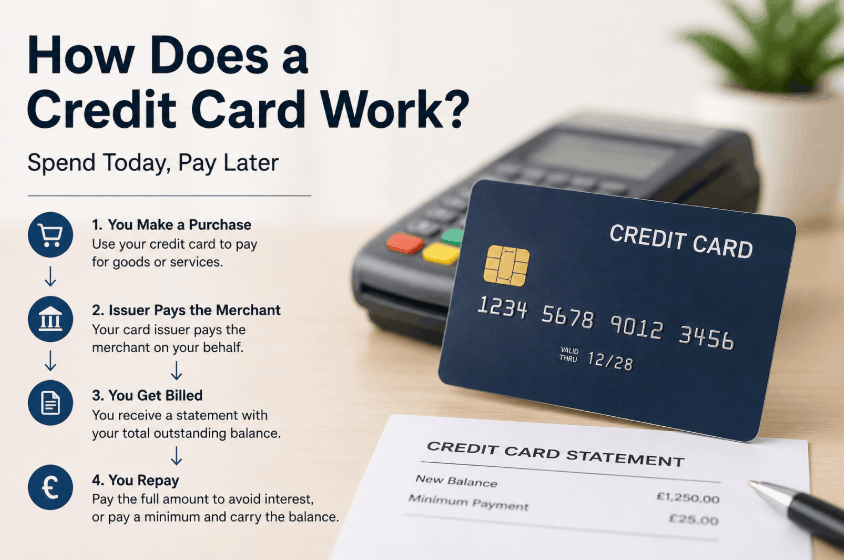
- The card is used. In a shop or online, the card details go to the shop’s own bank, which handles card payments for the shop.
- The request travels on. The shop’s bank sends it through the card network, such as Visa or Mastercard, to the card provider.
- The provider decides. It checks that the card is valid, that the amount fits within the limit and that the payment does not look like fraud. It then approves or declines.
- The shop gets the answer. The reply travels back the same way, so the shop knows whether to accept the payment.
- The money moves later. The provider records the amount as a debt on the account. The banks settle up afterwards; exactly when the shop receives the money depends on its agreement with its card-payment provider.
How a Credit Card Works Each Month: Spending, Statements and Payments
- Spend. Each purchase is added to the balance and uses up part of the limit.
- Statement. Once a month, the provider sends a statement listing purchases, any interest and fees, the total owed, the minimum payment and the due date.
- Pay. Payment must reach the provider by the due date. The amount, from the minimum up to the full balance, is the cardholder’s choice.
- Clear. Paying the full statement balance by the due date means no interest on purchases. This refers to the statement balance, not necessarily the current balance shown in the card app. Cash withdrawals and some other cash-like transactions are treated differently and can attract interest immediately.
- Carry. Any unpaid balance attracts interest, and the limit frees up only as repayments clear.
How Do Credit Card Companies Make Money?
The provider is involved in funding and settling the transaction, then collects repayment from the cardholder through the monthly statement.
It earns from interest on unpaid balances and from fees such as late payment charges. It also earns a small fee on each purchase, called interchange, which the shop’s bank pays to the card provider. UK rules cap interchange at 0.3% on consumer credit cards.
A cardholder who clears the balance every month pays the provider no interest. On that account, the provider’s earnings come from the purchase fee and any annual fee.
How does a credit card work when you first get it?
New cards normally need activating before use, and arrival times vary by provider. The first statement then shows what was spent and when payment is due.
Follow the provider’s activation instructions, then set up a Direct Debit for the full statement balance before the first statement arrives. That removes the risk of a missed payment and of interest on purchases.
Do All Credit Cards Work the Same Way?
All credit cards share the same core mechanics: a limit, a monthly statement and interest on unpaid balances. A balance transfer credit card or a 0% credit card nonetheless behaves very differently from an everyday purchase card.
| Card type | Designed for | Main cost to check | Catch to watch |
|---|---|---|---|
| Standard purchase card | Everyday spending | Interest rate on unpaid balances | Interest applies once a balance is carried |
| 0% purchase card | Spreading new spending interest-free | Standard rate after the offer ends | A balance left at the end starts accruing interest |
| Balance transfer card | Moving debt from another card | One-off transfer fee | Standard rate applies when the 0% period ends |
| Rewards or cashback card | Earning points or cashback | Annual fee and interest rate | Rewards only pay off when the balance is cleared monthly |
| Credit builder card | Building a credit history | Higher interest rate | Low credit limits are common |
How Does Interest Work on a Credit Card?
Interest on a credit card applies only to balances not cleared by the due date. The Bank of England reported an effective rate of 21.55% on interest-charging card balances in August 2026, up from 21.45% in July. Paying the full statement balance each month avoids interest on purchases.
Interest builds daily on the outstanding balance. The Bank of England’s effective rate was 21.56% in December 2025, so the cost of carrying a balance has changed little over that period.
The 21.55% figure is the effective rate paid on interest-charging balances, which can differ from a card’s advertised rate.
Providers quote an interest-free period of up to 56 days on purchases when the previous balance is paid in full, as Santander and MoneySupermarket both state.
An older “20 to 55 days” range still circulates from a Citizens Advice page last reviewed in December 2020. The real length depends on the provider and where in the statement cycle a purchase falls.
Once a balance is carried, interest is typically charged from the purchase date, including on the first statement of a newly issued card. Cash advances differ again: a fee usually applies and interest typically starts on the day you withdraw cash.
To avoid interest on purchases, set up a Direct Debit for the full statement balance and avoid using the card for cash withdrawals.
How Does an APR Work on a Credit Card?
APR, short for annual percentage rate, is the yearly cost of borrowing on a card, covering interest plus compulsory fees such as an annual fee. It is a comparison tool, not a bill.
Representative APR is the rate shown in card adverts. HSBC and MoneySupermarket both explain that for cards it assumes a £1,200 limit spent on day one and repaid in equal instalments over a year. What it counts and ignores:
- Counts: The standard purchase rate and compulsory charges such as an annual fee.
- Ignores: Balance transfer and cash advance rates.
- Ignores: Fees for late payment, going over the limit or returned payments.
For a rate to be advertised as representative, the lender must reasonably expect to provide credit at that rate or better under at least 51% of agreements resulting from the promotion. Some accepted applicants can therefore be offered a higher rate.
HSBC’s own illustration shows why fees matter: an 18.9% purchase rate with a £195 annual fee produces a 59.3% representative APR, while a 21.9% card with no annual fee remains at 21.9%.
The FCA opened consultation CP26/15 on 29 April 2026, asking whether the 51% threshold remains appropriate. It closed on 17 June 2026, and law firm Pinsent Masons reports that the FCA will update on the outcome later this year.

What Happens If You Only Pay the Minimum?
A UK credit card’s minimum payment must cover that month’s interest, fees and charges plus at least 1% of the balance.
Depending on the interest rate and the provider’s minimum-payment formula, paying only the minimum can clear debt very slowly or, where interest exceeds the principal repayment, leave the balance broadly unchanged or increasing.
On a hypothetical £1,000 balance at 20% APR with no new spending, a minimum made up only of interest plus 1% of the balance would not reduce the debt. Monthly interest would be about 1.67% of the balance, while the 1% principal repayment would be smaller, so the balance would gradually increase.
By contrast, paying a fixed £50 a month on the same £1,000 balance would clear it in about 25 months, assuming no fees and no new spending. Total repayments would be about £1,227, including about £227 in interest. Real minimum payments vary by provider and may include a fixed minimum amount.
FCA rule CONC 6.7.4R requires repayments to go first to the highest-rate balance when a card carries balances at different rates, such as purchases and a cash advance.
CONC 6.7.6R lets customers choose their own regular repayment between the minimum and the full balance. A persistent-debt timeline follows once repayments are mostly interest.
| Stage | What triggers it | What the lender must do |
|---|---|---|
| 1 | Over 18 months, repayments covered less principal than interest, fees and charges, and the balance never fell below £200 | Notify the customer, explain that higher payments cut cost and time, and point to free debt advice |
| 2 | The pattern still looks likely 9 to 10 months later | Repeat that communication |
| 3 | A further 18 months with the same pattern | Help the customer repay faster, normally within three to four years, and consider suspending or cancelling the card where the customer does not respond or declines an affordable repayment option; any suspension or cancellation must be objectively justified. |
A common mistake is setting a Direct Debit at the minimum and leaving it unchanged. Raising it well above the minimum, or to the full balance, cuts both interest and repayment time.
How Do 0% and Balance Transfer Credit Cards Work?
A 0% credit card charges no interest for a set introductory period, then switches to the card’s standard rate. The type depends on what the 0% covers: new purchases or debt moved from another card.
How does a 0% credit card work?
A 0% purchase card applies the promotional rate to new spending for a fixed period. Interest starts on any balance left when the period ends, so the full amount needs clearing before then. Which? has reported that applicants can be offered a shorter 0% term, a lower limit or a higher rate than advertised.
How does a balance transfer credit card work?
A balance transfer credit card moves debt from another card so that repayments go towards the debt, not interest, during the 0% period. A one-off fee usually applies.
Current market comparisons put the longest 0% balance-transfer deals at up to 38 months, with fees on the longest offers generally around 3.1% to 3.5%. Fee-free deals tend to have shorter introductory periods. A 3% fee on a £3,000 transfer would cost £90.
Most balance transfer cards bar transfers between cards from the same banking group. When the 0% period ends, any remaining balance reverts to the standard rate, which is where how an APR works on a credit card matters again.
Before applying, check:
- The balance transfer fee as a pound amount on the balance to be moved
- The date the 0% period ends and the rate that follows
- Whether the card accepts transfers from the existing card’s issuer
- Whether new purchases on the card carry interest
What Fees and Charges Can a Credit Card Carry?
Fees add to the cost of a card on top of interest, and most can be avoided. The table lists the main ones with typical levels and their sources.
| Fee | When it applies | Typical level |
|---|---|---|
| Late payment | Minimum payment missed by the due date | Often £12, though this varies by provider |
| Cash advance | Withdrawing cash or other cash-like transactions | Often around 3%, sometimes with a minimum fee; interest usually starts at once |
| Balance transfer | Moving debt onto the card | Often around 3% to 3.5% on longer 0% deals; some shorter deals charge none |
| Non-sterling transaction | Spending in another currency or with an overseas seller | Often around 3%, though some cards charge nothing |
| Annual fee | Holding the card | Varies by card; some cards charge none |
Check the card’s summary box and fees page before applying, because every figure above varies by provider.
How Does Section 75 Protect Credit Card Purchases?
Section 75 of the Consumer Credit Act 1974 makes a card provider jointly liable with the seller when a purchase goes wrong. It applies when a single item costs more than £100 and up to £30,000.
Covered:
- Each item priced above £100 up to £30,000, judged item by item and not on the whole basket.
- Purchases paid only partly by credit card, including deposits, for the full price of the item.
- Some qualifying purchases made abroad, although whether Section 75 applies depends on the transaction and the credit agreement.
Not covered:
- Cash withdrawals, or cash taken out and then spent.
- Debit card payments, where chargeback may help instead.
- Two £60 items bought together, because neither costs more than £100.

What Should You Do If a Credit Card Is Lost or Stolen?
Reporting a lost or stolen card to the provider immediately limits the cardholder’s liability for unauthorised spending, because the report is what stops further use.
- Report it. Use the provider’s app, helpline or online banking at once.
- Cancel, not just freeze. Which? has warned that some offline contactless payments may still go through a frozen card, so cancelling is safer for a card that cannot be found.
- Check transactions. Review recent activity and flag anything unrecognised to the provider.
- Update stored details. Replace the old card number with any shops, subscriptions and digital wallets.
- Replace it. Activate the new card on arrival.
Section 84 of the Consumer Credit Act 1974 generally caps liability for misuse of a lost or stolen card at £35, or the credit limit if that is lower.
The cap does not apply if the cardholder acted fraudulently or was grossly negligent about card security, and there is no liability for use after the provider has been told the card is lost or stolen. The cap was reduced from £50 to £35 on 13 January 2018 by the Payment Services Regulations 2017.
Conclusion
How does a credit card work? The provider lends up to a limit, the cardholder repays through monthly statements, and interest applies only to balances left unpaid. Paying the full statement balance by the due date avoids interest on purchases. Minimum-only repayment is the costliest pattern.
FAQs
Do you have to pay your credit card in full every month?
No. Only the minimum payment is compulsory, but paying the full statement balance by the due date avoids interest on purchases. That is how a credit card works as a payment tool, not a loan. Paying less leaves a balance that attracts interest.
What are the disadvantages of using a credit card?
The main disadvantages are interest on unpaid balances, fees such as cash advance and non-sterling charges, and years of minimum-only repayment. Missed payments can lower a credit score, as can high credit utilisation, meaning most of the limit in use.
Can you use a UK credit card abroad?
Yes, most UK credit cards work abroad. Many charge around 3% for non-sterling transactions, and cash withdrawals usually carry a fee plus immediate interest. Section 75 can cover qualifying purchases of more than £100 and up to £30,000 per item, but eligibility depends on the transaction and credit agreement. Check with your card provider before relying on it.
How much credit card limit for a £20,000 salary?
No fixed formula links a £20,000 salary to a limit, because providers set limits applicant by applicant using income, existing debts and credit history. A higher salary may support a higher limit, but a provider can still offer a lower limit depending on affordability checks and credit history.
Figures reflect rates and rules published as of 29 October 2026. This article is for general information only and is not financial advice; check current terms with your card provider before making decisions.