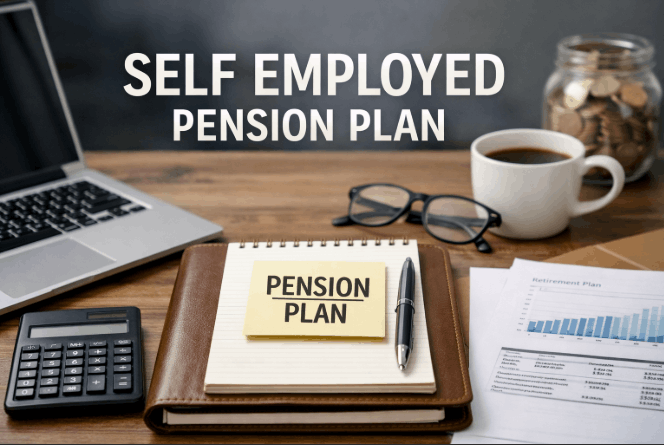
How to Choose a Self Employed Pension Plan: Tax Relief, SIPP Rules, and Variable Income Setup
A self employed pension plan is a private retirement savings arrangement that self-employed workers in the UK must set up and fund entirely themselves. Unlike employees, self-employed people are not automatically enrolled in a workplace pension.
For the 2026/27 tax year, contributions attract tax relief of up to 20% at the basic rate, applied automatically by the provider, with an annual allowance of £60,000.
Key Takeaways
- Self-employed people in the UK are not covered by auto-enrolment and receive no employer contributions, building a pension is entirely the individual’s responsibility
- The annual allowance for 2026/27 is £60,000 or 100% of net relevant earnings, whichever is lower, with unused allowance from the previous three tax years available to carry forward
- Sole traders and limited company directors face different contribution rules, company directors can route contributions through the business as employer contributions, reducing corporation tax
Why Self-Employed People Face a Different Retirement Challenge
Self-employed people receive no employer contributions and are excluded from automatic enrolment. The entire burden of retirement saving falls on the individual, and the scale of that burden is larger than most realise.
Research from the Pensions and Lifetime Savings Association puts the proportion of self-employed workers actively contributing to a private pension at fewer than 20%. Department for Work and Pensions figures confirm this is a structural problem, not a temporary one.
Employees enrolled in a workplace pension benefit from a minimum combined contribution of 8% of qualifying earnings under auto-enrolment rules.
A sole trader saving the equivalent 8% of trading profit does so entirely from their own pocket, with nothing added by an employer. Three compounding disadvantages define the self-employed retirement picture:
- No employer pension contributions at any level, regardless of how long someone has been self-employed
- No automatic enrolment to create a default saving habit at the point work begins
- Variable income makes sustaining fixed monthly contributions considerably harder than it is for salaried workers with a predictable pay cheque
Understanding these structural disadvantages is the starting point for choosing the right self employed pension plan and for setting contribution levels that genuinely compensate for the absent employer match.

The Four Types of Self Employed Pension Plan Available in the UK
Four main options exist for self-employed workers: a personal pension, a Self-Invested Personal Pension (SIPP), a stakeholder pension, and NEST. Each suits a different level of investment involvement and income pattern.
| Pension Type | Best Suited To | Contribution Flexibility | Investment Choice | Key Consideration |
|---|---|---|---|---|
| Personal Pension | New savers, hands-off approach | Vary or pause contributions anytime | Provider-managed funds | Charges vary widely between providers |
| SIPP | Experienced investors, higher earners | Lump sums and regular payments | Widest range including shares and ETFs | Most cost-effective for larger pots |
| Stakeholder Pension | Low-to-mid earners, simplicity | Highly flexible with low minimums | Limited fund range | FCA-regulated charge cap of 1.5% |
| NEST | Those wanting a government-backed option | Flexible with minimum £10 per contribution | Restricted fund range | Run by DWP with no profit motive |
For most self-employed workers, a SIPP or personal pension will be the primary vehicle. The right choice depends on income level, investment confidence, and whether contributions will come from personal earnings or through a limited company.
Both the SIPP and the personal pension operate as defined contribution arrangements, meaning the retirement income they produce depends on what goes in and how the underlying investments perform.
Before committing to a pension type, it helps to understand the rules around when and how money can be accessed. The full guidance on can i withdraw money from my pension plan covers the key withdrawal rules in detail.
How Much Can a Self-Employed Person Pay Into a Pension?
For 2026/27, the annual allowance is £60,000 or 100% of net relevant earnings, whichever is lower. For a sole trader, net relevant earnings means taxable trading profit, not turnover, and not dividend income from a limited company.
This distinction matters more than most articles acknowledge. A sole trader with £38,000 in trading profit cannot contribute £60,000 and receive full tax relief on all of it. The maximum tax-relievable contribution in that scenario is £38,000. The £60,000 figure is a ceiling, not a guaranteed entitlement.
The contribution rule operates across three tiers:
- Personal contributions are capped at 100% of net relevant earnings for the tax year. If trading profit is £35,000, the maximum contribution attracting relief is £35,000, not the full annual allowance.
- The £60,000 annual allowance is the absolute ceiling on all pension inputs combined. This includes personal contributions and any employer contributions made by a limited company into the same SIPP.
- Unused allowance from the previous three tax years can be carried forward, provided the individual was a member of a registered pension scheme in each of those years. A self-employed worker who opened a SIPP but contributed little in earlier years can use this rule to make a larger contribution in a more profitable year.
High earners should note that HMRC’s tapered annual allowance reduces the £60,000 limit for those with threshold income above £200,000. For every £2 of income above that threshold, the allowance reduces by £1, down to a minimum of £10,000.
For 2026/27, a self-employed person can contribute up to £60,000 or 100% of their net relevant earnings to a registered pension scheme, whichever figure is lower.
Unused annual allowance from the previous three tax years can be carried forward, making it possible to make a larger single contribution in a profitable year without triggering an HMRC tax charge.
For a full breakdown of how pension contributions interact with income tax bands and the Self Assessment process, the detailed guide to Pension plan taxation covers the mechanics in full.

How Self Employed Pension Tax Relief Works?
All self-employed pension contributions use a relief at source mechanism. The FCA-regulated provider claims 20% basic rate relief from HMRC and adds it to the pension pot automatically, meaning the contribution is boosted without any action required from the saver.
What this looks like in practice is straightforward. A contribution of £800 from personal funds becomes £1,000 inside the pension once the 20% basic rate relief is applied. The government adds the relief directly to the pot, not as a separate payment to the individual.
| Taxpayer Rate | Contribution from Own Pocket | Added by HMRC | Total in Pension |
|---|---|---|---|
| Basic rate (20%) | £800 | £200 automatically | £1,000 |
| Higher rate (40%) | £800 | £200 auto + £200 via Self Assessment | £1,000 (£200 reclaimed separately) |
| Additional rate (45%) | £800 | £200 auto + £250 via Self Assessment | £1,000 (£250 reclaimed separately) |
Higher and additional rate taxpayers receive the initial 20% relief automatically through their provider. The additional relief, a further 20% for higher rate taxpayers and 25% for additional rate payers, must be actively claimed each year through the Self Assessment tax return.
This is one of the most consistently missed tax reliefs among self-employed workers. A higher-rate taxpayer who contributes £10,000 to a personal pension and fails to claim through Self Assessment loses £2,000 that HMRC would otherwise have returned.
The correct framing, worth noting because it causes confusion, is that the relief rate is 20% at the basic rate. The contribution grows from a net £800 to a gross £1,000, which some describe as a 25% gross-up on the net amount paid in.
Both descriptions are technically accurate, but the relief rate itself is 20%, not 25%. Failing to claim higher-rate or additional-rate relief through Self Assessment means leaving money that HMRC owes on the table.
The annual claim process is straightforward but must be completed each tax year without exception.

Sole Trader or Limited Company: Why Your Contribution Strategy Differs
The pension contribution strategy for a sole trader and a limited company director is not just slightly different. At the point of contribution, the tax mechanics diverge in a way that makes one approach materially more efficient than the other for company directors.
A sole trader makes personal contributions from post-tax profit. Those contributions are capped at 100% of trading profit and attract income tax relief at the marginal rate through the relief at source process. This is straightforward and effective, but it works within a fixed ceiling set by personal earnings.
A limited company director has a second option that the sole trader does not. The company itself can make employer contributions directly into the director’s SIPP.
These contributions are treated as an allowable business expense under HMRC’s “wholly and exclusively” test, meaning they reduce the company’s taxable profits before corporation tax is calculated.
A company contributing £30,000 to a director’s SIPP at the 25% corporation tax rate saves approximately £7,500 in tax. The effective cost to the business is £22,500, not £30,000.
Three key differences define each path:
- Sole trader contributions are personal only, capped at 100% of trading profit, and attract relief at the individual’s marginal income tax rate
- Limited company employer contributions are not constrained by the director’s personal salary, reduce corporation tax directly, and are not subject to employer National Insurance
- Both structures are subject to the same £60,000 annual allowance, and both can use carry forward rules to increase contributions in profitable years
For directors running a family business with multiple family members involved, a Small Self-Administered Scheme (SSAS) offers an additional layer of flexibility.
Governed under the Pension Schemes Act 2021, an SSAS can accommodate up to 11 members including family directors and allows the trustees to invest in commercial property and make loans back to the sponsoring employer.
It carries greater administrative complexity than a SIPP but provides planning options that no personal pension or standard SIPP can match.
Limited company directors who contribute personally from post-tax dividends when employer contributions from the company are available are giving up a meaningful corporation tax saving. This is the single most common pension planning error among director-shareholders, and it is also the most avoidable.
For directors building a larger pension pot over time, how the fund is treated on death becomes an equally important consideration. The full guidance on how to avoid Inheritance Tax on pensions explains the current rules and the planning options available.
Building Contributions Around Variable Income
The most effective approach for self-employed workers is to tie pension contributions to income receipts rather than a fixed monthly schedule. This prevents under-saving in profitable months and avoids unsustainable commitments during slow trading periods.
A four-step framework makes this practical:
- Set a contribution percentage against net profit rather than a fixed pound amount. MoneyHelper recommends aiming for 15 to 20% of income, though 10% is a genuinely strong starting point for anyone beginning from zero or returning to saving after a gap.
- Separate a pension reserve from every invoice payment at the point money arrives. Depositing a fixed percentage immediately after receiving payment removes the temptation to spend it and avoids the pressure of finding a lump sum at the tax year end.
- Make contributions as lump sums after strong months or quarters rather than forcing a fixed direct debit that creates cash flow pressure during slower periods. Most SIPP and personal pension providers accept ad hoc payments with no minimum contribution size and no penalty for irregular timing.
- Use the carry forward rule before 5 April each year to sweep unused allowance from earlier years into the pension. Self-employed workers with variable income who under-contributed in previous years often find this is their most powerful tool for catching up.
Maintaining Class 2 National Insurance contributions, at £3.45 per week for 2026/27, is equally important. These contributions protect entitlement to the full State Pension of £241.30 per week, which requires 35 qualifying years on the NI record.
A self-employed worker who lets their NI record develop gaps faces a reduction in State Pension income that compounds over decades. Checking the NI record at gov.uk takes minutes and identifies any gaps that can still be filled with voluntary contributions.
Variable income is the defining constraint for self-employed savers, but a percentage-based contribution system combined with carry forward at year end turns that variability into an advantage rather than an obstacle.

When You Can Access a Self Employed Pension?
The minimum pension access age is currently 55, rising to 57 in April 2028 under legislation already confirmed by HMRC. This is a specific planning concern for any self-employed worker currently aged 53 or 54 who has factored a pension access date of 55 into their retirement plans.
From age 55, or 57 from April 2028, up to 25% of the pension pot can be taken as a tax-free lump sum. The remaining 75% is accessible but treated as taxable income.
Withdrawals are added to other income in the year of access and taxed at the marginal rate, which means a large withdrawal in a year when trading income is also high will attract a higher tax charge than the same withdrawal in a year of lower earnings.
For self-employed workers who intend to continue trading beyond 55, delaying access and allowing the pot to compound tax-free inside the pension wrapper is typically the more efficient strategy.
The tax-free growth inside a registered pension scheme is one of the most significant long-term advantages of pension saving over other forms of tax-efficient saving such as a stocks and shares ISA.
Self-employed workers aged 53 to 56 should review their retirement timeline now. Those planning to access their pension at 55 have considerably less time than they may realise before the access age rises permanently to 57.
Conclusion
A self employed pension plan offers no employer contributions, no auto-enrolment, and no default starting point. What it does offer is full control, generous tax relief through HMRC, carry forward flexibility for variable income years, and corporation tax efficiency for limited company directors.
A self employed pension plan means building retirement savings entirely on your own terms, for every self-employed worker in the UK in 2026 and beyond.
FAQ
How does tax relief work on a self-employed pension?
Relief at source applies to all personal pension and SIPP contributions. The provider claims 20% basic rate relief from HMRC automatically. Higher rate taxpayers reclaim a further 20% and additional rate taxpayers a further 25% through Self Assessment each year. Figures confirmed as of June 2026 via HMRC guidance.
Do self-employed people qualify for the State Pension?
Yes. Self-employed people qualify on the same terms as employees. A minimum of 10 qualifying years on the National Insurance record is required for any State Pension, and 35 years are needed for the full £241.30 per week in 2026/27. Class 2 NIC contributions at £3.45 per week count towards that total.
Is a SIPP the best pension type for the self-employed?
A SIPP is the most widely used self-employed pension plan because it accepts irregular contributions, offers the widest investment choice, and carries no penalty for varying or pausing payments. A stakeholder pension or NEST suits those who prefer simplicity, particularly at lower income levels.
What happens to pension contributions if income drops to zero?
Up to £3,600 gross per year, equalling £2,880 net after basic rate relief is claimed by the provider, can still be contributed with no earned income. This keeps the pension active and the carry-forward entitlement intact during lean trading periods or career breaks.
Is a Lifetime ISA a better option than a pension for the self-employed?
No, not as a primary vehicle. The Lifetime ISA is capped at £4,000 per year, must be opened before age 40, and can only be accessed before age 60 or for a first property purchase. A pension offers higher tax relief, a far greater annual allowance, and more flexibility at retirement.
Disclaimer: The information contained in this article is for educational purposes only and does not constitute formal financial, tax, or investment advice; always consult a regulated UK financial planner before making pension decisions.