
DWP State Pension Age Change 2026 | New Dates, Eligibility
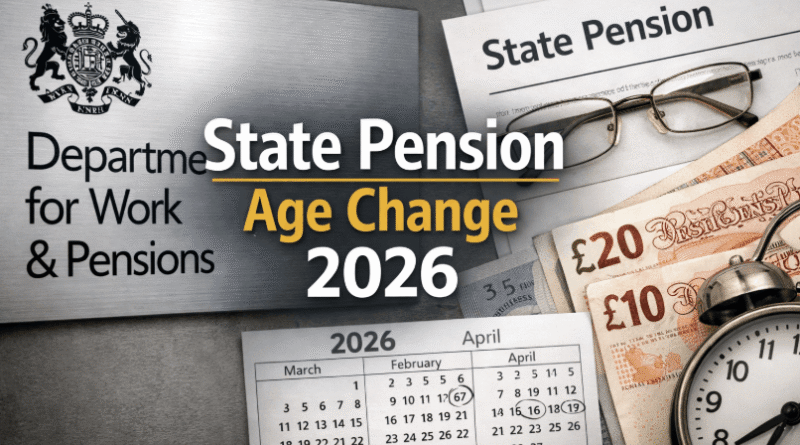
The DWP state pension age change 2026 signals the legislated increase in the UK retirement threshold from 66 to 67. Triggered on 6 April 2026 under the Pensions Act 2014, this phased transition affects individuals born between 6 April 1960 and 5 March 1961, deferring their eligibility by up to eleven months.
Precise verification of these dates is now a statutory necessity for anyone reaching retirement age during this financial year to avoid a total cessation of income.
2026 Pension Transition Executive Summary
- The Transition: The State Pension age begins rising from 66 to 67 starting 6 April 2026.
- The Affected Cohort: Anyone born between 6 April 1960 and 5 March 1961 will have a retirement age of 66 years and between 1 to 11 months.
- The 67 Milestone: Individuals born on or after 6 March 1961 will not reach State Pension age until their 67th birthday.
- Action Required: DWP does not pay automatically; you must respond to the Invitation to Claim sent four months before your new eligibility date.
Understanding the DWP state pension age change 2026 rollout
The DWP state pension age change 2026 operates through a phased rollout to prevent the fiscal and social shock of a single-day age jump. Instead of the age jumping immediately to 67 for everyone, the DWP has implemented a month-by-month increase.
If you were born in May 1960, for example, you do not claim on your 66th birthday in May 2026. Instead, your eligibility is deferred by two months to July 2026.
This pension gap is a core component of the 2026 reforms, requiring individuals to bridge their income for a period of 1 to 11 months, depending on their specific birth date.

Official DWP 2026 state pension age change dates by birth month
Your statutory claim date is determined by a precise birth window, as defined by the definitive DWP schedule for the 2026–2028 transition period.
| Date of Birth Range | New State Pension Age | Date Age Reached |
| 6 April 1960 – 5 May 1960 | 66 years and 1 month | 6 May 2026 – 5 June 2026 |
| 6 June 1960 – 5 July 1960 | 66 years and 3 months | 6 Sept 2026 – 5 Oct 2026 |
| 6 Oct 1960 – 5 Nov 1960 | 66 years and 7 months | 6 May 2027 – 5 June 2027 |
| 6 Jan 1961 – 5 Feb 1961 | 66 years and 10 months | 6 Nov 2027 – 5 Dec 2027 |
| 6 March 1961 onwards | 67 years | 6 March 2028 onwards |
You should consult the official UK state pension age retirement changes schedule to ensure you don’t cease employment prematurely, as DWP systems will reject applications submitted before these specific windows.
When did the government introduced DWP state pension age change 2026
The legislative foundation for the DWP state pension age change 2026 was established on 14 May 2014, when the Pensions Act 2014 received Royal Assent.
While the Pensions Act 2007 originally scheduled the shift to age 67 for the mid-2030s, the 2014 mandate accelerated this timeline by a full decade to address rising longevity costs.
This 2014 law adhered to the 10-year notice principle, giving the 1960s birth cohort time to prepare. The Department for Work and Pensions (DWP) reaffirmed this schedule on 30 March 2023, confirming the 2026–2028 increase as a statutory necessity for fiscal sustainability.
Why government introduced DWP state pension age change 2026?
The DWP maintains that the DWP state pension age change 2026 is a necessity for fiscal sustainability. According to the Office for Budget Responsibility (OBR), increasing the age to 67 will save the UK Treasury approximately £10 billion per year by the late 2020s.
These savings are generated through two primary channels:
- Reduced Outlays: Direct savings from paying the State Pension to fewer people for a shorter duration.
- Increased Tax Revenue: Encouraging older workers to remain in the labor market, thereby increasing income tax and National Insurance contributions.

Architects of the DWP state pension age change 2026 policy
From a regulatory perspective, the 2026 change is the product of successive administrations. The Pensions Act 2014 was spearheaded by the Coalition Government, with Steve Webb serving as the Pensions Minister at the time.
The current 2026 implementation was further solidified by the Second State Pension Age Review in 2023.
This review, conducted by Baroness Neville-Rolfe and accepted by then-Secretary of State for Work and Pensions Mel Stride, confirmed that the rise to 67 must proceed as planned in 2026 to offset the rising costs of the Triple Lock commitment.
Is the State Pension Age 66 or 67? Identifying Your Cohort
Eligibility is currently split between two distinct tiers depending on the specific birth cohort. Those reaching age 66 prior to 6 April 2026 remain under the previous 66-year threshold.
However, for the Transition Generation, those reaching 66 this year, you fall into a hybrid category.
You must recognize that your entitlement is no longer tied to your birthday alone, but to the statutory month addition. Failing to account for this can lead to a significant income void.
This is particularly poignant when considering if the new state pension being unfair to existing pensioners applies to you, as those retiring now must wait longer for a higher weekly rate (£241.30 in 2026) compared to those who retired before 2016.
What are the advantages and disadvantages of the DWP state pension age change 2026
Advantages
- Economic Stability: Reduces the national debt burden associated with an aging population.
- Labour Market Growth: Retains skilled, experienced workers in the economy for longer.
- Triple Lock Preservation: Higher retirement ages help fund the continued uprating of the pension rate.
Disadvantages
- Income Poverty: IFS data shows that increasing the age to 66 doubled poverty rates for that age group from 10% to 24%.
- Health Inequality: Those in manual labor or with chronic conditions (like fibromyalgia) may find it physically impossible to work until 67.
- Life Satisfaction: Studies indicate a decline in mental well-being for those forced to defer retirement.
Navigating the income gap created by the rise to 67
The most significant blind spot in mainstream coverage is the Income No-Man’s Land. This is the 1-to-12-month period where you have reached 66 but cannot yet claim the State Pension.
If you are unable to work during this gap, you must rely on working-age benefits such as Universal Credit.
However, Universal Credit is significantly less generous; a single person over 66 receives roughly 143% more in Pension Credit than a person under the pension age receives in Universal Credit.
Individuals must verify their exact entitlement date to mitigate the risk of an unfunded income gap, particularly as the DWP benefit fraud crackdown measures have intensified for 2026.

Impact of the 2026 transition on female retirement forecasts
While the retirement age in the UK for females was equalized with men’s in 2020, women born in 1960–1961 remain uniquely vulnerable.
Historical contracting out and gaps in National Insurance (NI) records due to caregiving often result in lower forecasted amounts.
Women in this cohort must verify their Qualifying Years. You need 35 years for the full £241.30 weekly payment.
If you have a gap, you can often buy back years or claim Child Benefit credits to bolster your final payout before your new 2026/2027 claim date.
Common myths about the 2026 pension changes debunked
| Myth | Reality |
| My pension starts on my 66th birthday. | False. If born after 5 April 1960, it starts 1–11 months after your 66th birthday. |
| The DWP will automatically send my money. | False. You must manually claim after receiving your invitation letter. |
| I can’t work and claim State Pension. | False. You can work, but your pension is treated as taxable income. |
| 10 years of NI is enough for a full pension. | False. 10 years is the minimum for any payment; 35 years are needed for the full rate. |
| The age is definitely rising to 68 in 2037. | Unconfirmed. This is legislated for 2044–46 but remains under review. |
When Will the State Pension Age Increase to 68?
While the focus is on the state pension age increase to 68, this shift is currently legislated for 2044–2046.
However, following the Neville-Rolfe review, there is significant political pressure to bring this forward to 2037–2039. A third review is expected by late 2026 to determine if life expectancy trends justify this further acceleration.
The Bottom Line for 2026 Retirees
The DWP state pension age change 2026 signals the conclusion of the age-66 retirement era and a fundamental shift in the UK social security contract.
For the 1960–1961 cohort, the standard retirement age of 66 has officially expired. Precision in date-checking and National Insurance auditing is now mandatory to avoid financial shortfalls.
DWP state pension age change 2026 means a phased, birthdate-specific deferral of income for UK residents in 2026.
FAQ
Can I retire at 62 and get State Pension?
No. You can retire from your job at any age, but you cannot receive the State Pension until you reach your statutory age (66 and X months in 2026). You would need private savings or working-age benefits to survive the interim years.
Does a woman who has never worked get a State Pension?
Not directly through her own NI record. However, you may be eligible if you received National Insurance credits (e.g., for raising children or being a carer) or via Pension Credit if you are on a low household income.
Do I inherit my husband’s State Pension if he dies?
This depends on when your husband reached State Pension age. If he reached it before April 2016, you might be able to inherit a portion of his Additional State Pension. For those under the New State Pension (post-2016), inheritance rules are much stricter.
Can you retire early due to ill health?
You cannot access the State Pension early due to ill health. You must instead apply for Personal Independence Payment (PIP) or the Limited Capability for Work element of Universal Credit until you reach the 2026 pension age.
Is 35 years of NI enough for the maximum pension?
Generally, yes. However, if you were contracted out of the additional state pension (common for NHS or civil service workers before 2016), you may need more than 35 years to reach the full £241.30 per week.
What happens if I have fewer than 10 years of NI contributions?
Under DWP rules, you will receive £0.00 in State Pension. You must have at least 10 qualifying years to receive any pro-rata payment.
Can I delay (defer) my State Pension?
Yes. For every 9 weeks you defer, your pension increases by 1%. This can be a strategic move if you continue to work past your 2026 eligibility date.



Pingback: DWP Universal Credit Bank Account Checks: Know Your Rights