
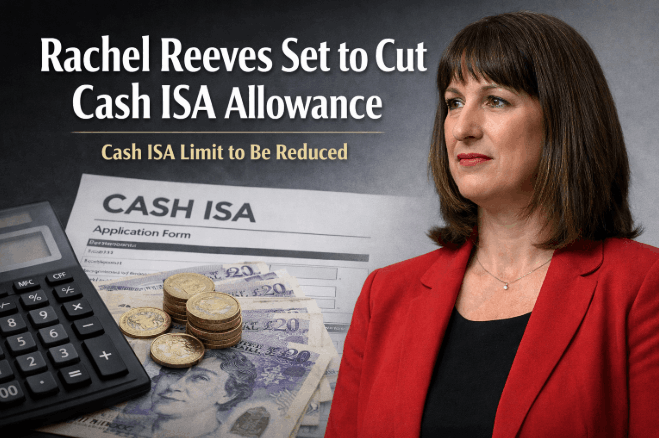
Rachel Reeves Set to Cut Cash ISA Allowance: £12,000 Limit, Who’s Exempt and What to Do
From 6 April 2027, Rachel Reeves is set to cut the cash ISA allowance from £20,000 to £12,000 per tax year for savers under 65. Savers aged 65 and over retain the full £20,000 allowance. The overall annual ISA limit of £20,000 remains unchanged, the remaining £8,000 must be directed into investment ISAs.
Delivered on 26 November 2025, the Autumn Budget made this the most significant reform to UK ISA rules in over a decade. The ISA cut is one piece of a wider fiscal overhaul. Rachel Reeves’ tax, pension and savings plans have touched nearly every corner of personal finance since the Budget.
Under-65s are now in the final full year of the current £20,000 cash ISA allowance, 2026/27 is the last tax year the existing rules apply.
Key Takeaways
- The cash ISA limit for under-65s drops from £20,000 to £12,000 from 6 April 2027.
- Savers aged 65 and over are fully exempt and retain the £20,000 cash ISA allowance.
- Existing cash ISA savings are not affected, only new contributions made from 6 April 2027 onwards.
- The same Budget also raised savings income tax rates from April 2027, making the ISA wrapper more valuable at precisely the moment it becomes more restricted.
What Is the Cash ISA Allowance Cut and What Has Been Confirmed?
The cash ISA allowance cut is confirmed government policy. From 6 April 2027, savers under 65 can contribute a maximum of £12,000 into a cash ISA each tax year, as confirmed in HM Treasury’s Autumn Budget 2025, down from the current £20,000 limit.
The overall annual ISA allowance stays at £20,000, the remaining £8,000 must be placed into investment-based products such as a Stocks and Shares ISA, an Innovative Finance ISA, or a Lifetime ISA.
Chancellor Reeves initially proposed reducing the cash ISA limit to £10,000. The Building Societies Association pushed back hard, warning in its October 2025 submission that the cut would result in 60,000 fewer mortgages per year by reducing the pool of cash available for lending.
The Treasury Select Committee also sided against the original proposal. The limit was subsequently revised upward to £12,000 before the Budget was delivered.
Existing cash ISA balances built up before 6 April 2027 are entirely unaffected by the new cap. The new cap applies only to new contributions made on or after that date.
Key Fact: The cash ISA limit cut applies only to new contributions from 6 April 2027, no existing savings are touched.
Cash ISA Allowance: Before and After
| Under 65 (Current) | Under 65 (From April 2027) | Aged 65+ (Current & Post-2027) | |
|---|---|---|---|
| Cash ISA limit | £20,000 | £12,000 | £20,000 |
| Stocks & Shares ISA limit | £20,000 | £20,000 | £20,000 |
| Overall ISA allowance | £20,000 | £20,000 | £20,000 |
| Remaining allowance after cash cap | NIL | £8,000 (investment only) | NIL |
| Transfer ban (S&S → Cash ISA) | No | Yes (from April 2027) | No |
Rachel Reeves Set to Cut Cash ISA Allowance: What Was Actually Confirmed?
Rachel Reeves confirmed the cash ISA allowance cut at the Autumn Budget 2025 on 26 November. The cut reduces the annual cash ISA limit for under-65s from £20,000 to £12,000, effective 6 April 2027. The policy was reaffirmed by Labour ministers in January 2026 during parliamentary scrutiny, despite pushback from the Treasury Select Committee.
Before the Budget, speculation centred on whether Reeves would act at all. Reports surfaced in early November 2025 that a cut was imminent, with the FT citing sources close to Budget preparations.
By the time the Budget was delivered, the policy had shifted from the shelved £10,000 proposal to the confirmed £12,000 figure. The government framed the change as reserving £8,000 of the annual ISA allowance for investment, with the stated aim of boosting retail investment in UK companies.
The January 2026 parliamentary scrutiny session saw Labour ministers stand firm. Despite committee concerns about the policy’s complexity and its potential to confuse consumers, the government’s position was described by the committee chair as now unambiguous.
The 2026/27 tax year, which began 6 April 2026, is the final full year under the existing rules. Changes to ISA rules 2026 do not yet include the new cap. The restriction on cash ISA contributions does not come into force until the 2027/28 tax year begins.
When Will the ISA Allowance Change?
The operative date for the cash ISA allowance change is 6 April 2027. Here is what each tax year means for savers:
- Stage 1 – 2025/26 tax year (ended 5 April 2026): The full £20,000 cash ISA allowance applied to all savers regardless of age. No restrictions were in force. Any contributions made in this period remain fully protected under ISA rules.
- Stage 2 – 2026/27 tax year (6 April 2026 to 5 April 2027): Current, this is the final full year at the £20,000 limit for under-65s. All current rules remain intact. Savers wishing to maximise their tax-free cash base before the rules tighten have until 5 April 2027 to do so. This tax year represents the last window to deposit the full £20,000 in cash.
- Stage 3 – From 6 April 2027: The £12,000 cash ISA cap applies to all under-65s. A transfer ban also activates: under-65s will no longer be permitted to transfer funds from a Stocks and Shares ISA or an Innovative Finance ISA back into a cash ISA. This measure is designed to prevent savers from circumventing the new limit via transfers.
Savers with standing orders or direct debits set above £1,000 per month into a cash ISA should review those instructions before April 2027. Contributions exceeding the new £12,000 annual cap will not be permitted from that date.
Why the ISA Cut and Tax Rise Hit Savers at the Same Time?
The cash ISA allowance cut was not the only savings measure in the Autumn Budget 2025. The same Autumn Budget 2025 that reduced the cash ISA limit also raised savings income tax rates across all bands from April 2027.
According to HM Treasury’s Autumn Budget 2025 documentation, the basic rate on savings income rises from 20% to 22%, the higher rate from 40% to 42%, and the additional rate from 45% to 47%. Property income is subject to the same new rates.
From April 2027, savers face two simultaneous pressures: the cash ISA cap drops to £12,000 for under-65s, and savings income tax rates rise by two percentage points across all bands.
At precisely the moment the cash ISA allocation shrinks, the ISA wrapper itself becomes more valuable. Savers who cannot fully utilise the tax shelter face a higher bill on any interest earned outside it.
The impact is not limited to high earners or those saving large monthly amounts. Lump-sum recipients, those receiving an inheritance, a property sale windfall, or a redundancy payment, face the sharpest impact.
A £40,000 lump sum, for example, can no longer be fully sheltered in a cash ISA in a single tax year. Under the new rules, up to £12,000 goes into cash, up to £8,000 can go into investment ISAs, and anything above £20,000 sits outside the ISA wrapper entirely, earning interest that is now taxed at a higher rate.
For those receiving inherited wealth, Rachel Reeves’ inheritance tax changes add a further layer of consideration to how lump sums are structured and sheltered.
According to HM Treasury, the policy is designed to promote an investment culture in the UK, citing figures showing that between 2021–22 and 2023–24, money placed into cash ISAs more than doubled while investment into Stocks and Shares ISAs fell by 9%.
The government’s position is that cash ISA dominance is suppressing retail investment that would otherwise support UK economic growth.
Critics, including the Building Societies Association and parts of the Treasury Select Committee, have argued that the reform complicates the ISA landscape without adequately protecting risk-averse savers who rely on cash as their primary savings vehicle.

What Does Martin Lewis Say About Cash ISAs?
Martin Lewis, founder of MoneySavingExpert, urged savers not to make rushed decisions in response to the announcement. His core position during the Budget period was that the cut does not take effect until April 2027, meaning there is no immediate need to panic or rapidly restructure savings.
Lewis highlighted the importance of the over-65 exemption, noting it protects the most risk-averse savers, typically those in or near retirement, from being forced into investment products unsuitable for their circumstances.
His guidance emphasised using the 2026/27 tax year as a deliberate maximisation window rather than a panic response.
On the broader ISA reform debate, MoneySavingExpert’s position has consistently been that cash ISAs remain valuable and appropriate for many savers, particularly those with shorter time horizons or lower risk tolerance. Lewis has stopped short of recommending a wholesale move away from cash savings.
MoneySavingExpert carries its most up-to-date guidance as the April 2027 date draws nearer.
Who Is Exempt From the Cash ISA Limit Cut?
Savers aged 65 and over are fully exempt from the new £12,000 cap and retain the full £20,000 cash ISA allowance. If you are 65 or over, the changes announced at the Autumn Budget 2025 do not affect your ability to save in cash within an ISA.
Key points on the exemption:
- The government has confirmed the over-65 exemption will stand at least initially, this phrase is important. It has not been permanently guaranteed and could be subject to future review. The exemption’s long-term status remains uncertain; separately, Reeves’ proposals on middle-class homeowners signal continued fiscal pressure on asset-holders beyond the ISA changes.
- The transfer ban (blocking transfers from Stocks and Shares ISAs back into Cash ISAs for under-65s) does not apply to savers aged 65 and over.
- If you are approaching 65 and will turn 65 during a tax year, the government has stated exact contribution rules for the transitional period will be clarified following further consultation. Check GOV.UK for updates.
Alongside the cash ISA changes, a consultation on a replacement for the Lifetime ISA, a simpler product aimed at first-time buyers, was announced for early 2026. Until that product becomes available, the existing Lifetime ISA rules remain in force.

Cash ISA Allowance Cut: Myth vs Reality
| Myth | Reality |
|---|---|
| The cash ISA cut affects existing savings | False. Only new contributions made from 6 April 2027 are subject to the £12,000 cap. Existing balances are fully protected. |
| The limit was confirmed at £10,000 | False. The original £10,000 proposal was shelved after industry and parliamentary opposition. The confirmed limit is £12,000. |
| Over-65s are also affected by the cut | False. Savers aged 65 and over retain the full £20,000 cash ISA allowance. The cut applies only to under-65s. |
| The Stocks and Shares ISA limit is also being cut | False. The annual allowance for Stocks and Shares ISAs remains unchanged at £20,000. |
| The change takes effect from April 2026 | False. The 2026/27 tax year operates under current rules. The new £12,000 cash cap applies from 6 April 2027. |
| The cut means cash ISAs are being abolished | False. Cash ISAs remain fully available. The change restricts the annual contribution limit for under-65s, not the product itself. |
Conclusion
The cash ISA allowance cut is confirmed, and the effective date is less than a year away. The 2026/27 tax year is the last full year under the existing rules, under-65s who wish to maximise their tax-free cash base have until 5 April 2027. Some reports have incorrectly stated the cut takes effect in April 2026
That is incorrect. According to HM Treasury’s Autumn Budget 2025 documentation, the new £12,000 limit applies from 6 April 2027. Check GOV.UK for the most current figures before making any decisions about ISA contributions.
The Rachel Reeves cash ISA allowance cut means a permanent reduction in tax-free cash savings capacity for under-65s in the UK from April 2027.
FAQ
What is the current cash ISA allowance?
The current cash ISA allowance is £20,000 per tax year. This applies to all eligible UK savers regardless of age for the 2026/27 tax year. The £12,000 limit for under-65s does not come into force until 6 April 2027.
Does the cash ISA allowance cut affect existing savings?
No. The £12,000 cap applies only to new contributions made from 6 April 2027 onwards. Any money already held in a cash ISA before that date remains fully sheltered and is not subject to the new limit.
Can under-65s still open a cash ISA after April 2027?
Yes. Under-65s can still open and contribute to a cash ISA after April 2027. The change restricts the annual contribution to £12,000, not access to the product itself.
What happens to the remaining £8,000 ISA allowance after the cut?
For under-65s, the remaining £8,000 of the £20,000 annual ISA allowance must be directed into investment products, such as a Stocks and Shares ISA, an Innovative Finance ISA, or a Lifetime ISA. It cannot be placed into a cash ISA.
Will the transfer ban affect me if I hold a Stocks and Shares ISA?
Yes, if you are under 65. From April 2027, under-65s will be barred from transferring funds held in a Stocks and Shares ISA or an Innovative Finance ISA back into a cash ISA. This closes a potential loophole that would have allowed savers to circumvent the new cash cap via transfers.
What is the ISA allowance for 2026/27?
The total ISA allowance for 2026/27 is £20,000, all of which can be held in a cash ISA if the saver chooses. This is the final tax year in which under-65s have full flexibility to allocate the entire allowance to cash.
Is the Lifetime ISA also changing?
A government consultation on a replacement first-time buyer savings product was announced alongside the Budget. Until a new product is introduced, the existing Lifetime ISA rules remain unchanged. Savers can contribute up to £4,000 per year and receive a 25% government bonus worth up to £1,000 annually, as set out under the Individual Savings Account Regulations
Where can savers check the latest ISA rules?
The authoritative source for current ISA rules is GOV.UK, search Individual Savings Accounts ISAs for the latest contribution limits, eligibility rules, and transfer guidance directly from HMRC.