HMRC Bank Account Deductions vs PAYE Code Drops: Protect Your Savings And Income Rules
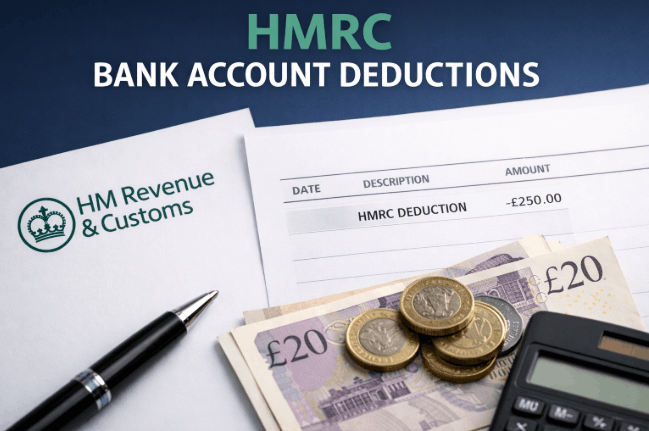
HMRC can make bank account deductions in the UK without a court order under a power called Direct Recovery of Debts (DRD). This applies where a tax debt exceeds £1,000, and the debtor’s accounts hold at least £5,000 in aggregate.
A second, more commonly experienced mechanism, a PAYE tax code adjustment, reduces monthly take-home pay to recover underpaid tax without touching a bank account directly.
HMRC’s enforcement powers are broader than most taxpayers realise, yet more tightly regulated than online coverage suggests. Two legally distinct collection routes exist, and which one applies shapes both the exposure involved and the right way to respond.
Key Takeaways
- HMRC can deduct from a bank account directly under the Direct Recovery of Debts (DRD) scheme, but only where a tax debt exceeds £1,000 and the debtor’s accounts hold at least £5,000 in aggregate across all affected accounts.
- Most taxpayers experiencing unexpected deductions are affected by a PAYE tax code adjustment, not a DRD action, each operates under different rules, with its own threshold, trigger, and route for challenge.
- The law requires HMRC to follow a strict multi-step process before any DRD deduction takes place, including mandatory face-to-face contact and a 14-day hold period.
- Most pensioners seeing unexpected reductions in their income are affected by an incorrect tax code applied to their pension, not a formal bank account seizure.
Can HMRC Deduct From a Bank Account?
Yes, HMRC can deduct from a bank account without a court order under powers granted by the Finance (No. 2) Act 2015. The Direct Recovery of Debts scheme allows HMRC to recover unpaid tax directly from personal bank accounts, savings accounts, and cash ISAs where specific, defined conditions are met.
Those conditions are precise. The tax debt must exceed £1,000. The debtor’s accounts must hold a minimum aggregate balance of £5,000, and HMRC must leave that full £5,000 intact after any deduction is made.
The debtor must also have been contacted on multiple occasions without settling or engaging with the outstanding amount.
HMRC can deduct directly from a UK bank account under the Direct Recovery of Debts scheme without applying for a court order. The outstanding tax debt must exceed £1,000 and the debtor’s accounts must hold a minimum aggregate balance of £5,000.
HMRC must always preserve that £5,000 across all affected accounts and is required to make repeated contact attempts, including a face-to-face visit, before any deduction proceeds.
The DRD scheme applies to individuals, self-employed taxpayers, and businesses. It is not triggered automatically by any level of debt, HMRC must work through a defined sequence of steps before funds are touched, and the debtor retains legal rights at every stage.

HMRC Uses Two Separate Deduction Mechanisms: Most People Only Know One
Most people experiencing an unexpected reduction in their pay or bank balance are not the subject of a DRD action. The far more commonly experienced mechanism is a PAYE tax code adjustment, yet it rarely gets a clear explanation.
HMRC adjusts a taxpayer’s PAYE code to recover underpaid tax, typically from a prior year. The adjustment reduces monthly take-home pay incrementally until the shortfall is cleared.
It operates through an employer or pension provider via HMRC wage raid payroll checks on earnings records, not directly against a bank account. There is no minimum balance requirement. There is no 14-day hold. The notice issued is a tax code notice (P2), not a DRD warning letter. The challenge route is entirely different.
Identifying which mechanism is actually at work is the right starting point for any taxpayer who finds an unexpected reduction in their pay or account balance.
DRD vs PAYE Code Adjustment: Key Differences
| Feature | Direct Recovery of Debts (DRD) | PAYE Code Adjustment |
|---|---|---|
| Legal basis | Finance (No. 2) Act 2015 | Income Tax (Earnings and Pensions) Act 2003 |
| Debt threshold | Over £1,000 | No minimum, any underpayment |
| Minimum balance preserved | Yes, £5,000 aggregate | Not applicable |
| Notice type | Formal DRD warning letter | Tax code notice (P2) |
| Face-to-face visit required | Yes, mandatory | No |
| 14-day hold applied | Yes | No |
| Challenge route | County court appeal within 30 days | Contact HMRC to query tax code |
| Who it most affects | Persistent non-paying debtors | Employees and pension recipients |
| Most common trigger | Unresolved tax debt | Prior-year underpayment or wrong code |
What Safeguards Protect You Against HMRC Bank Account Deductions?
The law requires HMRC to follow a strict, sequential process before any DRD deduction takes place. Taxpayers have enforceable rights at every stage. No step in that sequence can be skipped.
- Multiple contact attempt: HMRC must have made repeated attempts to contact the debtor by letter and telephone before DRD becomes available as an option.
- Face-to-face visit: A personal visit to the debtor is mandatory before any hold is placed on an account. This provides a final opportunity to discuss the debt, dispute it, or arrange payment.
- Formal notice of intention: HMRC must issue a written notice that it intends to place a hold on the account before taking any action.
- 14-day hold period: Once a hold is placed, funds are frozen for 14 days before any transfer occurs. That window is the debtor’s opportunity to contact HMRC, dispute the amount, or put a Time to Pay arrangement in place.
- Minimum £5,000 aggregate balance preserved: HMRC must leave at least £5,000 across all affected accounts in total, not per account, but as a combined figure.
- Right to appeal: Under the Finance (No. 2) Act 2015, you have the right to challenge a DRD action at a county court within 30 days of receiving notification. The HMRC Charter confirms that taxpayers have the right to appeal decisions they believe are wrong and to receive a full explanation of any debt calculation.
If any step in this process has not been followed, contact HMRC immediately, request a written breakdown of the debt, and ask for confirmation of which steps in the DRD process have been completed.

Common Myths About HMRC Bank Account Deductions
| Myth | Reality |
|---|---|
| HMRC can take money without warning | False. Multiple contact attempts, a mandatory face-to-face visit, and a formal 14-day hold are all required before any funds are transferred. |
| HMRC can empty a bank account | False. HMRC must leave a minimum of £5,000 in aggregate across all affected accounts and cannot proceed if this threshold is not met. |
| All unexpected bank deductions are DRD actions | False. The majority of unexpected deductions are PAYE tax code adjustments, which operate through employers or pension providers, not directly against bank accounts. |
| HMRC can access any account without conditions | False. DRD applies only where a debt exceeds £1,000, the account holds at least £5,000 in aggregate, and the full notice process has been completed. |
| Pensioners are exempt from DRD | False. Age provides no exemption from DRD. The scheme applies to any individual or business meeting the debt and balance thresholds. |
| An HMRC bank deduction cannot be challenged | False. The right to appeal to a county court within 30 days is a legal protection codified in the Finance (No. 2) Act 2015. |
| HMRC monitors savings accounts in real time | False. HMRC receives annual data reports from UK banks and financial institutions, it does not have live access to individual accounts. |
What is the HMRC Warning for Anyone With Over £3,500 in Savings?
The widely circulated HMRC warning for anyone with over £3,500 in savings is not a DRD alert. It refers to the Personal Savings Allowance (PSA), the annual threshold above which interest earned on savings becomes taxable income that HMRC may seek to recover.
For the 2025–26 tax year, the PSA stands at £1,000 for basic-rate taxpayers, £500 for higher-rate taxpayers, and £0 for additional-rate taxpayers. When savings interest exceeds the relevant PSA tier, HMRC will typically recover any tax owed through a PAYE code adjustment, not through a direct bank account seizure.
The £3,500 figure that circulates in tabloid coverage is not an official HMRC threshold. It reflects the approximate savings balance at which a typical easy-access account earning around 5% annual interest would generate roughly £175 in interest, well within the basic-rate PSA and creating no tax liability.
At higher savings balances or higher interest rates, the PSA can be exceeded more quickly, creating a liability HMRC will pursue.
Holding savings does not trigger HMRC bank account deductions. Earning taxable interest that is undeclared or underpaid may result in a PAYE code adjustment to recover the liability. Check the current PSA rates and any outstanding tax position via the HMRC Personal Tax Account at gov.uk.

Why Pensioners Are Seeing Unexpected HMRC Deductions?
Most pensioners experiencing unexpected deductions are not subject to a DRD action. The root cause is almost always an incorrect PAYE tax code applied to one or more pension income sources.
When income arrives from multiple pensions, HMRC may apply the full personal allowance to one source and an emergency or basic-rate code to others. Underpayments accumulate unnoticed until HMRC recalculates the total liability and recovers the shortfall through a PAYE adjustment, reducing net pension income incrementally until the balance is cleared.
The £500 figure widely cited in recent coverage reflects the typical size of these accumulated underpayments, not a fixed HMRC deduction threshold. DRD can apply to pensioners where a formal debt exists and all conditions are met, but it is not the mechanism driving most of the cases reported in recent coverage.
Where an unexpected reduction has appeared in pension income or a bank balance:
- Check the current tax code via the HMRC Personal Tax Account at gov.uk
- Review any HMRC notices for UK pensioners savings received to confirm whether the deduction relates to a savings interest liability
- Request a P800 or Simple Assessment notice from HMRC if one has not been received
- Contact HMRC for a full written breakdown of the debt calculation (HMRC telephone number free 0800 0345 opening times)
- Seek advice from a tax adviser or the Low Incomes Tax Reform Group (LITRG) if the figure appears incorrect
Can HMRC See All of My Bank Accounts?
HMRC does not have real-time access to individual UK bank accounts, but receives substantial financial data from banks and financial institutions on a structured annual basis.
Under the Common Reporting Standard (CRS), UK banks are legally required to report account holder information, balances, and interest payments to HMRC each year.
HMRC processes this through its Connect system, which cross-references declared income, Self Assessment returns, and financial data to identify discrepancies.
Closer scrutiny tends to follow savings interest that exceeds the Personal Savings Allowance, significant unexplained deposits, or income missing from a Self Assessment return.
According to HMRC, Connect draws on data from over 30 sources, routine savings held within declared income rarely attract attention.

Conclusion
HMRC bank account deductions sit within a defined legal framework, one that carries real protections for the taxpayer at every stage. DRD applies only where a debt exceeds £1,000, a minimum £5,000 aggregate balance exists, and the full notice sequence is completed.
Most unexpected deductions are PAYE code adjustments, not DRD actions, with an entirely separate challenge route.
Key Fact: HMRC must preserve a minimum aggregate balance of £5,000 across all affected accounts, it cannot proceed with a DRD action if this threshold is not met.
Claims that DRD was paused during the pandemic and restarted in 2025 are inaccurate. The Finance (No. 2) Act 2015 powers have remained in continuous force. No official HMRC source supports a pandemic suspension. For current thresholds and DRD procedures, gov.uk is the primary reference.
HMRC bank account deductions mean a structured legal process with defined conditions and enforceable appeal rights for UK taxpayers in 2025.
Information correct as of May 2025. Verify current rates, thresholds, and Personal Savings Allowance figures via gov.uk or a qualified tax adviser.
FAQ
Does HMRC have to warn you before making a bank account deduction?
Yes. HMRC must follow a defined multi-step process, multiple written and telephone contact attempts, a mandatory face-to-face visit, a formal notice of intention, and a 14-day hold before any transfer occurs. Any deduction made without completing this sequence under the Finance (No. 2) Act 2015 can be formally challenged.
What is the minimum amount HMRC must leave in my account?
HMRC must leave a minimum aggregate balance of £5,000 across all accounts subject to a DRD action, as a combined total, not per account individually. If the aggregate balance is £5,000 or less, HMRC cannot proceed. The balance remaining after any transfer must not fall below £5,000.
How long does HMRC have to collect an unpaid tax debt?
HMRC has four years from the end of the relevant tax year for standard underpayments, six years for careless errors, and up to 20 years for deliberate non-disclosure. These limits apply to the formal assessment of the debt, DRD collection begins only once the debt is formally assessed and HMRC has made multiple contact attempts without resolution.
Can HMRC take money from a joint bank account?
HMRC can place a DRD hold on a joint account, but only the debtor’s share of the funds is treated as recoverable. The non-liable co-holder has the right to contact HMRC to demonstrate what share of the balance belongs to them, something HMRC must account for before proceeding.
What is the difference between a DRD action and a PAYE code change?
A DRD action places a direct hold on a bank account to recover a formal tax debt. A PAYE code adjustment reduces monthly take-home pay through an employer or pension provider until the underpayment is cleared. DRD requires a debt over £1,000, a face-to-face visit, and a 14-day hold. A PAYE adjustment requires none of these.
Can I appeal against an HMRC bank account deduction?
Yes. A DRD action can be challenged at a county court within 30 days of receiving formal notification. Valid grounds include a disputed debt amount, evidence that the required process was not followed, or financial hardship. For a PAYE code adjustment, contact HMRC directly to request a formal review of the underlying tax calculation.
Will HMRC deduct money if a payment plan is already in place?
No. Where a Time to Pay arrangement is agreed and payments are on schedule, DRD should not proceed. If HMRC has made contact about an outstanding debt, requesting a Time to Pay arrangement before the process reaches the face-to-face visit stage is the most effective way to prevent a direct account deduction.
Disclaimer: The information contained in this article is for general guidance and educational purposes only and does not constitute formal legal, financial, or professional tax advice.