UK Dividend Tax Calculator: Easily Work Out Rates, Bands, Allowances, And Total Tax Owed
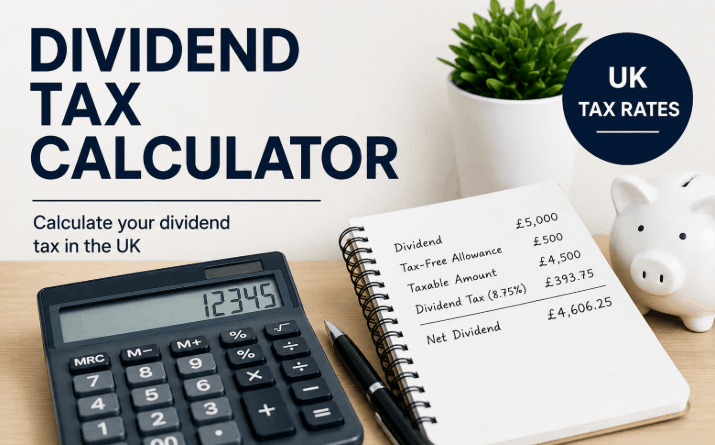
A UK dividend tax calculator works out how much income tax you owe on dividend income, based on your total earnings, the tax year, and HMRC’s dividend allowance and tax bands. Enter your salary, other income and dividend total below to see your exact tax bill, broken down by band, in seconds.
UK Dividend Tax Calculator
Work out exactly how much tax you'll pay on your dividends for any tax year since 2016/17 — based on HMRC's official rates and allowances.
Your gross salary before tax. Enter 0 if not applicable.
Add everything except dividends here. Enter 0 if not applicable.
The gross amount, before any tax is taken off.
Please enter valid income figures to continue.
How this was worked out
| Band | Dividends taxed here | Rate | Tax |
|---|
This calculator gives an estimate for England, Wales and Northern Ireland taxpayers based on the official HMRC rates and allowances for the tax year selected (dividend tax rates are the same for Scottish taxpayers). It assumes a standard tax code and does not account for Gift Aid, pension contributions, marriage allowance or other reliefs. For advice on your own circumstances, speak to a qualified accountant or check gov.uk.
How to Use the Dividend Tax Calculator?
- Select the tax year you want, every year from 2016/17 to 2026/27 is available.
- Enter your salary or employment income, and any other taxable income (pension, rental, self-employment) separately, non-taxable income, such as state benefit arrears estimated via a PIP back pay calculator, should be excluded.
- Enter your total dividend income for that year, before any tax is deducted.
- Click “Calculate my dividend tax” to see your total bill and the full band breakdown.
How the Dividend Tax Calculator Works?
Most calculators apply a single flat rate to your whole dividend total. That’s not how HMRC actually taxes dividends, and it can give you the wrong figure. Ours follows the real calculation order:
- Personal Allowance first. Your salary and other income use up your £12,570 Personal Allowance before dividends are considered at all.
- Unused allowance shelters dividends. If your other income doesn’t use the full Personal Allowance, the leftover shelters part of your dividends at 0%.
- Dividend allowance next. The first £500 of dividends (for 2024/25 onwards) is taxed at 0%, but importantly, it still occupies whichever tax band it falls into, it isn’t simply ignored.
- Remaining dividends stack on top. Whatever’s left is taxed progressively at the basic (10.75%), higher (35.75%) or additional (39.35%) rate, depending on which band your total income reaches for 2026/27.
- Personal Allowance taper. If your total income exceeds £100,000, your Personal Allowance shrinks by £1 for every £2 over that threshold, disappearing entirely at £125,140, which pulls more of your dividends into higher tax bands.
This band-stacking approach, rather than a flat-rate shortcut, is what HMRC’s own guidance describes and what a Self Assessment calculation actually follows.
Who Uses Dividend Tax Calculator?
Limited company directors who pay themselves through a mix of salary and dividends use this most often, since it’s the standard way to extract profit tax-efficiently.
Investors with share portfolios outside an ISA also rely on it to work out what they owe before Self Assessment. Contractors, freelancers running their own company, and retirees combining share dividends with property wealth planned using a lifetime mortgage calculator make up the rest.
Worked Example
Say you earn a £45,000 salary and receive £30,000 in dividends during 2026/27. Here’s how the calculator arrives at your bill:
- Your £45,000 salary uses the full £12,570 Personal Allowance, leaving none spare to shelter dividends, and puts £32,430 of taxable income into the basic rate band already.
- The first £500 of dividends is covered by the dividend allowance at 0%, but this still occupies part of the basic rate band, bringing your position to £32,930.
- Only £4,770 of the basic rate band remains, so that slice of dividends is taxed at 10.75% — £512.78.
- The remaining £24,730 of dividends spills into the higher rate band and is taxed at 35.75% — £8,840.98.
- Total dividend tax owed: £9,353.75, leaving £20,646.25 of dividends after tax.
Change the salary, other income or dividend figures even slightly, and the split across bands shifts, which is exactly why a calculator that models the real HMRC order gives a more reliable answer than one using a single flat rate.
Common Mistakes to Avoid
- Assuming the £500 allowance is a full deduction. It’s a 0% band, not money subtracted from your dividends, it still uses up part of your basic or higher rate band.
- Forgetting salary is taxed first. Dividends are always treated as the “top slice” of your income, stacked on top of everything else.
- Ignoring the £100,000 taper. Many directors don’t realise their Personal Allowance starts shrinking well before the additional rate kicks in.
- Using last year’s rates by habit. Dividend rates changed in April 2022, April 2023, April 2024 and April 2026, always check you’ve selected the correct tax year.
- Mixing up gross and net dividend figures. Always enter the amount before tax, not what actually landed in your bank account.
Why Your Result May Differ From Other Calculators?
Some free calculators apply your highest tax band to your entire dividend total, or don’t correctly account for unused Personal Allowance sheltering part of your dividends.
Ours calculates band-by-band, applies the Personal Allowance taper above £100,000, and lets you select the exact tax year rather than assuming the current one, so if you’re checking figures for a prior Self Assessment return, the year-specific rates and allowances are already built in.
Dividend Tax Calculator Rate Changes Timeline
This is a running log of every official change to dividend tax since the modern allowance system began, listed most recent first. We update this section whenever HMRC or the Treasury announces a new change, so you can see at a glance what’s shifted and why.
- 26 November 2025 (Autumn Budget 2025): Basic and higher dividend tax rates increased by 2 percentage points, to 10.75% and 35.75% respectively, effective 6 April 2026. The additional rate remained unchanged at 39.35%.
- 17 November 2022 (Autumn Statement 2022): Dividend allowance reduced from £1,000 to £500, effective 6 April 2024.
- 17 November 2022 (Autumn Statement 2022): Dividend allowance reduced from £2,000 to £1,000, and the additional rate threshold lowered from £150,000 to £125,140, both effective 6 April 2023.
- September 2021 (Health and Social Care Levy announcement): All three dividend tax rates increased by 1.25 percentage points, effective 6 April 2022.
- 8 March 2017 (Spring Budget 2017): Dividend allowance reduced from £5,000 to £2,000, effective 6 April 2018.
- 8 July 2015 (Summer Budget 2015): The £5,000 tax-free Dividend Allowance was introduced, replacing the old 10% notional tax credit system, effective 6 April 2016.
FAQs
Do I need to pay tax on dividends under £500?
No. The first £500 of dividend income (for 2024/25 onwards) is covered by the dividend allowance and taxed at 0%. You may still need to declare it on a Self Assessment return if your total dividends exceed the allowance.
What is the dividend tax rate for 2026/27?
For 2026/27, dividends are taxed at 10.75% within the basic rate band, 35.75% within the higher rate band, and 39.35% within the additional rate band, after the £500 dividend allowance.
Do I pay dividend tax and income tax on the same money?
No. Dividends are taxed separately from your salary at dividend-specific rates, which are lower than standard income tax rates, though your salary still determines which dividend tax band you fall into.
Does the dividend allowance reduce my Personal Allowance?
No, they’re separate. The dividend allowance is an additional 0% band on top of your Personal Allowance, not a replacement for it.
This calculator provides estimates based on published HMRC rates and allowances for England, Wales and Northern Ireland; it isn’t a substitute for professional tax advice.