Tax Crackdown on Savings Accounts: HMRC Rules, Thresholds, and How to Protect Your Money
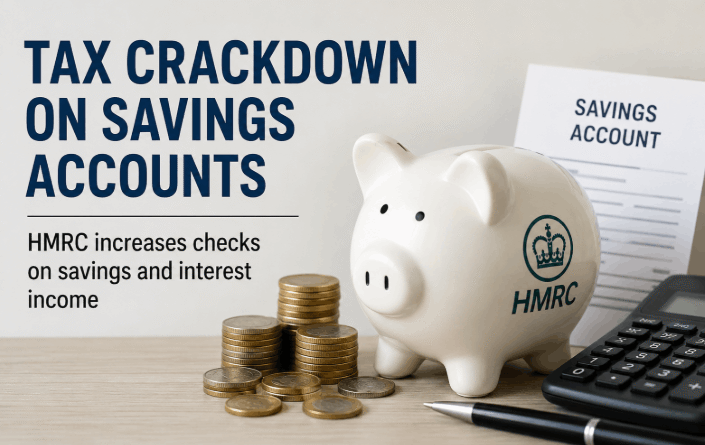
The tax crackdown on savings accounts refers to new HM Revenue and Customs rules, approved for April 2027, requiring banks to share customers National Insurance numbers so tax owed on savings interest above the Personal Savings Allowance can be matched and collected automatically.
As of the 2026/27 tax year, that allowance remains £1,000 for basic rate taxpayers and £500 for higher rate taxpayers.
Key Takeaways
- Basic rate taxpayers can earn up to £1,000 in savings interest tax free in 2026/27, falling to £500 for higher rate taxpayers and £0 for additional rate taxpayers.
- From April 2027, banks and building societies must collect savings customers National Insurance numbers so HMRC can match interest income to tax records automatically.
- HMRC estimates more than three million savers will owe tax on their savings interest this year, an increase of 120,000 on the previous year.
What Is the Tax Crackdown on Savings Accounts?
The tax crackdown on savings accounts is a plan to close a longstanding gap in how HM Revenue and Customs collects tax on interest earned outside an ISA. Banks already report savings interest to HMRC every year. Around a fifth of that data currently cannot be matched to a taxpayer record.
From April 2027, National Insurance numbers close that gap. Every saver with a standard account gets their interest linked directly to their tax file, not just those who already exceed their allowance. Current accounts and ISAs stay outside the new reporting requirement.
How Much Money You Can Have in Savings Before Being Taxed?
Most savers can earn a meaningful amount of interest before HMRC takes a share. The exact figure depends on total income, not just the savings balance itself.
Three separate allowances can stack together. The Personal Allowance, the starting rate for savings, and the Personal Savings Allowance each apply in order, based on how much other income a saver already has.
| Income tax band | Other annual income | Personal Savings Allowance |
|---|---|---|
| Non taxpayer | £0 to £12,570 | £1,000 |
| Basic rate | £12,570 to £50,270 | £1,000 |
| Higher rate | £50,270 to £125,140 | £500 |
| Additional rate | Over £125,140 | £0 |
Savers with other income below £17,570 may also qualify for the starting rate for savings, worth up to £5,000 on top of the Personal Allowance.
With interest rates from NS&I remaining competitive against high street providers, more savers are unknowingly earning enough interest to breach these thresholds for the first time.
Savers who are unsure which band they fall into should check it directly, since that figure decides the allowance that applies to them.
The £3,500 HMRC Savings Warning Explained
A £3,500 balance can trigger a tax bill, and the reason comes down to how fixed rate accounts pay interest. HMRC has been writing to savers whose accounts pushed them over their allowance without any change in their spending habits.
- A higher rate taxpayer, with a £500 allowance, locks £3,500 into a three year fixed rate bond paying 5 percent.
- The bond pays no interest annually. Instead, all three years of growth arrive in one lump sum when it matures.
- That single payment can exceed £500, breaching the allowance in one tax year even though the balance itself was modest.
- HMRC’s data matching flags the excess, and a tax code adjustment or bill usually follows within the same tax year.
Basic rate taxpayers face a similar risk at higher balances. Someone holding £20,000 at 5 percent generates £1,000 in a single year, landing exactly at their limit.
Fixed rate products that pay interest only on maturity carry more risk than accounts that pay monthly or annually, since spreading interest across tax years keeps each year’s total below the allowance.

How Rachel Reeves Approved the New HMRC Savings Rules?
Chancellor Rachel Reeves approved the National Insurance number requirement so HMRC can collect tax on savings interest more accurately. The change addresses a specific weakness already flagged by HMRC, where too much of the interest data banks report cannot be matched to a taxpayer.
- Banks and building societies must request National Insurance numbers from new and existing savings customers.
- The requirement applies to traditional savings accounts, not current accounts or ISAs.
- Implementation is expected from April 2027, pending legislation due to pass through Parliament during 2026.
- HM Treasury has estimated the changes will cost HMRC around £35 million to implement, with banks facing separate systems costs.
HMRC has said the reforms will make it easier for customers to get their tax right the first time. The change sits within a wider push by HM Treasury to reduce error and fraud across third party income data.
How HMRC Collects Tax on Savings Interest?
Most savers never need to fill in a form for this. HMRC collects tax on savings interest one of two ways, depending on employment status.
Employed savers and pensioners usually see their tax code adjusted automatically. HMRC estimates the coming year’s interest based on the previous year’s figure, then deducts the extra tax gradually through PAYE.
Self employed savers report interest directly through Self Assessment instead, alongside their other income.
According to HM Revenue and Customs, anyone who exceeds their savings allowance and does not receive a tax calculation letter by 31 March of the following tax year should contact HMRC directly to avoid a penalty.
Savers should not assume no letter means no tax is owed, since responsibility for contacting HMRC rests with them if one does not arrive.

Self Employed Savers and the Self Assessment Reporting Threshold
Self employed savers face a registration rule that most savings guides leave out entirely, and missing it can lead to a penalty even where no tax was actually due.
Registration Threshold for Savings Income
Anyone whose income from savings and investments exceeds £10,000 in a tax year must register for Self Assessment, according to GOV.UK. This threshold applies on top of any other income already reported, and it catches savers who assume only large earners need to file a return.
Reporting Deadlines and Self Assessment
Interest must be declared on the Self Assessment return covering the tax year it was received, not the year the account matures if that differs. Late or inaccurate reporting can trigger separate penalties from HMRC, regardless of whether any extra tax was ultimately owed.
Self employed savers earning over £10,000 in combined savings and investment income must register for Self Assessment, per GOV.UK guidance. This threshold sits separately from the £1,000 or £500 Personal Savings Allowance and applies even if most of that income falls within existing tax free allowances.
Do You Need to Notify HMRC of Savings Interest?
No, most savers do not need to notify HMRC directly. Banks and building societies report interest earnings automatically at the end of each tax year, so HMRC already receives the figures without any action from the account holder.
The exception applies to those completing Self Assessment, who must declare all savings interest as part of their return. Everyone else simply waits for HMRC to adjust their tax code or send a calculation letter if tax is due.
How Savings Interest Works for Joint Accounts and Couples?
Joint account interest is split equally between account holders by default, regardless of who contributed more to the balance. Each holder then uses their own Personal Savings Allowance against their share.
- Interest on a joint account is automatically split 50:50 between named holders.
- Each person’s tax band, not the account’s total, determines what portion of their share is taxable.
- Couples with different tax bands can shift more savings toward the lower earner to make better use of a larger allowance.
- HMRC can be contacted directly if a joint account should be split unevenly for genuine ownership reasons.
Couples wanting a fuller picture of HMRC joint bank accounts savings tax rules can use that split to decide which partner should hold the larger share of any interest bearing balance before the next reporting year begins.
How to Avoid Paying Tax on Your Savings in the UK?
Tax on savings interest can be reduced or avoided legally, and doing so does not always mean switching account type.
- Use a Cash ISA first, since interest earned inside one is completely tax free and does not count toward the Personal Savings Allowance.
- Split savings between spouses or civil partners if one holds a lower tax band, making better use of their larger allowance.
- Choose accounts that pay interest monthly or annually rather than fixed rate bonds that pay only on maturity.
- Check your Personal Tax Account on GOV.UK regularly to confirm what interest HMRC already has on record.
Each tax year allows up to £20,000 to be saved across all ISA types combined, sheltering that portion of savings from the new reporting rules entirely.

Why This Crackdown Is Part of a Wider HMRC Revenue Push?
This reform is one part of a larger pattern, not a standalone measure. It reflects a broader effort by HM Treasury to close revenue gaps as interest rates and frozen tax thresholds pull more people into paying tax for the first time.
The Office for Budget Responsibility has flagged frozen income tax thresholds as a significant driver of rising tax receipts in recent forecasts.
As the Bank of England’s rate decisions continue to shape what savings accounts pay out, HMRC’s data matching push mirrors similar 2027 dated reforms already underway, including the HMRC Inheritance Tax Changes 2027 affecting a different corner of personal finance.
Both share the same underlying goal of tightening third party data collection.
Tax Crackdown on Savings Accounts: Myth vs Reality
Several misconceptions circulate about who this crackdown affects and how, and most of them lead savers to either worry needlessly or miss a genuine risk.
| Widely believed claim | What is actually true |
|---|---|
| All savings are tax free below a certain balance | Only interest within your allowance is tax free, not the balance itself |
| ISAs will be affected by the new rules | ISAs and current accounts remain outside the National Insurance number requirement |
| Small savers are not checked by HMRC | Banks report all interest regardless of amount, even small sums |
| One account under the limit means you are safe | HMRC totals interest across every account you hold, not just one |
| You must declare interest yourself every year | Most employed savers have their tax code adjusted automatically instead |
Conclusion
Most savers will not owe extra tax, but the margin for error is shrinking as HMRC’s data matching improves.
Keeping interest within your allowance mostly comes down to knowing your tax band and putting an ISA to proper use. The tax crackdown on savings accounts means closer HMRC scrutiny of everyday interest for UK savers in 2026 and 2027.
FAQ
How much money can you have in a savings account before being taxed?
There is no fixed savings balance that triggers tax on its own. Tax depends on interest earned versus your Personal Savings Allowance, which is £1,000 for basic rate taxpayers and £500 for higher rate taxpayers in 2026/27.
What is the HMRC warning for anyone with over £3,500 in savings?
Yes, £3,500 held in a fixed rate bond can generate enough interest to breach a higher rate taxpayer’s allowance in one lump sum. The risk comes from interest paying out entirely at maturity rather than annually.
Are HMRC going to tax your savings?
Only interest earned above your Personal Savings Allowance is taxed, not your savings balance itself. Most savers remain within their allowance and pay nothing extra on their interest.
How can I avoid paying tax on my savings account in the UK?
Yes, using a Cash ISA is the most straightforward way to avoid tax on savings interest entirely. Spreading balances between spouses in different tax bands also reduces overall exposure.
Do pensioners pay tax on savings interest?
Yes, pensioners follow the same Personal Savings Allowance rules as other taxpayers, based on total income including any pension received. A pensioner with low total income may still benefit from the starting rate for savings.
Disclaimer: This article is for informational purposes only and should not be taken as professional financial or legal advice.


Pingback: Nationwide Savings Account Rate Increases: What You Earn Now