
What Is Salary Sacrifice? How the UK Scheme Works, Tax Benefits, Limits, and 2029 Pension Rules
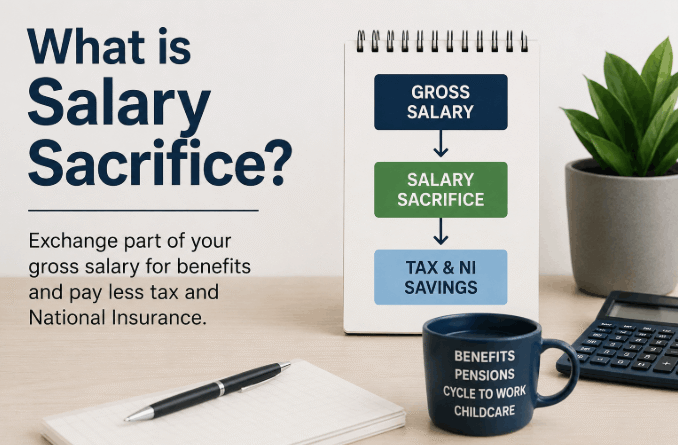
Salary sacrifice is a formal agreement to reduce an employee’s gross pay in exchange for a non cash benefit, most often a pension contribution, a company car, or bicycle equipment.
HM Revenue and Customs treats the sacrificed amount as if it was never paid as salary, so Income Tax and National Insurance are calculated on the lower figure for the 2026/27 tax year.
Key Takeaways
- Salary sacrifice reduces contractual gross pay in exchange for a non cash benefit, cutting Income Tax and Class 1 National Insurance on the amount given up.
- From 6 April 2029, National Insurance relief on salary sacrificed pension contributions will be capped at £2,000 a year, while Income Tax relief stays unaffected.
- A salary sacrifice arrangement cannot reduce cash pay below the National Minimum Wage or National Living Wage rate for the employee’s age band.
What Is Salary Sacrifice?
Salary sacrifice works like a swap. Instead of taking the full amount as cash, an employee agrees to give up part of their salary, and their employer puts that money towards something else instead, most often a pension.
HMRC sums up the idea simply: a salary sacrifice happens when an employee gives up the right to part of the cash remuneration due under their contract of employment.
Timing is the part most people get wrong. The swap has to be agreed before the pay is earned, not after. Get that the wrong way round and it is not a genuine sacrifice at all. It becomes an ordinary deduction, and HMRC will still tax it as though the original, higher salary had been paid.
Once the new contract is in place, payroll works out tax and National Insurance on the lower salary, and the employer provides whatever benefit was agreed instead.
The rules are set out in HMRC’s Employment Income Manual, and HMRC checks that arrangements are properly set up before the tax saving is allowed to stand.

How Salary Sacrifice Works in Practice?
Once an employer offers salary sacrifice, joining the scheme is a short process.
- Your employer confirms which benefits are available, such as pension contributions, a bicycle scheme, or an electric car.
- You agree the amount to give up, and your contract is formally varied to reflect the lower salary before the change takes effect.
- Payroll applies the reduced salary each pay period, and Income Tax and National Insurance are calculated on that lower figure rather than the original one.
Here’s what that looks like in practice. An employee earning £2,000 a month who sacrifices £200 into their pension sees Income Tax and National Insurance calculated on the remaining £1,800, while the full £200 reaches their pension pot before tax.
Benefits Available Through Salary Sacrifice
Employers choose which benefits to offer, though most UK schemes centre on a similar set of options.
- Pension contributions, the most common use, where the sacrificed amount is paid by the employer directly into a registered pension scheme.
- Cycle to Work scheme equipment, which lets an employee hire a bicycle and safety gear through payroll deductions taken from gross pay.
- Electric vehicle leasing, taxed at a low Benefit in Kind rate that keeps the overall saving attractive despite the car itself being a taxable benefit.
- Workplace nursery places, still available in full through salary sacrifice, unlike childcare vouchers, which closed to new joiners in October 2018.
- Technology equipment such as laptops or phones, though this carries a smaller saving since it does not qualify for the same tax exemptions as pensions or cycling.
Pension contributions carry the widest tax advantage of any of these because they sit outside the Optional Remuneration Arrangements rules entirely.
That is why salary sacrifice pension arrangements are usually the first benefit employers introduce, and often the one that delivers the largest saving over a working life.

How Much You Can Save Through Salary Sacrifice?
Savings scale with income, because Income Tax and National Insurance are both charged at higher rates further up the pay scale.
A basic rate taxpayer sacrificing part of their salary saves 20 percent Income Tax plus 8 percent employee National Insurance, a combined 28 percent of the amount given up.
Employers save a further 15 percent in Class 1 secondary National Insurance on the same amount, which some pass back into the employee’s pension.
| Tax band | Income Tax saved | Employee NI saved | Combined saving |
|---|---|---|---|
| Basic rate | 20 percent | 8 percent | 28 percent |
| Higher rate | 40 percent | 2 percent | 42 percent |
| Additional rate | 45 percent | 2 percent | 47 percent |
Employees earning between £100,000 and £125,140 get an extra advantage on top of the savings shown in the table.
Sacrificing salary into a pension lowers adjusted net income, which can restore some or all of the Personal Allowance lost through the taper in that band, making each pound sacrificed worth more than the standard percentage suggests.
The Rules and Limits on Salary Sacrifice
A few hard limits apply to every salary sacrifice arrangement, whichever benefit you choose.
- Your remaining cash pay cannot fall below the National Minimum Wage or National Living Wage rate for your age band, and employers must build payroll checks around this floor.
- The contract change has to be agreed and documented before the pay period it applies to, since HMRC will not accept a sacrifice applied retrospectively.
- Pension contributions made through salary sacrifice still count toward the £60,000 annual allowance alongside any other pension contributions you make in the same tax year.
Most employers only allow changes to a salary sacrifice agreement at set points, such as a salary review or a qualifying life event like marriage or the birth of a child, rather than at any time you choose.
What Is Changing for Salary Sacrifice Pensions From April 2029?
From 6 April 2029, National Insurance relief on salary sacrificed pension contributions will be capped at £2,000 a year, under the National Insurance Contributions (Employer Pensions Contributions) Bill confirmed at the Autumn Budget 2025.
Figures confirmed as of July 2026, based on the House of Commons Library briefing and the Autumn Budget 2025 announcement.
The change only affects National Insurance, not Income Tax. Below the £2,000 threshold, salary sacrifice pension contributions keep their full National Insurance exemption exactly as they do now.
Above that threshold, both employee and employer National Insurance will apply to the excess, in the same way they would to ordinary earnings.
- Widely circulated claim: Several employer facing guides state the National Insurance change to salary sacrifice pensions takes effect from April 2026.
- Correct position: The change does not begin until 6 April 2029, giving employers and employees more than two years to plan.
- Source: Autumn Budget 2025 and the National Insurance Contributions (Employer Pensions Contributions) Bill, House of Commons Library briefing.
Salary sacrifice itself is not going away, and the change has no effect on anyone using it for benefits outside pensions, such as cycling or electric vehicles.
The £2,000 figure is one of several thresholds that apply here, alongside the National Minimum Wage floor and the wider HMRC salary sacrifice limit rules that govern how much can be given up in total.

The Disadvantages of Salary Sacrifice
Salary sacrifice does come with drawbacks, and a few of them are easy to miss until they matter.
- Mortgage lenders often assess affordability against the reduced, post sacrifice salary shown on a payslip, which can lower the amount they are willing to lend.
- Statutory payments such as maternity pay and sick pay are calculated from average earnings, so a large sacrifice can reduce them if earnings drop near the Lower Earnings Limit.
- Life insurance and death in service cover based on a multiple of salary will typically use the reduced figure, unless the employer agrees to a notional higher salary for that purpose.
- Salary sacrifice does not normally reduce State Pension entitlement, because entitlement depends on qualifying years above the Lower Earnings Limit rather than the exact amount of National Insurance paid, and the National Minimum Wage floor sits well above that limit for most employees.
Anyone whose earnings sit close to the Lower Earnings Limit should check their qualifying year status with their employer before sacrificing a large amount.
Is Salary Sacrifice Worth It?
For most employees, salary sacrifice is worth using, because few other legal routes offer the same combined Income Tax and National Insurance saving. The benefit grows with income.
A higher rate taxpayer keeps more of each pound sacrificed than a basic rate taxpayer, and anyone earning between £100,000 and £125,140 gains the added Personal Allowance effect described earlier.
There are only a few real exceptions to this. If you are close to the National Minimum Wage, planning a mortgage application in the near future, or relying on statutory pay calculated from your current salary, it is worth checking the numbers with your employer before committing.
How to Set Up Salary Sacrifice With Your Employer?
Everything here depends on your employer offering a scheme in the first place, but the process itself is simple.
- Ask your employer or HR team which benefits are available through salary sacrifice and whether there is a minimum or maximum amount you can give up.
- Decide on the amount, keeping the National Minimum Wage floor and the £60,000 pension annual allowance in mind if the benefit is a pension.
- Sign the contract variation before the change takes effect, since HMRC will not recognise a sacrifice applied to pay you have already earned.
Most schemes allow you to review the arrangement at a salary review or after a qualifying life event, so it is worth asking your employer how and when changes can be made.

Conclusion
Salary sacrifice is still one of the most effective ways to reduce Income Tax and National Insurance on part of a salary, as long as the National Minimum Wage floor and the upcoming 2029 pension cap are factored into the decision.
Employees considering a new arrangement should check the current numbers with their employer first. Salary sacrifice means lower tax and higher take home value for most UK employees in 2026.
FAQ
Is Salary Sacrifice a Good Idea?
Yes, for most employees salary sacrifice is a good idea, because it reduces both Income Tax and National Insurance on the amount given up. The exception is anyone close to the National Minimum Wage or planning a mortgage application soon, who should check the numbers first.
Sacrificing 100 Percent of Your Salary?
No, an employee cannot sacrifice their entire salary. Cash pay must remain above the National Minimum Wage or National Living Wage rate for their age band, so only company directors who are not classed as workers can sacrifice their full pay.
An Example of Salary Sacrifice?
A common example is an employee earning £2,000 a month who sacrifices £200 into their pension. Income Tax and National Insurance are then calculated on the remaining £1,800, while the full £200 reaches the pension pot before tax.
The Concept of Salary Sacrifice Explained?
Salary sacrifice is a contractual exchange, not a deduction from pay already earned. An employee agrees in advance to give up part of their gross salary, and the employer redirects that amount into a non cash benefit instead of paying it as cash.
Is Salary Sacrifice Legal in the UK?
Yes, salary sacrifice is fully legal in the UK when implemented correctly, and HMRC sets out the rules in its Employment Income Manual. Arrangements that breach the National Minimum Wage or are applied retrospectively can be challenged and denied their tax advantages.
Disclaimer: This article is for informational purposes only and does not constitute formal financial, legal, or tax advice; consult a qualified financial advisor or HMRC guidelines before altering your employment contract.




Pingback: Can I Have a SIPP and a Workplace Pension? How to Max Both