Bank Holiday Early Benefit Payments DWP: 2026 Schedule Rules, Budgeting Tips, And Exceptions
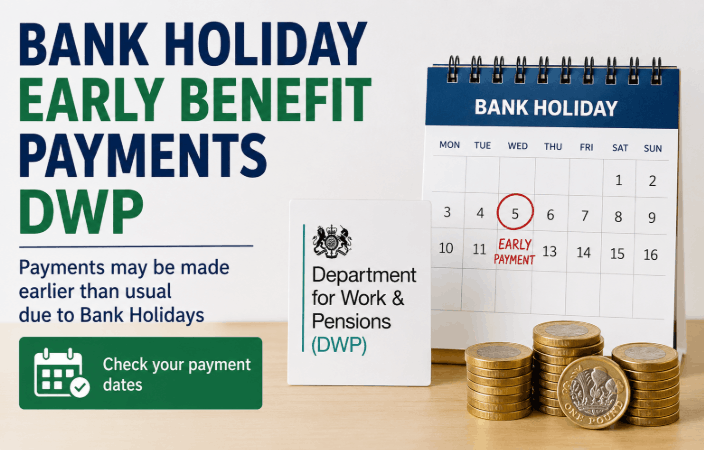
When bank holiday early benefit payments DWP rules apply, Universal Credit, State Pension, PIP and other DWP benefits are paid on the last working day before a bank holiday whenever the normal payment date lands on one.
As of July 2026, this rule applies to every UK bank holiday, including Northern Ireland’s holiday on 13 July.
Key Takeaways
- DWP moves benefit payments to the last working day before a bank holiday, including Universal Credit, State Pension and PIP.
- Northern Ireland claimants due Child Benefit on 13 or 14 July 2026 receive it a day later, not earlier, according to GOV.UK.
- Early payment never increases the amount received; the following payment date does not change.
Bank Holiday Early Benefit Payments DWP: Is It Automatic?
Yes, this happens automatically, with no action needed from claimants. DWP applies this rule to every claimant whose normal payment date falls on a bank holiday, without any application or request needed.
DWP’s system reviews the calendar for each benefit cycle and reschedules the transfer whenever a bank holiday or weekend would otherwise hold up processing. Banks and government offices close on bank holidays, so BACS transfers cannot be sent through the usual channels on those dates.
Claimants do not need to contact DWP, update their claim, or take any action. The payment simply lands earlier than the date shown on an award letter or online journal, and everything reverts to the normal schedule the following cycle.

Why Does DWP Move Payments Before a Bank Holiday?
The reason comes down to BACS, the system that processes benefit transfers, which cannot run on bank holidays or weekends.
BACS, the Bankers’ Automated Clearing Services, is the electronic network DWP and HMRC use to send benefit and pension payments directly into bank accounts.
BACS transfers need three working days to clear, so any payment due on a day when the network is closed is processed and released on the last working day before it, arriving at the normal time that morning.
It’s a scheduling adjustment rather than a policy change, and it isn’t tied to any single benefit. The same rule has applied consistently since BACS became the standard payment method, and it will keep applying every time a bank holiday lands on a scheduled payment date.
DWP Bank Holiday Payment Dates 2026: England, Wales, Scotland and Northern Ireland Compared
DWP bank holiday payment dates in Scotland and Northern Ireland include extra regional bank holidays that push the schedule slightly earlier or later than the rest of the UK.
| Nation | Bank Holiday | 2026 Date | Adjusted Payment Date |
|---|---|---|---|
| Northern Ireland | Battle of the Boyne | Monday 13 July | Most DWP benefits: last working day before. Child Benefit (per GOV.UK): Tuesday 14 July |
| Scotland | Summer Bank Holiday | Monday 3 August | Social Security Scotland benefits due Wednesday 4 or Thursday 5 August adjust to the preceding working day |
| England, Wales and Northern Ireland | Summer Bank Holiday | Monday 31 August | Friday 28 August |
| All UK nations | Christmas and New Year cluster | 25 and 28 December | Thursday 24 December for most DWP benefits; Social Security Scotland claimants move to Wednesday 23 December |
It’s worth confirming the relevant nation before assuming a date applies UK wide, as Scotland and Northern Ireland each add their own regional adjustments to the shared calendar.
Which Benefits Are Affected by the Bank Holiday Payment Change?
A wide range of DWP payments are affected whenever their normal date falls on a public holiday.
- Universal Credit, paid monthly to people with living costs
- State Pension, paid every four weeks based on National Insurance record
- Personal Independence Payment (PIP), paid every four weeks
- Attendance Allowance, paid every four weeks to older claimants with care needs
- Employment and Support Allowance (ESA), usually paid every two weeks
- Jobseeker’s Allowance (JSA), usually paid every two weeks
- Carer’s Allowance, paid weekly or every four weeks
- Child Benefit, paid weekly or every four weeks by HMRC
Every one of these follows the same last working day rule, though Child Benefit carries a Northern Ireland exception, explained further on.

How Universal Credit Payment Dates Change Around a Bank Holiday?
Start by looking at your Universal Credit journal if you think a bank holiday might move your payment.
- Open your Universal Credit online journal or your most recent award letter and confirm your usual payment date.
- Compare that date against the bank holiday calendar for your part of the UK.
- If your date falls on a bank holiday, expect the payment on the last working day before it, at the normal time that morning.
- Remember that your monthly assessment period itself does not shift, only the date the money arrives.
This date change is separate from DWP Universal Credit bank account checks, which continue on their usual schedule regardless of when a particular payment lands.
PIP and Other Four Weekly Benefits: Why Bank Holidays Hit Them More Often?
The reason four-weekly benefits like PIP run into bank holidays more often simply comes down to how the payment cycle lands against the calendar.
A four week cycle moves through the calendar at a different pace than a calendar month, so over a year it crosses more of the fixed bank holiday dates than a monthly payment does. DLA and Attendance Allowance follow the same four weekly pattern and are affected in the same way.
Claimants on these benefits can generally expect a handful of payment date shifts across a typical year, more than someone paid strictly monthly.
State Pension Bank Holiday Payment Dates and What to Check
Your State Pension payment day is the first thing to confirm, as it determines whether a bank holiday affects you at all.
- Your normal payment day is based on the last two digits of your National Insurance number, not a fixed date.
- State Pension is paid every four weeks, so a bank holiday clash follows the same pattern as PIP and Attendance Allowance.
- Payment moves to the last working day before the bank holiday and returns to the normal cycle afterwards.
- Claimants with wider concerns about account activity linked to their pension can find more detail in our guidance on DWP pensioner bank account monitoring changes.
Does Child Benefit Always Move Early? The Northern Ireland Exception
No, Child Benefit doesn’t always move early, as Northern Ireland’s July 2026 dates show. Many guides describe DWP and HMRC payments as always moving forward, never delayed, when they land on a bank holiday. GOV.UK’s own Child Benefit payment calendar shows this is not universally true.
Common assumption: Bank holiday benefit payments are never delayed, only ever paid earlier.
Correct position: Child Benefit due on 13 or 14 July 2026, around Northern Ireland’s Battle of the Boyne holiday, is paid a day later, on 14 or 15 July, not earlier.
Source: GOV.UK, Child Benefit payment dates: bank holidays.
This is because HMRC administers Child Benefit on its own weekly or four-weekly cycle, separate from DWP’s earlier payment rule, so the two systems don’t always move the same way.

Scotland’s Bank Holiday Payment Rules: Social Security Scotland and Local Holidays
Most questions about DWP bank holiday payment dates Scotland claimants ask come down to one distinction: Social Security Scotland runs its own calendar alongside the UK wide DWP system.
- Social Security Scotland pays Adult Disability Payment, Carer Support Payment, Child Disability Payment, Pension Age Disability Payment and the Scottish Child Payment, all of which shift early around bank holidays in the same way as DWP benefits.
- Best Start Foods payments are not affected by bank holiday adjustments.
- Local authority holidays can cause further delays outside the national calendar, including Glasgow’s late September holiday, Edinburgh’s late September holiday and Dundee’s early October holiday.
- Scotland’s own Summer Bank Holiday on 3 August 2026 mainly affects Social Security Scotland and HMRC administered benefits, rather than DWP’s UK wide payment run, since DWP offices in England remain open on that day.
How to Check and Budget for Your Early Payment?
Once you know your money is arriving early, it helps to budget for the longer gap before your next payment.
- Mark the adjusted payment date in a calendar or banking app reminder as soon as a bank holiday is confirmed.
- Split the payment into weekly amounts rather than spending it as a lump sum in the first few days.
- Check any direct debits or standing orders due around the bank holiday to confirm they will not clash with a lower balance later in the cycle.
- It’s worth planning cash needs in advance too, since branch and ATM access can be affected on the holiday itself. Our guide on how much cash you can withdraw from an ATM covers typical daily limits worth checking beforehand.
- Keep a note of your next scheduled payment date so the extended gap does not catch you out.
What to Do If Your Payment Does Not Arrive?
It’s worth checking your bank account again before ringing DWP, as payments can take a few hours to clear on the adjusted date.
- Confirm the correct adjusted date using your award letter or online journal rather than assuming the original date applies.
- Wait until the end of the working day before treating the payment as missing, since processing times vary by bank.
- Call the relevant benefit helpline on the last working day before the bank holiday, since Jobcentre Plus and DWP phone lines close for the holiday itself.
- Have your National Insurance number and claim details ready when you call to speed up the check.

Conclusion
The rule behind bank holiday early benefit payments DWP claimants rely on is simple: when a payment date lands on a bank holiday, DWP and HMRC pay on the last working day before it, without changing the amount.
Northern Ireland’s July dates are a genuine exception, so it’s worth checking the official calendar rather than assuming. In short, bank holiday early benefit payments DWP arrangements bring an earlier payday, not extra income, for UK claimants in 2026.
FAQ
Does an early bank holiday payment mean extra money?
No, the bank holiday early benefit payments DWP system does not add any extra money. DWP simply moves the same amount forward to the last working day before the bank holiday. The following payment still arrives on its normal date, creating a longer gap that needs planning for.
Does PIP get paid early for bank holidays?
Yes, PIP moves to the last working day before a bank holiday, just like other four weekly benefits. Because PIP follows a four weekly cycle rather than a calendar month, it crosses bank holiday dates more often than monthly payments such as most Universal Credit awards.
Will Child Benefit payment dates change for bank holidays?
Yes, but not always in the direction people expect. Child Benefit due on most UK bank holidays moves earlier, though GOV.UK’s calendar shows Northern Ireland claimants paid on 13 or 14 July 2026 receiving payment a day later instead.
What time do DWP bank holiday payments arrive?
Most DWP payments arrive by around 6 AM on the adjusted date, though the exact time depends on your bank’s own processing. Some digital banks may show funds as pending slightly earlier, though this can vary between providers.
Will Universal Credit be paid early for the August 2026 bank holiday?
Yes, Universal Credit due on Monday 31 August 2026 is paid on Friday 28 August instead, since that is the last working day before the Summer Bank Holiday across England, Wales and Northern Ireland.
Disclaimer: This guide is for informational purposes only; always verify your specific payment dates directly via your online DWP journal or GOV.UK.