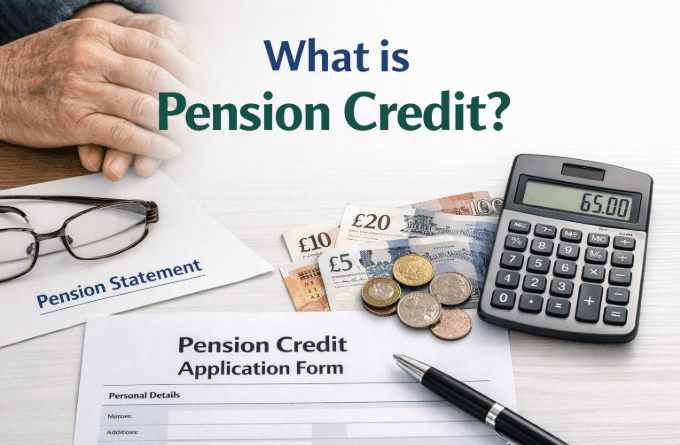
What Is Pension Credit? A Guide to 2026 Rates, Eligibility Rules, and Free Passported Benefits
Pension Credit is a means tested benefit from the Department for Work and Pensions that tops up weekly income for people over State Pension age. From April 2026 it guarantees at least £238.00 a week for single claimants and £363.25 for couples, with extra support for carers, disability and housing costs.
Key Takeaways
- Pension Credit tops up weekly income to £238.00 for single claimants and £363.25 for couples from April 2026, following a 4.8% rise under the Triple Lock.
- Savings Credit is closed to anyone who reached State Pension age on or after 6 April 2016, while Guarantee Credit remains open to all eligible claimants, whatever their age.
- A successful Pension Credit claim can unlock the Winter Fuel Payment, Council Tax Reduction, free NHS dental care and a free TV licence for claimants aged 75 and over.
What Is Pension Credit and Who Is It For?
Pension Credit exists to protect pensioners on the lowest incomes from poverty. It is administered by the Department for Work and Pensions and sits separately from the State Pension itself. Anyone who has reached State Pension age and lives in England, Scotland or Wales can apply.
The benefit was introduced under the State Pension Credit Act 2002 and launched in 2003, replacing the earlier Minimum Income Guarantee. It has two parts, Guarantee Credit and Savings Credit, each with its own separate eligibility rules.
Pension Credit can be claimed whether a person owns their home, has other pension income, or holds modest savings.
According to GOV.UK, claimants do not need a National Insurance contribution record to qualify, unlike the State Pension.
Independent Age estimates that almost 4 in 10 eligible pensioners are still not claiming it, leaving up to 880,000 households without money they are entitled to. This distinction has a direct bearing on how much a claim could be worth.

How Much Is Pension Credit Worth From April 2026?
From April 2026, Guarantee Credit tops up weekly income to £238.00 for a single claimant and £363.25 for a couple. This follows a 4.8% increase confirmed in the latest statutory uprating review.
| Pension Credit Element | 2025 to 2026 Rate | 2026 to 2027 Rate |
|---|---|---|
| Single claimant | £227.10 a week | £238.00 a week |
| Couple | £346.60 a week | £363.25 a week |
Extra weekly amounts apply on top of these figures. Carers can receive a carer addition of £48.15 a week, and claimants who are severely disabled can receive an additional £86.05 a week through the severe disability addition.
These additions are added before income is assessed, which can raise the final award by a meaningful amount. These figures only cover Guarantee Credit. Savings Credit follows a different set of rules.
Why Did Pension Credit Rates Rise This Year?
Pension Credit rates rise each year under the Triple Lock, a rule that increases the Standard Minimum Guarantee in line with whichever is highest among average earnings growth, inflation, or 2.5%.
Under the Triple Lock, the Standard Minimum Guarantee rose by 4.8% from April 2026, in line with average earnings growth recorded between May and July 2025.
This mechanism exists to stop pensioner incomes falling behind the cost of living, and it applies automatically each tax year without requiring fresh legislation.
The Department for Work and Pensions confirmed this uprating in a written statement to Parliament in November 2025. The same review raised the new and basic State Pension by 4.8%, since both are protected by the Triple Lock commitment.
Because these increases are automatic, claimants do not need to reapply each year to receive the higher rate.

What Is the Difference Between Guarantee Credit and Savings Credit?
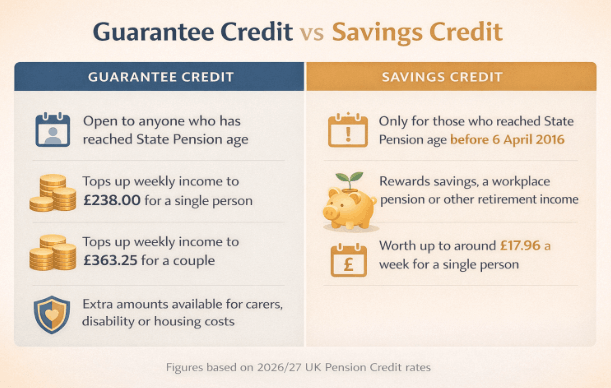
Guarantee Credit and Savings Credit work differently, and most claimants only ever qualify for one of them. Guarantee Credit tops up income to a set minimum level, while Savings Credit rewards people who saved for retirement.
Guarantee Credit
- Available to anyone who has reached State Pension age, no matter when they reached it.
- Brings weekly income up to £238.00 for a single claimant or £363.25 for a couple, from April 2026.
- Can include extra amounts for carers, severe disability, housing costs or dependent children.
Savings Credit
- Only available to claimants who reached State Pension age before 6 April 2016.
- Rewards modest savings, a workplace pension or other retirement income above the basic State Pension.
- Worth up to around £17.96 a week for a single claimant, based on the latest published GOV.UK figures.
Anyone still building a private pension pot before reaching State Pension age may want to compare options through the best pension provider in the UK.
Anyone unsure which credit applies should still make a claim, since the Pension Service assesses both automatically.
Why People Misunderstand Savings Credit Eligibility
Many people assume Savings Credit is simply a smaller version of Pension Credit available to anyone with savings. That assumption is incorrect, and it causes some pensioners to wrongly believe they cannot claim anything at all.
Savings Credit closed to new claimants under the State Pension Credit Act 2002 for anyone reaching State Pension age on or after 6 April 2016. Anyone reaching that age after this date can still claim Guarantee Credit in full, even with savings or a private pension.
This confusion often stops people from applying altogether. GOV.UK confirms that savings, a pension, or home ownership will not automatically rule out a Guarantee Credit claim.
The two credits follow separate rules, so eligibility for one says nothing about eligibility for the other.
Are You Eligible for Pension Credit?
You may be eligible for Pension Credit if you have reached State Pension age and your weekly income falls below the guaranteed minimum level for your circumstances.
Standard eligibility rules
- You must have reached State Pension age, currently 66, which begins rising to 67 from April 2026.
- You must live in England, Scotland or Wales, since Northern Ireland and the Isle of Man have separate arrangements.
- Your income, including your State Pension, other pensions and earnings, must fall below the threshold for your circumstances.
- The first £10,000 of savings is disregarded entirely, and every £500 above that is counted as £1 of extra weekly income, known as tariff income.
- Anyone from the EU, Switzerland, Norway, Iceland or Liechtenstein will usually need settled or pre-settled status under the EU Settlement Scheme to qualify.
Mixed age couples
Where only one partner has reached State Pension age, this situation is referred to as a mixed age couple. Since 15 May 2019, mixed age couples have generally needed to claim Universal Credit instead, until both partners reach State Pension age.
If you are still working and self-employed, income from your business counts toward this assessment, so reviewing a self employed pension plan now can shape your entitlement later.
Meeting these conditions does not fix a specific amount, since the final figure depends on full assessment by the Pension Service.

What Other Benefits Could You Get With Pension Credit?
If you qualify for Pension Credit, you could unlock several other forms of support automatically. These additional entitlements are often called passported benefits, since a Pension Credit award gives automatic access to them without a separate test.
- A Winter Fuel Payment worth up to £300, depending on your date of birth.
- A Cold Weather Payment of £25 for every 7-day period of average temperatures at or below 0°C.
- A one-off Warm Home Discount of £150 off an electricity bill.
- A Council Tax Reduction, which in many cases covers the bill in full.
- Free NHS dental treatment, glasses and help with hospital travel costs.
- A free TV licence once you turn 75.
According to Age UK, even a small award can unlock this wider support, since several schemes have no eligibility test of their own. Independent Age estimates the average Pension Credit award is worth around £3,900 a year once these extras are included.
This wider support can often be worth more than the Pension Credit award itself, which is why claiming even a small amount is worth pursuing.
How Do You Apply for Pension Credit?
You can apply for Pension Credit online, by phone or by post, and the process usually takes about 20 minutes if you have your details ready.
- Gather your National Insurance number, bank account details and information about your income, savings and housing costs.
- Apply online through GOV.UK if you already receive your State Pension and have no dependent children.
- Call the Pension Service on 0800 99 1234 if you would rather apply by phone or need a paper form.
- Submit your claim up to 4 months before you reach State Pension age, or at any time afterward.
Before applying, it may also be worth checking the DWP pension new bank rules September 2025 update, since it covers related changes to how DWP payments are handled. GOV.UK also provides a Pension Credit calculator to estimate an award before applying.
Since backdating is limited to 3 months, it is worth applying as soon as eligibility looks likely rather than waiting.

Conclusion
Pension Credit remains widely under claimed despite guaranteeing real weekly income for pensioners on a low income. Checking eligibility costs nothing. Pension Credit means a guaranteed weekly income top up for pensioners on a low income in 2026.
FAQ
Is Pension Credit Means Tested?
Yes. Pension Credit is means tested, so eligibility and payment amounts depend on income, savings and circumstances such as disability or caring responsibilities.
Can You Get Pension Credit If You Own Your Home or Have Savings?
Yes. Owning a home does not affect eligibility, and savings under £10,000 are ignored entirely when income is calculated.
How Far Back Can a Pension Credit Claim Be Backdated?
A claim can be backdated by up to 3 months, provided the claimant was eligible throughout that earlier period.
Does Claiming Pension Credit Affect Your State Pension?
No. Pension Credit is paid separately from the State Pension and does not reduce the amount already being received.




Pingback: DWP Pension Credit Review Bank Statements: How to Respond
Pingback: Best Equity Release Interest Rates: Unlock Lowest Fixed Rates
Pingback: How Much Is a Funeral Grant From DWP? Get Full Cost Help
Pingback: Do All Pensioners Get Winter Fuel Allowance? 2026 Guide
Pingback: Can You Get A Mortgage On Benefits? UK Rules, Criteria