
How To Time UK Retirement Annuity Payout Trends?
UK retirement annuity payout trends show how much guaranteed income a pension pot can buy, from historic lows between 2016 and 2020 to multi-year highs in 2025 and 2026. As of August 2026, a healthy 65-year-old converting £100,000 can expect roughly £7,800 to £8,000 a year, according to Which? and Hargreaves Lansdown.
Key takeaways:
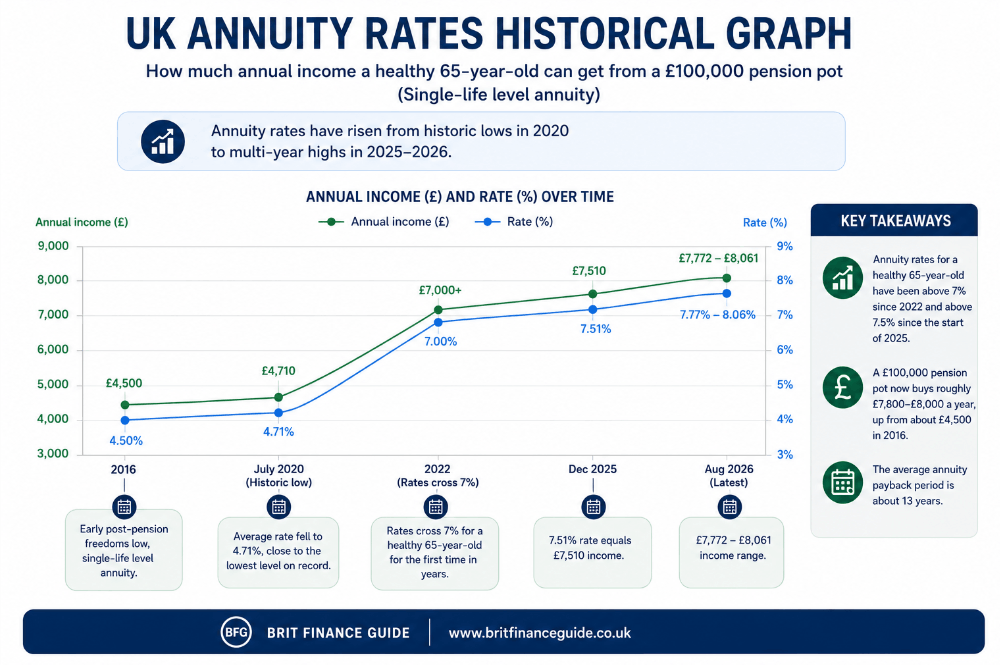
- Annuity rates for a healthy 65-year-old have been above 7% since 2022 and consistently above 7.5% since the start of 2025, according to Which?.
- A £100,000 pension pot now buys roughly £7,800–£8,000 a year for a healthy 65-year-old, up from about £4,500 in 2016.
- The average annuity payback period has fallen to about 13 years, according to Standard Life’s Annuity Rate Tracker.
What’s Happening to UK Annuity Payout Trends Right Now?
Annuity payout rates in the UK have climbed steadily since 2022 and now sit near multi-year highs. A healthy 65-year-old with a £100,000 pension pot can secure between £7,772 and £8,061 a year from a single-life annuity, based on Which?’s August 2026 provider comparison.
That is a significant change from 2016, when the same pot bought just under £4,500 annually, and from July 2020, when rates fell to roughly 4.71%, among the lowest points on record.
Gilt yields have risen sharply since 2022, and insurers have passed much of that increase into pricing.
The Bank of England’s interest rate policy also affects the wider market, while the Association of British Insurers reports that premiums paid into individual pension annuities grew 4% to £7.4 billion in 2025, the highest level since pension freedoms began in 2014.
The size of the defined contribution pension pot being converted still matters just as much as the rate on offer.
How Annuity Payout Rates Have Changed Since 2016
Annuity payouts have moved through two distinct phases since 2016: nearly a decade of decline, followed by a sharp recovery from 2022 onward. The table below shows the annual income a healthy 65-year-old could expect from a £100,000 single-life level annuity at five points during that period.
| Period | Approx. Annual Income (£100,000 pot) | Context |
|---|---|---|
| 2016 | ~£4,500 | Early post-pension-freedoms low, single-life level annuity |
| July 2020 | ~£4,710 (4.71% rate) | Historic low point, per Standard Life’s Annuity Rate Tracker |
| 2022 | ~£7,000+ | Rates cross 7% for a healthy 65-year-old for the first time in years |
| December 2025 | £7,510 (7.51% rate) | Standard Life Annuity Rate Tracker |
| August 2026 | £7,772–£8,061 | Live provider comparison, Which? |
2016–2020: The Low-Rate Era
Rates fell steadily through this period as low interest rates and rising life expectancy pushed insurers to price more cautiously. By July 2020, the average rate for a healthy 65-year-old had dropped to just 4.71%, close to the lowest level on record.
2022–2026: The Recovery
Rising gilt yields from 2022 onward reversed that decade-long decline almost entirely. Figures from Which? and the Standard Life Annuity Rate Tracker, confirmed as of August 2026, show rates have held above 7.5% since early 2025, continuing a recovery that began in 2022.
What’s Driving the Rise in Annuity Payout Rates?
Annuity payout rates have risen because insurers are earning more on the government bonds that fund them, not because of any single policy announcement. Several factors are behind the current UK retirement annuity payout trends:
- Gilt yields: Insurers buy long-dated government bonds to fund guaranteed payments, so when yields rise, so does the income they can offer. Ten-year gilts have traded above 5% multiple times during 2026, according to Moneyfactscompare.
- The Bank of England base rate: Base rate changes affect annuity pricing indirectly, through their knock-on effect on longer-term gilt yields, rather than setting rates directly.
- Solvency UK capital rules: The post-Brexit reform of insurer capital requirements has increased investment flexibility for insurers, including incentives to invest in longer-term productive assets.
- Providers compete on price, which can result in differences between the best-buy rates available and the wider market.
Widely circulated claim: Annuity rates move in lockstep with the Bank of England base rate.
Correct position: Pricing tracks long-dated gilt yields, which can diverge from the base rate. This is why rates have sometimes moved even when the base rate held steady.
Source: Which? Pensions Research, cross-referenced with gilt-yield analysis from Retirement Line.
How Big Does Your Pension Pot Need to Be for a Meaningful Payout?
The size of your pension pot directly affects your annuity income, so check your own figures before assuming a headline rate will apply to you.
A £50,000 pot buys roughly half the income of a £100,000 pot at the same age and rate, while a £150,000 pot buys roughly 50% more.
Using Hargreaves Lansdown’s August 2026 single-life, level annuity rate of £8,077 for a 65-year-old with a £100,000 pot as a baseline, a £50,000 pot would generate approximately £4,040 a year, and a £150,000 pot approximately £12,115.
If you’re still building your pot and want a sense of whether you’re on track, it’s worth working out how much you should have in your pension at 40, since the gap between a modest pot and a comfortable one tends to widen fastest in your 40s and 50s.
Why Your Retirement Age and State Pension Timing Affect Your Payout
The age at which you buy an annuity has one of the biggest effects on your payout, because providers price on how long they expect to pay you. When considering the timing, check the following:
- Check your State Pension age first. Recent UK state pension age retirement changes affect when your State Pension income starts, shaping how much an annuity needs to cover in the meantime.
- Compare rates across age bands. Hargreaves Lansdown’s August 2026 data shows a single-life annuity paying £7,283 at age 60, rising to £8,851 at age 70 and £10,101 at age 75, for the same £100,000 pot.
- Weigh delaying against the cost of waiting. Buying later generally means a higher rate but fewer years of guaranteed income overall, so the right timing depends on health and other income sources.
- Check for a guaranteed annuity rate. Pension schemes started before the late 1980s sometimes include rates well above today’s market average, under the Pension Freedoms framework introduced in 2015.
MoneyHelper’s free comparison tool can show how these factors interact for a specific pot size and age.
How Health and Lifestyle Change Your Annuity Payout
Health and lifestyle disclosures can significantly increase your annuity income, and providers assess this the same way regardless of gender under UK gender-neutral pricing rules introduced in 2012.
Declaring relevant conditions can increase your payout:
- Smokers and those with a raised BMI often qualify for an enhanced rate, since providers expect a shorter payment period.
- Which?’s own quotes found enhanced annuities paying between 6% and 15% more than a standard annuity for the same £100,000 pot, depending on provider and conditions declared.
- Common qualifying conditions include high blood pressure, high cholesterol, diabetes and stroke history, among more than 1,500 conditions insurers may consider.
- A medical examination usually isn’t required, though some providers request GP records for more serious conditions.
Because life expectancy assumptions still shape overall retirement planning, it is worth checking population-level data, even though the quoted rate itself is not set by gender under FCA rules.
Level, Escalating and Joint-Life Payouts Compared
The type of annuity you choose has a major effect on your payout, because each structure trades a higher starting income against different long-term protections. The table below compares the main options for a 65-year-old with a £100,000 pot.
| Annuity Type | Annual Income (Age 65) | Best Suited To |
|---|---|---|
| Single-life, level | £7,772–£8,061 | Maximising starting income, no dependants to protect |
| Single-life, RPI-linked | £5,365–£5,518 | Protecting income against inflation over a long retirement |
| Joint-life 50% | £7,142–£7,483 | Ensuring a surviving partner keeps receiving income |
| Joint-life, 3% escalation | £5,145–£5,752 | Combining partner protection with rising income |
Single-Life vs Joint-Life
A single-life annuity pays the highest starting income but stops entirely when the annuitant dies, while a joint-life annuity continues paying a reduced income to a surviving partner. Office for National Statistics life expectancy data is one factor providers weigh when pricing the joint-life discount.
Level vs Escalating
A level annuity pays the same amount every year, while an escalating annuity starts lower but rises annually. Which? notes it can take roughly a decade before escalating income overtakes what a level annuity would have paid from the start, and longer still before the total income received catches up.

Purchased Life Annuities: A Different Payout and Tax Treatment
Purchased life annuities work differently from pension annuities, particularly in how their payments are treated for tax. A purchased life annuity, or PLA, is bought with money from outside a pension using non-pension savings, rather than from a pension pot.
The key difference is tax treatment. Each PLA payment is split into a capital element, which is exempt from income tax because it simply returns the purchaser’s own money, and an income element, which is taxed as savings income.
This contrasts with pension annuities, which HMRC treats as pension income and taxes as income. That structure means a PLA can produce a meaningfully higher net income for some savers than a pension annuity of the same size, even before comparing headline rates.
Annuity Payback Period: How Long Until Your Payout Breaks Even?
The annuity payback period, how long it takes to receive back what you originally paid, has shortened considerably as rates have risen. The key points are:
- Start with the current average. Standard Life’s Annuity Rate Tracker put the payback period at approximately 13 years as of September 2025, down from roughly 23 years when rates were at their lowest.
- Factor in your purchase age. A 65-year-old buying today would typically break even by around age 78, according to Standard Life, though the exact figure moves with the rate secured and options chosen.
- Compare this with the retirement age in the UK for men, since purchase timing and average life expectancy together affect whether a shorter payback period results in more total income.
- Remember guarantees change the maths. Adding a guarantee period or value protection extends the point at which the annuity is considered fully “paid back,” but reduces the starting income slightly in exchange.
Should You Buy an Annuity Now or Wait?
Current annuity rates remain strong, with Standard Life reporting that rates for a healthy 65-year-old ended 2025 at around 7.5% and remained at similarly strong levels in 2026. Waiting for rates to rise further carries no guarantee of a better deal, since gilt yields can move in either direction.
For anyone with a health condition or nearing their preferred retirement age, securing today’s rate may outweigh the uncertain benefit of waiting.
Conclusion
UK retirement annuity payout trends point to a market that has recovered sharply since 2022, with rates for a healthy 65-year-old now near an 18-year high. Retirees comparing options should weigh pot size, age, health and annuity type, since each shifts the payout meaningfully.
For people considering their options in 2026, it may be worth reviewing quotes rather than waiting for rates to rise further.
FAQs
Are UK annuity rates rising or falling?
UK annuity rates have been rising since 2022 and have held above 7.5% for a healthy 65-year-old since early 2025. Rates depend on gilt yields, so they can still move either way, but the trend has been upward for four consecutive years.
How much does a £100,000 annuity pay per month in the UK?
A £100,000 pot currently pays a healthy 65-year-old roughly £650 to £670 a month on a single-life level annuity, based on Which?’s August 2026 comparison of £7,772–£8,061 annually. The exact figure depends on age, health and annuity type.
Is 7% a good annuity rate?
Yes, 7% is broadly in line with the current market for a healthy 65-year-old, though it sits slightly below the best single-life rates of around 7.8–8%. Martin Lewis’s Money Saving Expert and similar services both recommend shopping around, since rates vary between providers.
What is a purchased life annuity?
A purchased life annuity is bought using savings from outside a pension. Only the income portion of each payment is taxed, while the capital element is tax-free, making it distinct from a standard pension annuity.
Can you buy an annuity with a small pension pot?
Yes, there’s no minimum pot size in most cases, though very small pots generate limited income. Hargreaves Lansdown’s current annuity information shows that the income available depends on factors including the size of the pension, age, annuity type and options selected.
Disclaimer: This article is for informational purposes only and does not constitute financial advice; please consult an independent, regulated financial advisor before making any pension or retirement decisions.